
The foreign birth certificate is in a folder with the discharge papers, and nobody at the hospital mentioned the Philippine side of it. Or: the child is walking now, and a task you keep meaning to look up sits at the back of your mind.
Start here. Your child is already a Filipino citizen. The Philippine Embassy in Berlin puts it plainly: the Philippines follows jus sanguinis, the right of blood, so any child born to a Filipino parent is automatically considered a citizen, wherever the birth happened. The Report of Birth puts that fact on the civil register. There is a national shape to the process and then your own post's version of it — we read eight Philippine embassies and consulates to tell you which is which.
What the Report of Birth does — and what it does not
The Philippine Consulate General in Los Angeles defines it: it is "a declaration of the person furnishing information on the birth abroad of a Filipino child." It calls the child Filipino before anything is filed.
Registering the birth, as the Philippine Embassy in Washington DC puts it, "ensures that their Filipino citizenship is properly recorded with the Philippine Statistics Authority." Being a citizen and being recorded as one are different things. An unreported birth does not cost your child citizenship — it costs the proof, and until the record exists there is no birth certificate to hand an agency or a passport counter.
Which embassy or consulate is yours, and who files
Jurisdiction follows the place where your child was born — not the nearest post, not the one covering where you live now. Los Angeles states it directly: the birth "must be immediately reported to the Philippine Embassy or Consulate which exercises jurisdiction over the place of birth." Its list is specific: only births in "(1) Southern California; (2) Southern Nevada … and (3) Arizona" qualify. That is why embassy pages give different answers: each describes its own counter, and the one that governs you is your post's.

Who files? Canberra names the Filipino parent or parents, a person aged 18 or over, the attending physician, nurse or midwife, or the foreign parent. An adult whose own birth was never reported can file for themselves — New York contemplates "the child if already 18 years old" — though for a birth before 17 January 1973, Los Angeles requires the father to have been a Filipino citizen at the time. Some posts take the report only by mail; others only by appointment. The same civil registry section handles a report of marriage and a report of death, separate procedures with their own papers.
What you send
Across the posts we read, the core packet is:
- Four accomplished Report of Birth forms, originally signed and duly notarized — Canberra accepts notarization "by either the Philippine Consul, Notary Public or Justice of the Peace." Sydney asks for five original forms; Melbourne takes them signed in front of its consular officer if you file in person. Each post publishes the Report of Birth form itself.
- A letter-request signed by the informant, with contact details.
- The child's foreign birth certificate — the original plus four photocopies at Los Angeles; at New York, one original or certified true copy plus three. Four sets is the pattern; your post's number counts.
- Photocopies of both parents' passport data pages, which Canberra wants "duly certified by the JP", plus a valid ID for each parent.
- Proof of the Filipino parent's citizenship at the time of the birth: a permanent resident card, work permit, visa, or dual citizenship identification certificate.
- The parents' marriage certificate, where they married — from the Philippine Statistics Authority if the marriage was in the Philippines, or the local civil registrar if abroad, translated into English where needed.
- The fee and a self-addressed, tracked return envelope, where the post works by mail.
Los Angeles also asks for the parents' own birth certificates. A parent who lost Filipino citizenship and re-acquired it is on a different track, covered in our guide to dual citizenship for former Filipinos.
Before you pay anyone, let the post look at your draft: Washington DC invites applicants to email the draft form to its civil registration unit before notarization, and Los Angeles publishes the affidavit templates free. Incomplete requirements there "will not be processed and will be returned to the sender."
If the parents were not married to each other
Where the father acknowledges paternity, the posts ask for an Affidavit of Admission of Paternity executed by the father and — only if the child is to use the father's surname — an Affidavit to Use the Surname of the Father. That condition is Los Angeles's own, and it saves a notary fee you do not owe. Washington DC and New York each want four notarized copies, apostilled at Washington DC, with a $25 certificate of registration fee at New York. At Washington DC the Affidavit to Use the Surname of the Father is executed by the mother if the child is under 7, by the child with the mother from 7 to 17, and by the child alone at 18 or older. Parents who married after the birth take a different route: a Joint Affidavit of Legitimation plus the Filipino parent's Certificate of No Marriage from the PSA, which Los Angeles wants "issued no earlier than three months prior to the birth report."
The fee, and the part that sends people home
The fee is a small published consular charge — USD 25 at the four United States posts we read and AUD 45 at the three Australian ones, as posted on their own pages on 9 September 2026. Washington DC's checklist, headed "Revised 26 February 2026," carries that USD 25 and a USD 10 expedite fee. Fees change, so confirm yours.
The amount is rarely what goes wrong; the instrument is. Chicago accepts no personal checks and no credit cards; New York says "do not send cash"; Melbourne in person takes "cash and debit card only"; Canberra takes a postal money order or bank cheque.
Reported late? What actually changes
The report is still accepted: "There is no monetary penalty for delayed civil registration of birth," the Philippine Embassy in Washington DC states.
The twelve-month line is real, though. A birth should be reported "within twelve (12) months after its occurrence," Los Angeles says, and where parents do not, "the birth may nevertheless be recorded upon the determination of the consular officer of satisfactory evidence." Cairo states the same threshold as a definition. Every post we read draws the line at one year and none cites a statute for it, so treat it as the posts' stated practice.
A delayed registration adds paperwork: a notarized Affidavit of Delayed Registration of Birth — "a duly notarized affidavit explaining the delay," in Los Angeles's words, free to download there, AUD 45 at Canberra. And for a birth reported five years or more afterwards, Canberra, Melbourne and Sydney each require a recently issued PSA certificate showing no record of birth exists. The four United States posts we read carry no such requirement.
The cost of waiting is not a fine. It is more documents, more notarization and more time — worth knowing, because a civil record is one of the few things a family can build before they need it, and the families who never have a bad week over this are the ones who did it while it was small.
Where the record goes, and when to order the PSA copy
The post with jurisdiction registers the birth; the Department of Foreign Affairs is the channel the record travels through. Sydney describes the route: "The Philippine Consulate General will transmit the ROB to the Philippine Statistics Authority, through the Department of Foreign Affairs." Washington DC tells applicants to get the reference, dispatch and transmittal details from the DFA's Consular Records Division; you need them to order the PSA copy.
Once registered, the record is a PSA document, and most Philippine government agencies accept only a PSA copy for public transactions. The wait differs by post: six months from approval at Washington DC, 6 to 12 months from reporting at New York, six months to a year at Canberra, at least four to six months at Sydney. Use the channel your post's page names, and start from the official page rather than a search result. Our guide to the PSA documents Filipinos need for working abroad covers the rest of that stack.
The one clock that is genuinely urgent
The one that actually costs something is running on the report in your hand. At Washington DC you can use it for the child's passport application at the same post that issued it, up to one year from the issue date; older than that, or from anywhere else, and you need the PSA copy instead. Melbourne's window is different — six months from the date the report is transmitted to the PSA. Do not assume you have a year; ask your post.
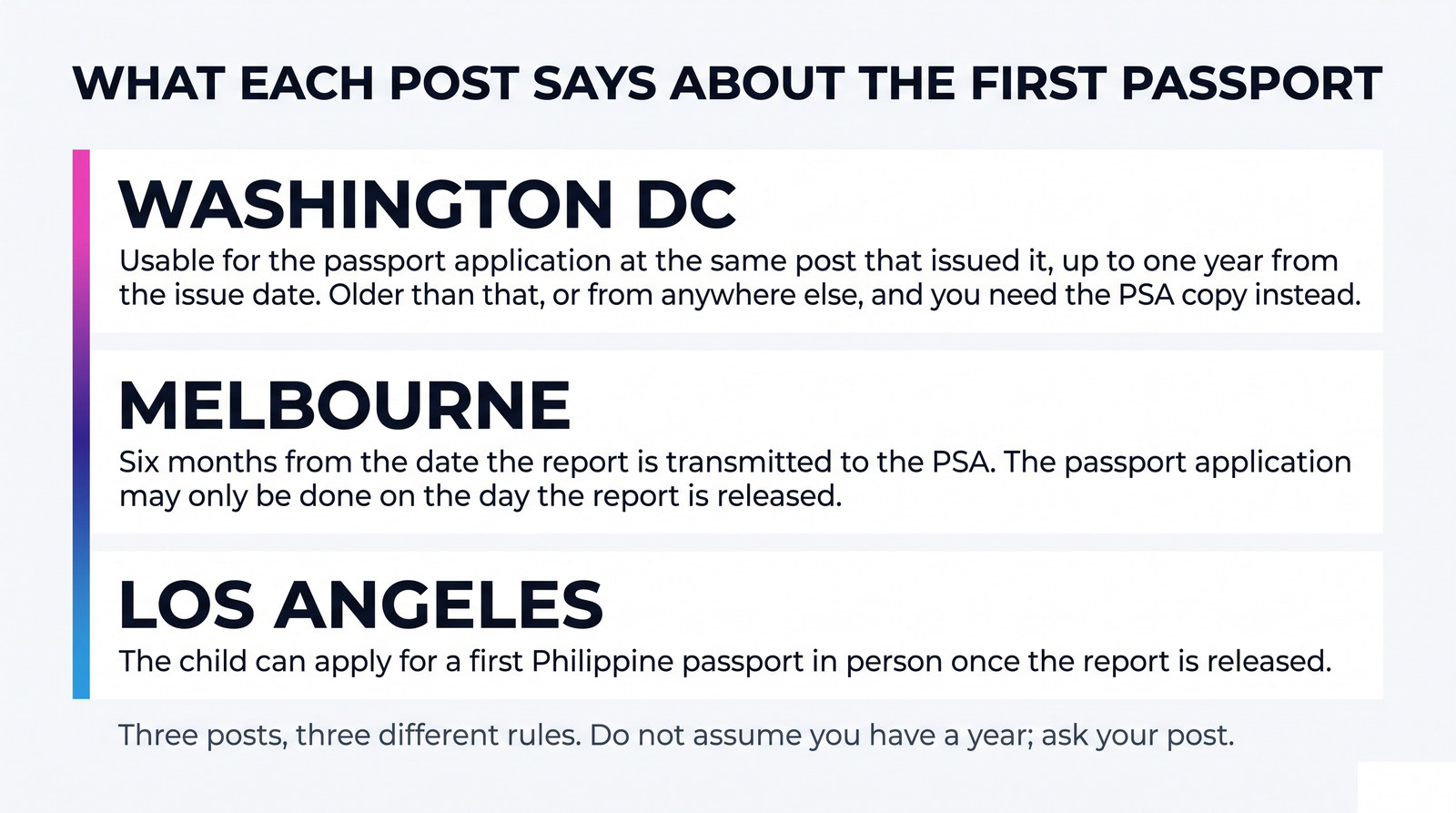
At Los Angeles the child can apply for a first Philippine passport in person once the report is released; at Melbourne, only on that day — and renewing a Philippine passport abroad picks up at the same counter. Filed once, this record is the one every later document leans on — the child's first passport now, and later the documents a Filipino needs to work abroad in their own name.
Before you seal the envelope
- Find the post covering the place of birth, not where you live; print its checklist.
- Email your draft Report of Birth form to the post before notarizing, if offered.
- Check the payment instrument, not just the amount.
- If the parents were not married to each other, check which affidavits you need.
- Confirm the mailing address, use a tracked envelope, and diary when to order the PSA copy.
None of this is complicated. It is specific, and specific is learnable.
The Questions Filipinos Ask Us Most
How do I report my child's birth to the Philippine Embassy? File at the embassy or consulate with jurisdiction over the place of birth, sending the packet listed above. Some posts take it only by mail, others only by appointment.
Can I file the Report of Birth with the DFA in Manila? Registration belongs to the post with jurisdiction over the place of birth, which transmits the report "to the Philippine Statistics Authority, through the Department of Foreign Affairs," as Sydney puts it. Ask the Department itself about filing from inside the Philippines; no post's page we read covers it.
How do I get my child's Philippine birth certificate if they were born abroad? Order the PSA copy once the report is registered, through the channel your post's page names — six months after approval at Washington DC, 6 to 12 months at New York.
Is there a penalty if I report the birth late? No monetary penalty, Washington DC states. A delay adds an Affidavit of Delayed Registration, sometimes a fee, and at the Australian posts a PSA certificate of no record after five years.
Sources
Report of Birth — Embassy of the Philippines, Washington DC: https://philippineembassy-dc.org/report-of-birth-application-by-mail/
Checklist revised 26 February 2026 — Washington DC: https://philippineembassy-dc.org/wp-content/uploads/2026/02/20260226-ROB.pdf
Passport for a minor — Washington DC: https://philippineembassy-dc.org/minor-passport/
Report of Birth — Consulate General, Los Angeles: https://losangelespcg.org/consular-services-2/civil-reg1stry-2/report-of-birth-of-a-filipino-abroad/
Report of Birth — Consulate General, New York: https://newyorkpcg.org/pcgny/civil-registration/report-of-birth-of-a-filipino-abroad/
Report of Birth — Consulate General, Chicago: https://www.chicagopcg.com/reportofbirth.html
Report of Birth — Embassy of the Philippines, Canberra: https://www.philembassy.org.au/consular/civil-registry/report-of-birth
Report of Birth — Consulate General, Melbourne: https://melbournepcg.org/?page_id=1066
Report of Birth — Consulate General, Sydney: https://www.sydneypcg.org/reportofbirth
Report of Birth — Embassy of the Philippines, Cairo: https://www.philippines-egypt.com/ro-birth
Citizenship FAQs — Embassy of the Philippines, Berlin: https://philippine-embassy.de/faqs-on-citizenship/