
There is a drawer in many Filipino homes abroad holding a current foreign passport and a Philippine passport that expired around your third contract.
You do not have to choose. A 2003 law lets a former Filipino take that status back — not a visa application but a government process, and it turns on your PSA birth certificate.
Who RA 9225 is for, and who it is not
Republic Act No. 9225, the Citizenship Retention and Re-acquisition Act of 2003, is for a natural born Filipino who lost Philippine citizenship by naturalising in another country. The Bureau of Immigration, which administers it, calls them "former Philippine citizens who have been naturalized in another country and wishes to retain or re-acquire their Philippine citizenship."
Natural born is a legal test, not a description. A natural born Filipino is, in Article IV of the 1987 Constitution, a citizen "from birth without having to perform any act to acquire or perfect their Philippine citizenship." Vancouver's consulate general spells out who that covers: born from 17 January 1973 with a Filipino parent; born to a Filipino mother before then and having elected Philippine citizenship upon reaching the age of majority; or born under the 1935 and 1973 Constitutions to a Filipino father. Washington DC adds one Vancouver omits: before that date, to unmarried parents, a Filipino mother at birth is enough without an election.
A foreign national married to a Filipino citizen wants the Bureau's 13(a) immigrant visa by marriage — a visa, not citizenship. And a person naturalised into Philippine citizenship is not a natural born Filipino, so RA 9225 is not their route.
Section 3 splits those who qualify. If you had already lost your status by naturalising elsewhere, the Act deems you to have re-acquired it upon taking the oath of allegiance — swearing to "support and defend the Constitution of the Republic of the Philippines" and obey its laws. If you naturalised after 29 August 2003, when the Act took effect, you retain it upon the same oath.
How to get a Filipino dual citizenship
File the petition form and the required documents at the Bureau or your post abroad, take the oath of allegiance, and receive your approval and Identification Certificate:
- The application form — Washington DC's Application for Retention/Reacquisition of Philippine Citizenship; Canberra and Melbourne want two petition forms each, plus the Bureau's supplement form for dependants.
- Your PSA birth certificate, "issued by the Philippine Statistics Authority (PSA) on security paper," says Washington DC; Canberra wants the registry number on it.
- Your certificate of naturalisation — Madrid requires it apostilled and translated, with the Spanish civil registry birth certificate alongside.
- The data pages of both passports — your old Philippine passport and your foreign one, "whether valid or expired."
- Photographs, and your marriage certificate if your name changed.
The shape is the same everywhere; the copies, the photo size, the translations, the extra local documents and the appointment system are your post's to set.
Where can I apply for dual citizenship
At the Bureau of Immigration's main office in the Philippines, where the route ends with the Certificate of Retention/Reacquisition of Philippine Citizenship. Abroad it is a consular transaction at the Philippine Embassy or Consulate General with jurisdiction over where you legally live, and the map is each post's own: Canberra sends New South Wales residents to Sydney's consulate general, and Victoria, South Australia and Tasmania to Melbourne. A Filipino in Australia or Canada reads their own post's page.
How much does it cost to apply for dual citizenship
There is no single national fee: the Bureau publishes one figure for filings in the Philippines, and every post abroad sets its own consular fee. As published on 4 September 2026:
- Bureau of Immigration — PHP 2,500 application, PHP 10 legal research, PHP 500 express: PHP 3,010 on its service page.
- Washington DC and San Francisco — USD 50 per adult principal, USD 25 per minor derivative.
- Canberra and Melbourne — A$90 and A$45, both non-refundable.
- Vancouver — C$77.50 and C$38.75.
- Madrid — no fee published on its dual citizenship page.
Washington DC takes cash, card or a money order, not personal checks. And nobody needs paying to "process" this for you: it is a published government fee, paid at the post, and the instinct that checks whether an agency is licensed belongs here.
How long will it take to process dual citizenship
It depends on your post. Washington DC requires an appointment per applicant and completes the process the same day, while Vancouver holds no same-day oath taking ceremonies, and Canberra and Madrid schedule the oath after approval. The Bureau's 2026 Citizen's Charter does publish a timeline for the Philippines: 60 working days at its main office, 47 online. Abroad, read your own post's page.
Your children: what the law covers, and the window that closes
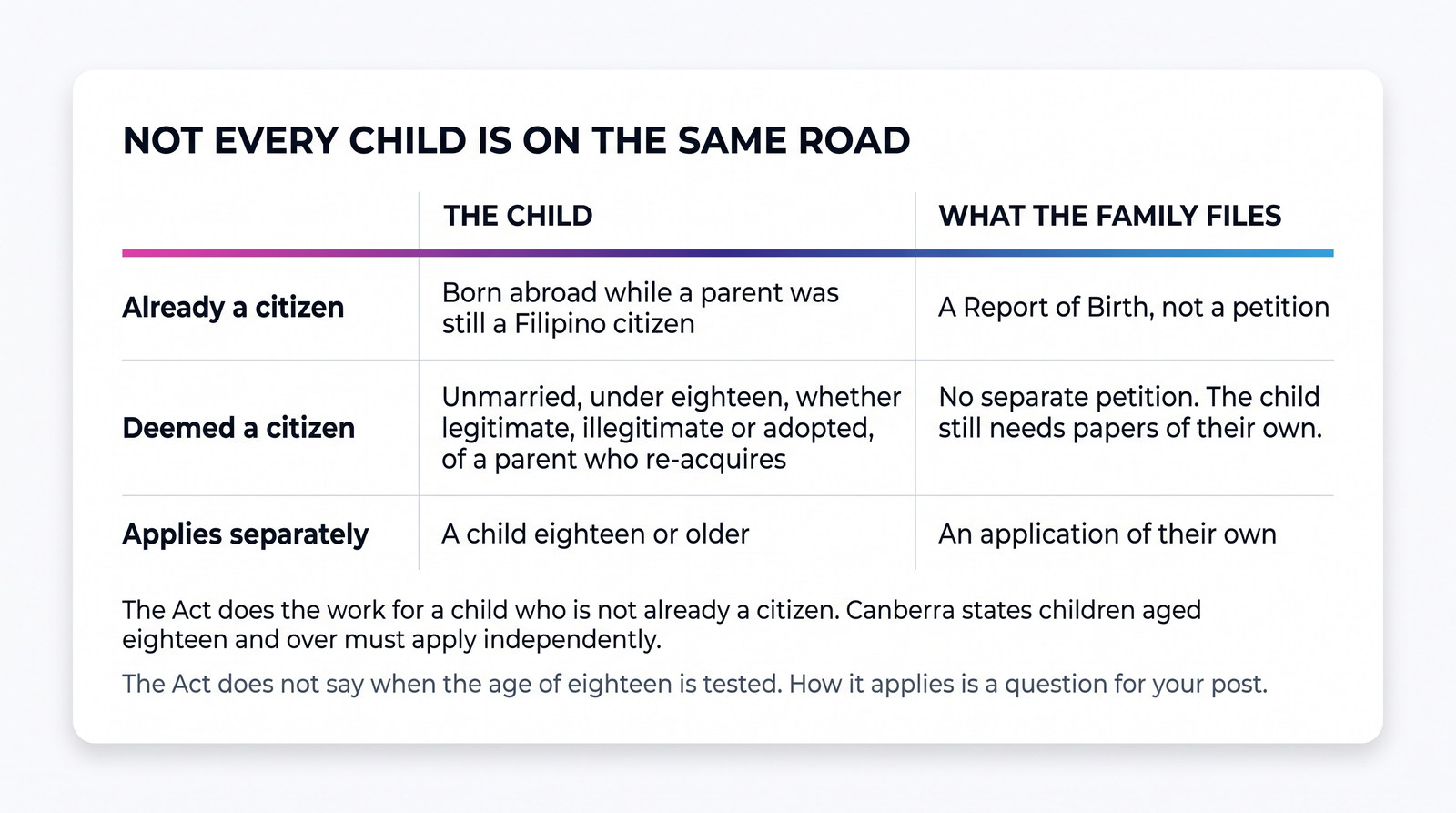
Section 4 of RA 9225 covers derivative citizenship: the unmarried child, whether legitimate, illegitimate or adopted, below eighteen (18) years of age, of a parent who re-acquires is deemed a citizen of the Philippines. Washington DC states minors are included in the parent's application and need not attend the appointment.
Each child needs their own papers: photographs, the child's birth certificate — the PSA copy if born in the Philippines, a Report of Birth if abroad, as Canberra names both — their passport data pages and foreign citizenship certificate. Canberra also wants one Identification Certificate application form per child, Melbourne two.
A child born abroad while a parent was still a Filipino citizen is already a Filipino citizen — citizenship by descent, where the transaction is a Report of Birth, not a petition. Washington DC says it is important to report their birth to the Philippine Statistics Authority through the post with jurisdiction over the place of birth — how a child goes onto the Philippine civil registry. Melbourne states such children need not apply unless they have expressly renounced. Section 4 does the work for a child who is not already a citizen.
The sources mostly go quiet at that window's edges, and we would rather say so. Canberra states children aged 18 and over must apply independently. Madrid names the moment: a child eighteen or older at the parents' reacquisition, born while a parent was still a Filipino citizen, applies separately. The Act itself does not say when the age is tested. Your child's eighteenth birthday is a date worth knowing, and how it applies is a question for your post.
Most people treat citizenship as something you either hold or lost. What this restores is closer to optionality: a job at home without a visa, the standing to sign for a parent's care, a claim your child can use in twenty years.
What dual citizenship gives you, and what it does not
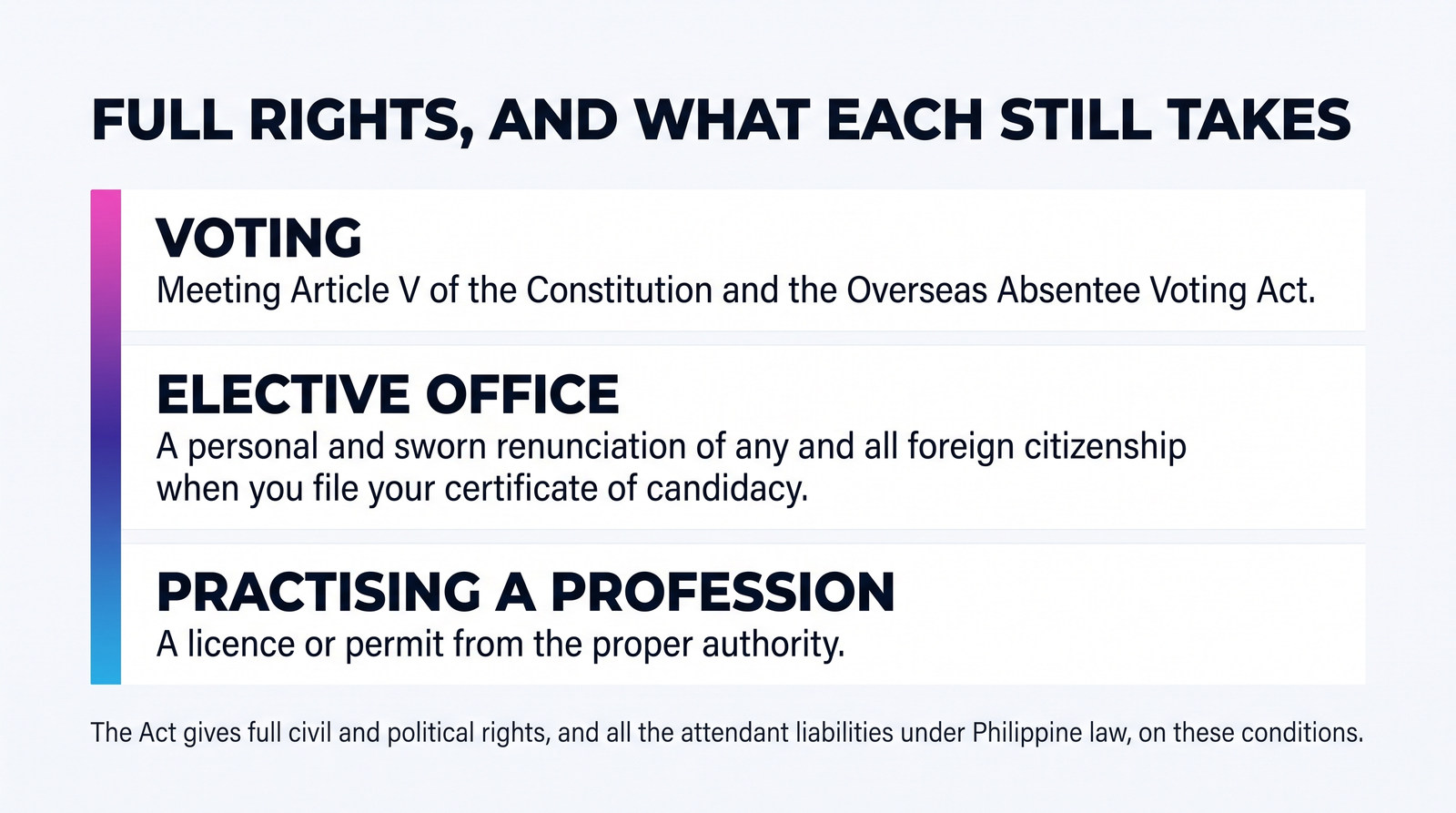
Section 5 says those who retain or re-acquire enjoy "full civil and political rights" and all the attendant liabilities under Philippine law, on conditions. For a returning worker that is the point: you can live and work at home without a visa, because you are a Filipino citizen again.

Those conditions sit in the same section: voting requires meeting Article V of the Constitution and the Overseas Absentee Voting Act of 2003; elective office requires a personal and sworn renunciation of any and all foreign citizenship when you file your certificate of candidacy; practising a profession requires a licence or permit from the proper authority.
Upon taking the oath you receive the Identification Certificate, which San Francisco describes as sufficient proof of Philippine citizenship for people entering or leaving the Philippines on a foreign passport. A Philippine passport is a separate application afterwards, which Washington DC offers on the same day as your oath taking; our guide to renewing one abroad covers it.
Before you book the appointment
- Check yourself against the natural born Filipino test above, and ask your post before paying anyone.
- Find the Philippine Embassy or Consulate General covering where you legally live, and read its requirements, fee and oath taking schedule.
- Download that post's application form, and one per child you are including.
- Order the PSA birth certificates, on security paper.
- Write down every child's age and marital status, and ask how the under-18 rule applies.
The Questions Filipinos Ask Us Most
How long will it take to process dual citizenship in the Philippines? The Bureau of Immigration's 2026 Citizen's Charter sets 60 working days at its main office. Abroad it is your post's: Washington DC completes the process the same day of your appointment, Vancouver holds no same-day oath taking ceremonies.
How to get a Filipino dual citizenship? File the application form with your PSA birth certificate, certificate of naturalisation, photographs and the data pages of your Philippine passport and your foreign one, at the Bureau of Immigration or your post abroad, take the oath of allegiance, and collect your Identification Certificate.
How much does it cost to apply for dual citizenship in the Philippines? PHP 3,010 on the Bureau of Immigration's service page. Abroad it is the post's own consular fee — USD 50 per adult at Washington DC and San Francisco, A$90 at Canberra and Melbourne, C$77.50 at Vancouver, with a lower rate for each minor child, on 4 September 2026.
Where can I apply for dual citizenship in the Philippines? At the Bureau of Immigration's main office, or from abroad at the Philippine Embassy or Consulate General with jurisdiction over where you live — each post publishes the territory it covers.
Sources
Republic Act No. 9225 — Bureau of Immigration: https://immigration.gov.ph/wp-content/uploads/2023/11/3_RA_9225.pdf
Retention/re-acquisition — Bureau of Immigration: https://immigration.gov.ph/services/application-for-retention-re-acquisition-of-phil-citizenship/
Citizen's Charter 2026 — Bureau of Immigration: https://immigration.gov.ph/wp-content/uploads/2026/08/BI-CC2026-1stEdition.pdf
1987 Constitution, Article IV: https://lawphil.net/consti/cons1987.html
Philippine Embassy Washington DC: https://philippineembassy-dc.org/dual-citizenship-application/
Philippine Consulate General San Francisco: https://pcgsanfrancisco.org/dual-citizenship/
Philippine Embassy Canberra: https://www.philembassy.org.au/consular/dual-citizenship
Philippine Consulate General Melbourne: https://melbournepcg.org/?page_id=1062
Philippine Embassy Madrid: https://www.philembassymadrid.com/dual-citizenship
Philippine Consulate General Vancouver: https://www.vancouverpcg.org/services/dual-citizenship/
13(a) immigrant visa — Bureau of Immigration: https://immigration.gov.ph/visas/immigrant-visa-by-marriage-13a/