

It is late, the house is quiet, and you keep returning to the same browser tab. You have sent the resumes, half-believed a few Facebook "agencies," and somewhere in the scrolling a deposit was being asked of you before a single job was real. If you have been quietly working out how to work in Australia from the Philippines, you are not dreaming too big — you are asking the right question. So here is what we, the iStart team, give you: the honest map. By the last line you will know the visa routes genuinely open to you, the work Australia is short of, the order to do this in, how to spot the recruiter about to take your money, and — just as important — how to keep rising once you are in, because this is a career you are starting, not a one-time exit. This is real, and it is reachable.
Can a Filipino really work in Australia? The honest answer
Yes — and not as a long shot. Australia openly recruits skilled people from overseas because it cannot fill every role locally, and Filipinos are already part of that workforce: in hospitals, on construction sites, in technical offices across Sydney and out in the regions. And these are rarely dead-end placements — many we watch arrive as staff and, years on, are leading shifts and supervising sites. Australia is a place to build a career, not just hold a job. It runs on a system, not luck. There are three families of routes: an Australian company sponsors you for a job it cannot fill at home; you qualify on points for skilled migration on your own merits, with no sponsor required; or a younger work-and-holiday door lets you land first. Under all three sit the same checks — your occupation on an official list, a positive skills assessment, and proof of English — and getting those right turns your work rights in Australia from a wish into a process you can run.
The main visa options to work in Australia from the Philippines
Visa subclasses sound like a tax form, so we translate each into who it is for and what it asks. You do not need all of them — you need the one that fits your life. We describe how each works rather than quote exact figures, because the government re-sets several each year; confirm the current number on the source we name.
Employer-sponsored work: the Skills in Demand visa (subclass 482)
This route starts with a real job offer from an approved Australian company that nominates you for a role on the Core Skills Occupation List; your visa application stands on that nomination, so the offer comes first. Here is the naming point out-of-date blogs get wrong: the Department of Home Affairs confirms that on 7 December 2024, the Skills in Demand (SID) visa replaced the old Temporary Skill Shortage (TSS) visa. It is still subclass 482, now with three streams — Core Skills, Specialist Skills, and Labour Agreement — so if someone is still selling a "TSS visa," their information is stale. For the Core Skills stream, the Department says you must be nominated in an occupation on that list, be paid no less than the Core Skills Income Threshold, have at least one year of relevant work experience, provide a skills assessment if your occupation requires one, and meet the English standard; your educational qualification and work history are checked against the occupation, so they must genuinely match. That income floor sits at AUD 76,515 as of the 2025–26 program year and is re-indexed every 1 July, so treat it as today's number and check the current one with Home Affairs. You can stay up to four years on a full-time, sponsored role; the visa costs from around AUD 3,210; and holders may, if eligible, later apply for permanent residence. Treat that sponsored job as a starting position, not the summit: those years are where you build the local experience, references, and track record that lead toward permanent residence and the next role up — runway to climb, not just time on a visa. You will need to prove English proficiency — generally IELTS 5.0 in each band for this stream, or an equivalent such as OET grade B, with exemptions for passport holders of countries like the UK, US, Canada, Ireland, or New Zealand.
The skilled migration visa route — points-tested, no employer needed (subclass 189)
This is the door with no sponsor required, where you qualify on your own. A points-tested skilled migration visa rewards exactly what many Filipino professionals already have: a recognised degree, real experience, strong English. The Department of Home Affairs describes the Skilled Independent visa (subclass 189) as points-tested and granting permanent residence — the right to live and work in Australia permanently. You must have your occupation on the relevant skilled list, hold a suitable skills assessment, submit an Expression of Interest in SkillSelect, be invited to apply, and pass the points test; it costs from around AUD 4,910, and most are full-time professional roles. The Department publishes the official points table, where a few factors carry the weight: age (roughly 25 to 32 scores highest, tapering after 40, and the route generally closes around 45), English (Competent adds nothing, Proficient and Superior add more), your skilled employment here and overseas, education, and partner skills. Notice that the very things scoring you points — more experience, a higher qualification, stronger English — are the same things that grow your career, so building your profile is never wasted: it raises your points now and your ceiling later. We will not quote a single "pass mark," because the threshold to be invited moves — the more your age, English, and experience stack up, the better your chances.
State-nominated and regional pathways (190, 491, 494)
Beyond the 189, the Department of Home Affairs runs routes where an Australian state or territory nominates you (subclass 190), or where you go regional (the provisional subclass 491, or the sponsored regional subclass 494). These exist because shortages are sharpest outside the big cities, where local businesses cannot find enough people, and they add points that often open up when the main list is tight. Regional does not mean lesser — it is frequently the faster real door, it still leads to permanent residence, and it can be the most realistic way to join the Australian workforce. Criteria vary by state and year, so check your target state's current list.
The Work and Holiday visa (subclass 462) — now open to Filipinos
This is the newer, younger door, and it is genuine recent good news. The Department of Home Affairs sets the Work and Holiday visa (subclass 462) for ages 18 to 30 inclusive, gives a 12-month stay, and prices it at AUD 670. And the part that changed things: the Philippines was added to the 462 program from 1 July 2024, confirmed by the instrument on the Federal Register of Legislation. Filipino applicants must show Functional English, hold tertiary qualifications or have completed at least two years of post-secondary study, and provide a letter of support from the Philippine Government; places are a limited annual quota, not a guaranteed seat. Be honest about what it is — a taste-and-network visa, not instant permanent residence — but it gets you on the ground, working, and visible to the businesses hiring.
In-demand jobs in Australia for skilled Filipino professionals
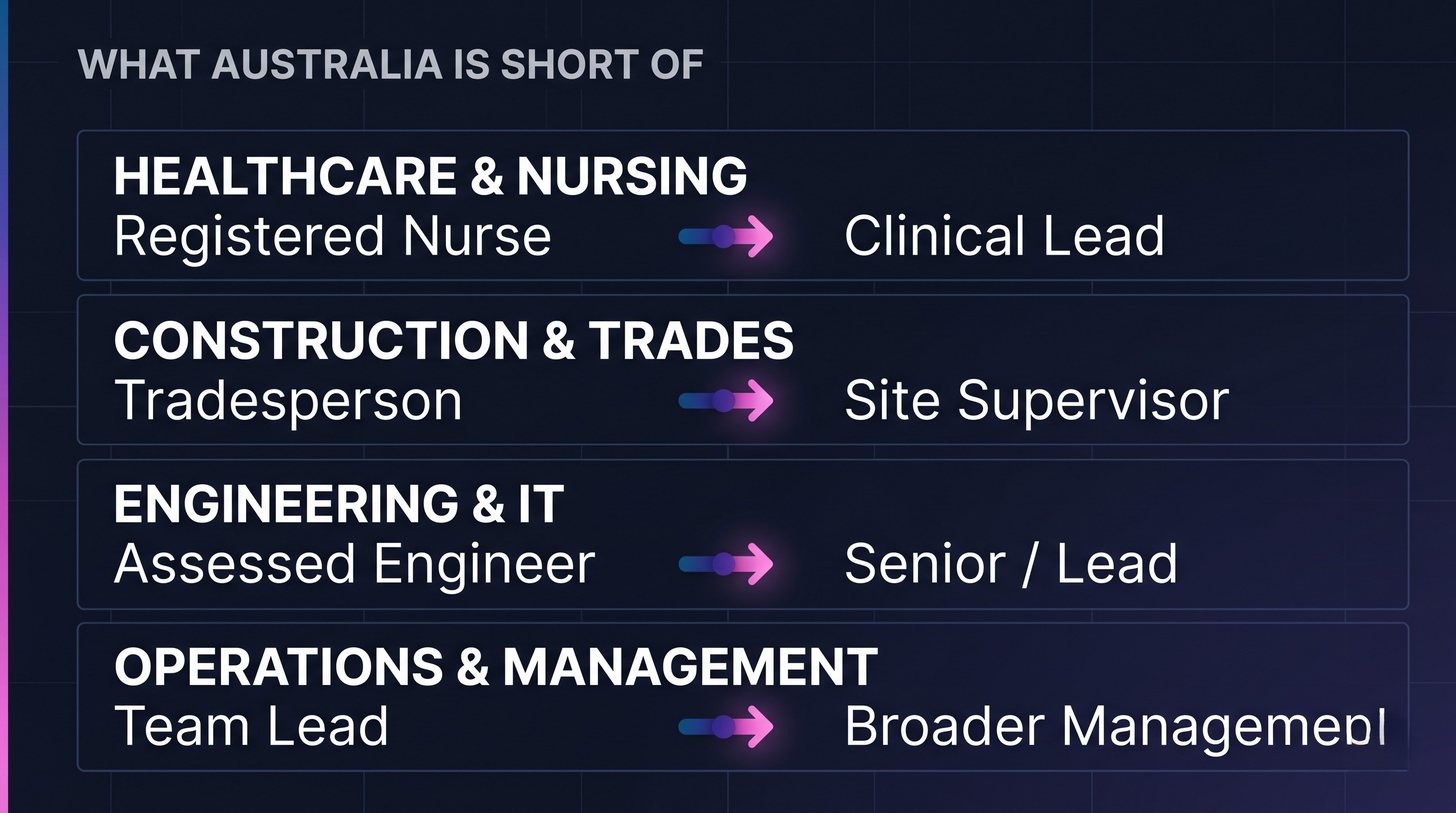
Now turn the question around: not how you get in, but what you would do. Australia recruits internationally because it genuinely cannot fill some roles at home, and those shortage areas line up with skills many Filipinos already carry. Read them for what they are, though: not vacancies to fill once, but professions with long ladders — the value of getting in is the career the first role opens, not a single paycheck. The job types Australia keeps recruiting from overseas fall into a few areas in genuinely high demand. One honest test first: check your exact occupation, by its ANZSCO code, against the live Core Skills Occupation List — built by Jobs and Skills Australia and published by the Department of Home Affairs. Do not trust a Facebook post that says "all nurses" or "all carpenters" are in demand; lists get reviewed, and no single job is guaranteed.
Healthcare and nursing
This is the largest and most dependable shortage area, and one many Filipino healthcare workers are already built for: registered nurses, aged-care and disability-support roles, mostly full-time roles inside Australia's healthcare system. But here is the nuance most "agencies" will not tell you, because it costs them a quick sale: for nurses, the visa is only half the job — you must also register to practise. AHPRA and the Nursing and Midwifery Board of Australia (NMBA) are clear that a registered nurse cannot practise in Australia without registering with the NMBA, through AHPRA, separate from your visa. Their English standard for nurses is higher than the visa standard, around IELTS 7 or OET grade B, and the test settings change from 23 April 2026, so check the live NMBA standard. One more point: the NMBA's streamlined "fast-track" pathway does not include the Philippines — it covers places like the UK, Ireland, the US, parts of Canada, Singapore, and Spain — so Filipino-trained nurses use the standard registration route. Do not let anyone sell you a shortcut that does not exist for you. And see registered nurse for what it is: a starting registration, not a finish line — above it sit specialisations and senior, clinical-lead roles, and the nurses who keep learning and re-credentialing keep rising. Continuous professional development is not optional admin here; it is how the career compounds.
Construction and the skilled trades
This is the other huge door, and the one Filipinos most often underestimate. Australia's construction industry has run ahead of its own workforce for years, which keeps the trades genuinely short — carpenters, electricians, bricklayers, plumbers, welders. If you have a trade, this is where your real leverage sits: on Australian sites and across major infrastructure projects where quality workmanship and steady project management on site are exactly what is missing. A trade on an Australian site is not the ceiling either — the path runs through leading-hand and site supervisor, on into project management and, for some, running their own crew. What climbs it is proven reliability plus picking up Australian codes and ticketing as you go. The honest catch is the paperwork: most trades need a positive skills assessment from the designated assessing authority, and sometimes a practical test. The Department of Home Affairs lists who assesses what — Trades Recognition Australia (TRA) handles many trades, and VETASSESS covers a wide range of professional and trade occupations — so look up your exact occupation's authority on the Home Affairs page, because your trade qualifications must be recognised first.
Engineering, IT and technical roles
For degree-holding professionals, this is your lane: civil, mechanical, electrical, and mining engineering, alongside IT and technology roles such as software developers, cyber-security, and data. Australian businesses keep hiring here because local supply has not kept up, and some technical work is even remote once you are settled. The Department of Home Affairs designates Engineers Australia to assess engineering occupations and the Australian Computer Society (ACS) to assess ICT occupations; these are recognised shortage areas on the Core Skills Occupation List, but the rule still holds — check your exact occupation. An assessed engineer or developer arrives mid-ladder, with senior, lead, and specialist rungs above — and in a field that moves this fast, the ones who climb are the ones who keep their skills current. A skilled software or engineering professional with a clean assessment and solid experience delivering for clients has a serious, credible case.
Retail, sales and full-time operations management
Do not count out a supervisory or operations background — it transfers better than most people expect. These sit among the full-time roles Australian businesses recruit for, especially where someone can genuinely lead a team and manage day-to-day operations. Operations management, team management, supply-chain management — a management background built in a busy Philippine business often maps cleanly onto an Australian one, and those management skills keep compounding once they are in: an operations or team-lead role is a platform to grow into broader management, not a plateau. Retail and sales experience counts too, particularly when you have run a floor, served clients across industries, and kept a team steady under pressure: your real operations experience is an asset, not a footnote.
How to read an Australian job ad honestly
Before you apply, learn to read a real Australian listing. The duties section is the heart of it: the listings that get Filipinos hired are the ones where those duties match your history, so learn the difference between "essential" criteria (the door you must walk through) and "desirable" ones (a bonus). A sales role might ask you to exceed sales targets; most skilled and trade roles are judged on craft and safety, not a sales number, so do not be thrown when one ad lists targets and another does not. An office role may list Microsoft Office as essential, while a welding role lists a trade certificate instead — read the criteria for what the job actually needs. Some ads offer flexible hours; some trades start at 6am on site, so know which life you are signing up for. When an ad asks for "strong communication," it usually means clear English on a team and a worksite; and "cultural fit" really tests reliability and attitude. One last truth: being an early applicant genuinely matters, because many roles fill before the closing date, so apply the week you see them.
The step-by-step pathway: how to work in Australia from the Philippines
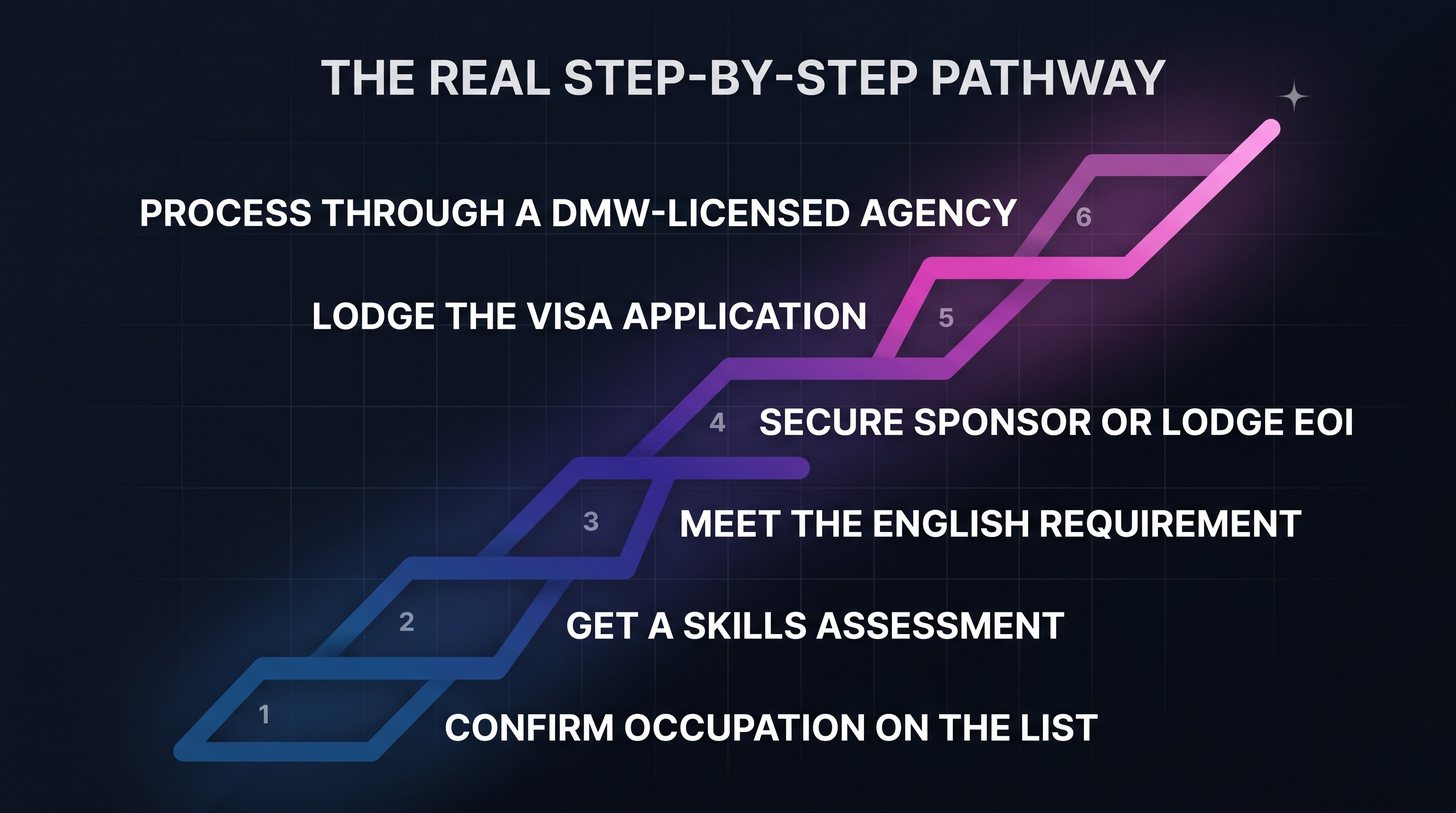
Here is the spine — the honest order, each step mapped to who owns it. Notice what is not step one: paying a fee. And notice why the list begins where it does. We tell every Filipino who asks us the same thing: most people treat this as a paperwork lottery you apply into and then wait on, but it works the other way around. The visa is not the thing you chase — it is what falls into place after you have made yourself the person Australia is short of. You do not wait to become eligible; you build eligibility — the assessment, the English, the proven experience — and the door opens because you walked up to it ready. That is why the steps start with proving your occupation and your skills, not with money: opportunity here is built, not bought, and not waited for. The Filipinos who get through are not the luckiest applicants — they are the most prepared.
- Confirm your occupation is on the relevant skilled occupation list — the Core Skills Occupation List or relevant skilled lists, published by the Department of Home Affairs. Focus here first: if it is not on a list, no amount of money fixes that.
- Get a skills assessment from the designated assessing authority — VETASSESS, TRA, Engineers Australia, or the ACS, the bodies that run the assessment services you will use. Gather your documents early, because each assessment can take a week or more.
- Meet the English requirement for your visa. If you are a nurse, start your AHPRA/NMBA registration in parallel — it runs on its own clock.
- Either secure an eligible company to sponsor you for the 482, with a genuine job offer, or submit an Expression of Interest in SkillSelect and wait to be invited for the 189, 190, or 491.
- Lodge the visa application with the Department of Home Affairs — one complete, accurate application rather than several rushed ones.
- For deployment as an OFW, process through a DMW-licensed agency with the required DMW exit clearance.
Plan around the waiting: much of this is preparing documents, then waiting on an invitation or a decision, so being an early applicant with everything ready spares you avoidable delay. And no legitimate step here starts with handing cash to a "recruiter" before a real job and a signed contract exist.
Protect yourself: the Philippine rules that guard your money

Now we shift to your home turf, and the part some agencies hope you never learn. The law is already on your side — Philippine rules, enforced by the Department of Migrant Workers (DMW), are built to protect your money from people recruiting for jobs that do not exist. This is not theoretical: in 2026 the DMW shut down unlicensed Manila agencies that had been charging Filipinos fees for overseas jobs — including roles advertised for Australia — that never materialised. So keep your focus on the legitimate route, and lean on the support these rules give you.
The placement-fee rule that protects you
This is the single most important rule in this guide. The rule that protects you: a placement fee can only ever be one month's basic salary — and only after you have signed your contract. Under the DMW's restatement of the Revised POEA Rules (2016), a placement fee charged to an Overseas Filipino Worker can only be the equivalent of one month's basic salary under the POEA-approved contract (Section 51); it may be collected only after you have signed that contract, and the agency must issue a BIR-registered receipt stating the date and exact amount. Some workers pay nothing — domestic workers are exempt, as are workers deployed to countries whose system does not allow charging a placement fee. So if anyone asks for a placement fee before you have signed a contract, will not give a real receipt, or wants more than one month's salary — stop. There is no shortcut solution you can buy, and that is exactly the kind of operation the DMW shuts down.
What the employer must pay for — not you
Now flip the script, because this is where most illegal billing gets exposed. Under the same POEA Rules (Section 53), the major recruitment and placement costs are the responsibility of the principal or employer — not you: visa fees, work and residence permits, round-trip airfare, transport from the airport to the jobsite, POEA processing, and the OWWA membership fee, while the licensed agency covers the compulsory insurance premium. OWWA membership is the standard contribution of about USD 25 for two years, and it sits among the costs the principal pays. So when an "agency" tries to bill you for airfare or permits, you now know who is actually supposed to pay.
Going through a DMW-licensed agency, the legal way
The legitimate channel is simple to recognise. A foreign company must hire Filipinos through a Philippine recruitment or manning agency licensed by the DMW, and you normally need a DMW-processed employment contract and the DMW's exit clearance, the Overseas Employment Certificate (OEC), before you leave for work — though there are exemptions and the process is partly digital now, so confirm your situation with the DMW. The move that protects you most: verify any agency's licence on the DMW's own list before handing over a single document. A reliable, licensed recruiter passes that check easily; anyone who flinches at it is telling you something — so look at the DMW's official site, not a Facebook post.
The Questions Filipinos Ask Us Most
Can I work in Australia from the Philippines without a job offer first? Yes — the points-tested Skilled Independent visa (subclass 189) lets you qualify on points alone, with no employer required, while the 482 is the route when you already have a job offer and a company to sponsor you. (Department of Home Affairs.)
Which jobs are most in demand for Filipinos? Healthcare and nursing, construction and the skilled trades, and engineering and IT are among the most persistent shortage areas, per the Department of Home Affairs and Jobs and Skills Australia — but what is needed shifts, so check the current Core Skills Occupation List for your exact occupation.
How good does my English need to be? It depends on the route: roughly IELTS 5.0 in each band for the 482 and Competent English (around IELTS 6.0) for the 189, while nurses face a higher bar of around IELTS 7 or OET grade B to register with AHPRA — confirm the current standard before you book a test. (Department of Home Affairs; AHPRA/NMBA.)
How long does the process take? It varies by visa, occupation, and how complete your documents are, so distrust anyone promising a fixed timeline; expect a week or more waiting on each assessment and on your invitation, which is why being an early applicant with everything ready saves real time. Use the Department of Home Affairs processing-time guide.
How much should I pay an agency? Legally no more than one month's basic salary, and only after you have signed your POEA-approved contract with a BIR-registered receipt — and many costs, including visa fees and airfare, are the employer's, not yours, so anyone demanding money up front to "secure" a job is a red flag. (DMW / POEA Rules.)
Is it safe to go through an agency? It can be, with a reliable, licensed recruiting agency whose DMW licence you verify on the DMW's own list; the danger is the unlicensed operators charging illegal fees for jobs that do not exist, so your success depends on preparation, not on what you pay a fixer.
Before You Apply: Your Readiness Checklist
- Find your exact occupation, by its ANZSCO code, on the live Core Skills Occupation List — confirm it is actually there before anything else.
- Identify your designated assessing authority (TRA, VETASSESS, Engineers Australia, or the ACS) and list the documents it asks for.
- Gather and scan your documents early — qualifications, references, proof of experience — because each assessment takes time.
- Book or plan your English test, and aim above your visa's minimum — stronger English lifts both your points and your prospects.
- If you are a nurse, start your AHPRA / NMBA registration in parallel — it runs on its own, higher English clock.
- Decide your route honestly: a job offer to sponsor you (482), or qualifying on points yourself (189 / 190 / 491).
- Verify any recruitment agency's licence on the DMW's own list before you hand over a single document or peso.
- Remember the rule: no placement fee before a signed POEA-approved contract — and many costs are the employer's, not yours.
- Plan one rung ahead: note the senior or specialist roles your occupation leads to, so your first job is a start, not a stop.
You now know the real routes, the work Australia is short of, the order to move in, and how to protect every peso. The next step is not a leap — it is small and concrete: open the Core Skills Occupation List, find your occupation, and start your skills assessment. But understand it for what it is — the start of a career, not the end of a search, because what carries you up from here is the same thing that gets you in: staying ready, and never stopping learning. Big dreams start with one honest step, and you are standing right at it — and the dream here is a career, not a single visa stamp. This is the kind of journey we help Filipinos navigate — and wherever you go from here, you walk in with your eyes open and the law on your side.
Sources
Australian visas & skills (Department of Home Affairs)
- Skills in Demand visa (subclass 482), Core Skills stream — Australian Department of Home Affairs: https://immi.homeaffairs.gov.au/visas/getting-a-visa/visa-listing/skills-in-demand-visa-subclass-482/core-skills-stream
- English proficiency (subclass 482) — Australian Department of Home Affairs: https://immi.homeaffairs.gov.au/visas/getting-a-visa/visa-listing/skills-in-demand-visa-subclass-482/sufficient-english
- Salary requirements / income thresholds (CSIT, SSIT, TSMIT) — Australian Department of Home Affairs: https://immi.homeaffairs.gov.au/visas/employing-and-sponsoring-someone/sponsoring-workers/nominating-a-position/salary-requirements
- Skilled Independent visa (subclass 189), Points-tested stream — Australian Department of Home Affairs: https://immi.homeaffairs.gov.au/visas/getting-a-visa/visa-listing/skilled-independent-189/points-tested
- Points table, subclass 189 — Australian Department of Home Affairs: https://immi.homeaffairs.gov.au/visas/getting-a-visa/visa-listing/skilled-independent-189/points-table
- Work and Holiday visa (subclass 462) — Australian Department of Home Affairs: https://immi.homeaffairs.gov.au/visas/getting-a-visa/visa-listing/work-holiday-462
- Assessing authorities (incl. ACS, ANMAC, Engineers Australia, VETASSESS, TRA) — Australian Department of Home Affairs: https://immi.homeaffairs.gov.au/visas/working-in-australia/skills-assessment/assessing-authorities
- SkillSelect (Expression of Interest / 190 / 491 / 494) — Australian Department of Home Affairs: https://immi.homeaffairs.gov.au/visas/working-in-australia/skillselect
- Core Skills Occupation List (CSOL) document — Australian Department of Home Affairs: https://immi.homeaffairs.gov.au/Documents/core-sol.pdf
- Temporary Skill Shortage (subclass 482) now repealed (confirms SID replaced TSS on 7 December 2024) — Australian Department of Home Affairs: https://immi.homeaffairs.gov.au/visas/getting-a-visa/visa-listing/repealed-visas/temporary-skill-shortage-short-term-visa-subclass-482
Occupation list developer & legislation
- Core Skills Occupations List — Jobs and Skills Australia: https://www.jobsandskills.gov.au/consultations/2025-core-skills-occupations-list-csol-consultations
- Instrument adding the Philippines to subclass 462 (F2024L00768) — Federal Register of Legislation: https://www.legislation.gov.au/F2024L00768/latest/text
Nurse registration (AHPRA / NMBA)
- English language skills registration standard — AHPRA: https://www.ahpra.gov.au/Registration/Registration-Standards/English-language-skills.aspx
- English language skills — Nursing and Midwifery Board of Australia: https://www.nursingmidwiferyboard.gov.au/registration-standards/english-language-skills.aspx
- Streamlined pathway for internationally qualified registered nurses (comparable-jurisdictions list) — AHPRA: https://www.ahpra.gov.au/News/2025-01-27-media-release-IQRN.aspx
Philippine side (DMW / OWWA)
- Q&A on the Revised POEA Rules and Regulations (2016) — placement-fee cap, exemptions, employer-paid costs, OEC — Department of Migrant Workers: https://dmw.gov.ph/archives/poea/laws&rules/files/Q%20&%20A%20on%20Revised%20POEA%20Rules%202016.pdf
- DMW issuances / advisories — Department of Migrant Workers: https://dmw.gov.ph/resources/issuances/advisories
- OWWA membership processing — Overseas Workers Welfare Administration: https://membership.owwa.gov.ph/
- DMW enforcement against illegal recruiters (2026 reporting) — GMA News: https://www.gmanetwork.com/news/pinoyabroad/dispatch/982168/dmw-shuts-down-manila-firm-for-alleged-illegal-recruitment/story/