
You have the venue and the date. Then a clerk slides a list across the counter, and near the bottom sits a line you have never seen: a certificate from your embassy saying you are free to marry.
A Philippine embassy or consulate issues it, and the posts call it a Certificate of Legal Capacity to Contract Marriage — LCCM for short. Your post's list is not the next post's list. This guide is for the Filipino marrying abroad; a foreigner marrying in the Philippines needs a different one.
What the LCCM is, and why a foreign registrar asks for it
It is a certificate issued by a Philippine embassy or consulate confirming that the Filipino applying for it is legally free to marry. It does not come from your partner's embassy, and it is not a marriage license.
The requirement usually belongs to the country you are marrying in. The German Federal Foreign Office states that all persons not registered in Germany but marrying there require an Ehefähigkeitszeugnis, a certificate of no impediment, and the City of Stuttgart's registry office adds that for foreigners this is the one their home authority issues.
Who actually needs one — and who does not
This is for a Filipino marrying a foreign national where they live. Berlin states that a Filipino who wishes to marry a foreigner or non-Filipino in Germany must secure an LCCM from the Embassy. Tokyo says it is issued only to Filipinos presently residing in Japan who wish to get married to a foreign national — the emphasis is the post's own.
If both of you are Filipino, the route may differ. Berlin and Washington DC both state that the Embassy may solemnize a wedding between two Filipino citizens eligible to marry under Philippine law, after a mandatory ten-day publication of the banns.
As the Philippine Consulate General in Toronto states, a foreign citizen marrying in the Philippines submits a certificate of legal capacity to contract marriage from their own consular officials to the local civil registry office where they will marry, before a license is issued — Canadians through their embassy in Manila.
What your post will actually ask you to bring
There is no single national checklist, and someone else's will cost you a week.
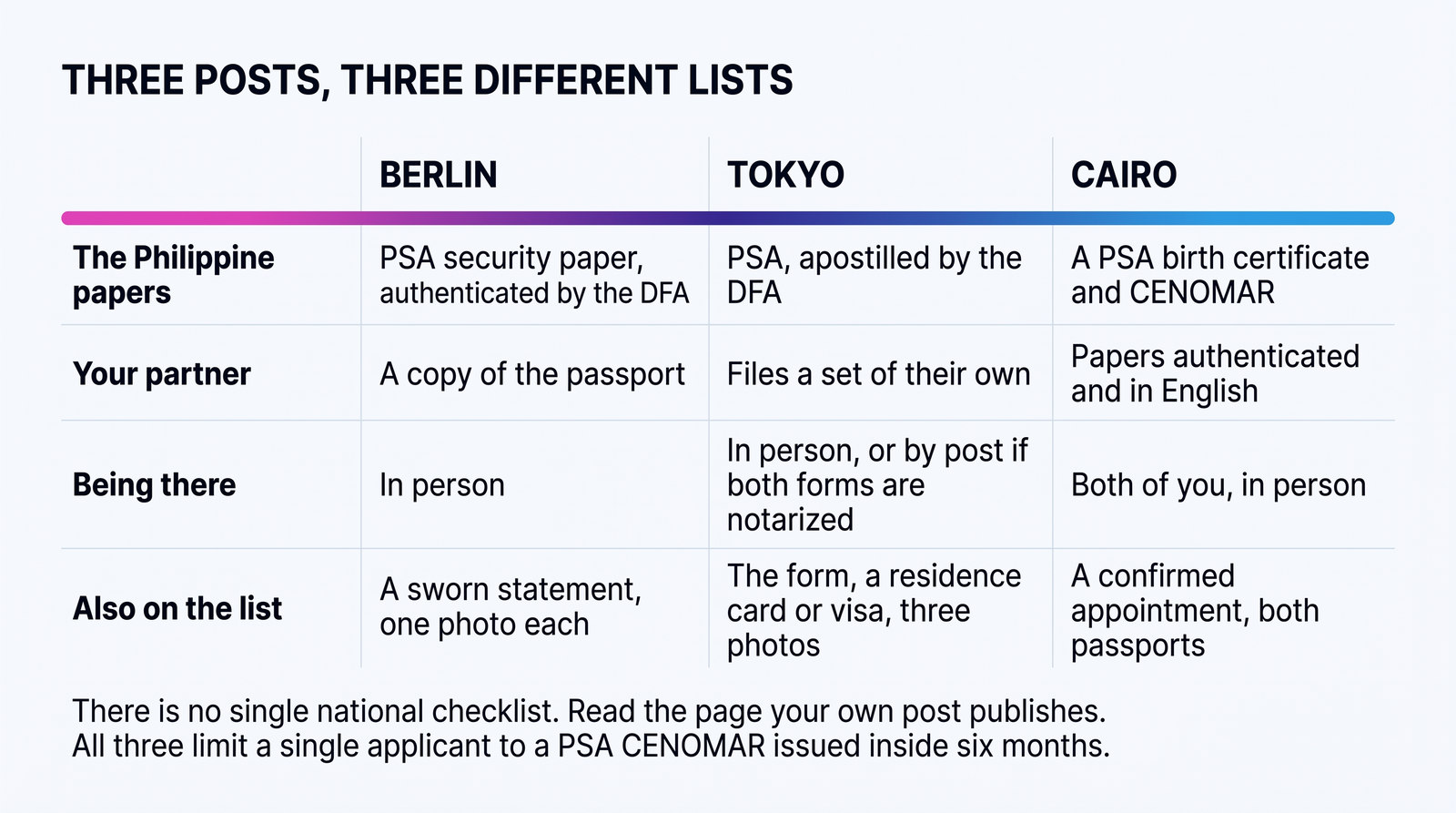
Berlin lists a Sworn Statement, a valid passport, a birth certificate on PSA security paper authenticated by the Department of Foreign Affairs, a copy of the partner's passport, one photo each, and — if you will not collect in person — a return envelope with €4.25 in postage.
Tokyo asks for the form, the passport, a Residence Card or visa in Japan, a DFA-apostilled PSA birth certificate, a DFA-apostilled PSA Certificate of No Marriage (CENOMAR), three photos and a ¥600 Letterpack — and asks the partner to file too: a Japanese national a family registry, any other foreign national their own embassy's equivalent, in English.
Cairo requires a confirmed appointment, the personal appearance of both applicants, both passports, a PSA birth certificate, a PSA CENOMAR, and — for the Egyptian national — a birth certificate and proof of singleness authenticated by the Ministry of Foreign Affairs, in English.
Bring originals with photocopies. Berlin states the rule behind it: civil registry documents from the Philippines must be on PSA security paper, authenticated by the DFA.
All three require the PSA CENOMAR of a single applicant and limit it to six months from issuance. Applicants aged 25 or younger are asked for a parental document, and even those brackets vary: Berlin and Tokyo split at 18 to 20, an Affidavit of Parental Consent, and 21 to 25, an Affidavit of Parental Advice, while Cairo writes its first bracket as 18 to 21.
All three want you there in person; Tokyo accepts a mail application only where both forms are notarized by a Japanese notary public. Nobody can obtain it for you; the channel that counts is your post's appointment page.
The PSA copy and any DFA authentication come before the embassy step, which makes your PSA document kit the long pole, as with the documents you need to work overseas.
If you have been married before
Widowed applicants are asked for proof of the earlier union and of the death, and each post words it differently: Berlin wants an authenticated death certificate, plus a Report of Death only if that spouse was a Philippine citizen who died overseas; Tokyo wants the apostilled PSA Advisory on Marriages and a death certificate matching the late spouse's nationality. Where a union was annulled in the Philippines, the posts ask for the decree with a certificate of finality and the annotated marriage record.
A divorce obtained outside the Philippines does not travel on its own. Berlin states that, pursuant to a decision of the Supreme Court of the Philippines, an applicant divorced by a foreign spouse must first have that divorce judicially confirmed by a Regional Trial Court in the Philippines, register the decision with the PSA-local civil registry office where the court has jurisdiction, and secure the annotated PSA record — and only then apply. Tokyo requires an apostilled judicial recognition of foreign divorce with a certificate of finality; Cairo requires the same, plus the annotated PSA marriage certificate.
This is the step that turns a booked date into a problem, and we say so because we have watched it happen: it runs through Philippine courts, and no consular officer can shorten it. That is what these three posts require, not the law behind it. Get legal assistance early.
How long it takes, what it costs, and how early to start
Berlin publishes ten working days, during which the wedding is announced at the Embassy premises — a notice period, not a queue. Tokyo publishes ten working days regular and five express, both from receipt of complete documents. Cairo publishes no processing period at all.
Those numbers start when your file is complete, after the PSA documents are issued and apostilled. No post publishes an end-to-end estimate.
Validity has more than one clock. Cairo states the document it issues is valid only for 120 days; Berlin and Tokyo publish none. Stuttgart separately states that Germany's own certificate of no impediment is valid for six months — a different paper, a different limit. It can be issued too early as well as too late, so ask your post and your registrar which applies. Fees are the post's too: Tokyo lists ¥3,750 for the certificate, Cairo US$25.00 or EGP 1,350.00, and Berlin €50 on its schedule of consular fees — read on their pages on 9 and 10 September 2026, and consular fees change.
The people who move through this smoothly are rarely the fastest on the day; their papers were already current before there was a date on the calendar.

After the wedding, the paperwork is not finished
Berlin describes the Report of Marriage as a declaration forwarded to the Philippine Statistics Authority, filed within twelve months; Tokyo says within one year, with an Affidavit of Delayed Registration after that. Both posts also limit which places they may register at all — Berlin nine German states, Tokyo fifteen prefectures. Berlin adds that citizenship and previous civil status can affect an application, so if you hold dual citizenship, say so. The Report of Marriage has its own guide.
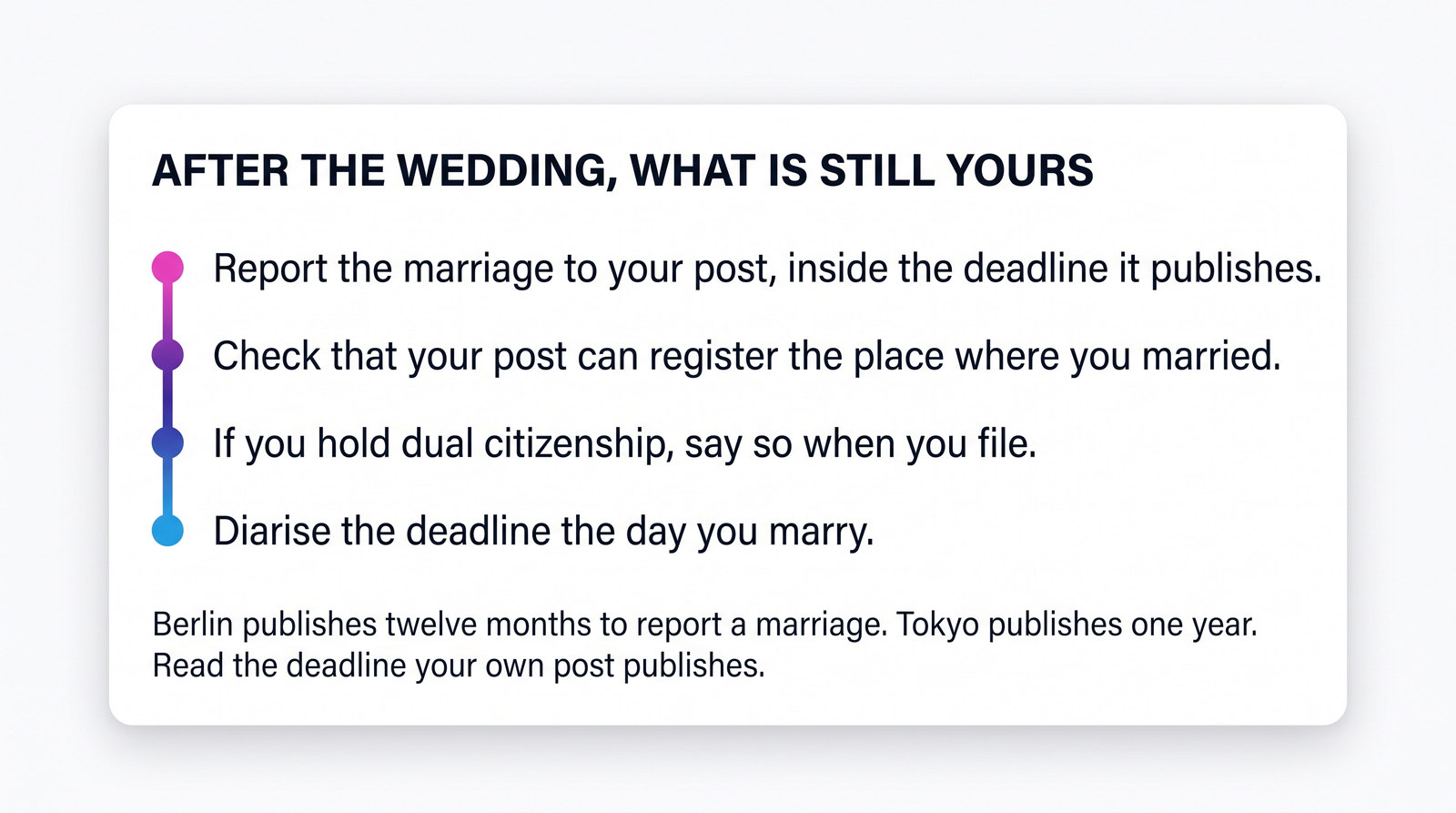
Skipping it does not delete the paperwork: Tokyo requires those who did not apply for an LCCM beforehand to produce, at the Report of Marriage, the same apostilled PSA documents the certificate would have needed, in four copies. The work moves to the moment you are least able to face it, alongside renewing a passport abroad.
Before you book anything
- Read your post's page, not a summary.
- Order the PSA birth certificate and CENOMAR early; watch the six-month clock.
- If a divorce or annulment abroad ended your earlier marriage, start the court step first. It is the longest.
- Ask your post and your registrar how long the document stays valid, and diarise the Report of Marriage.
The Questions Filipinos Ask Us Most
How do I get a certificate of Legal Capacity to Contract Marriage? Apply at the Philippine embassy or consulate serving where you live, with that post's packet, in person unless it takes a notarised mail application.
Can the U.S. embassy in the Philippines notarize my Legal Capacity to Contract Marriage? That question belongs to an American marrying in the Philippines, not to you. In a message dated 6 April 2021 the U.S. Embassy said its citizens no longer need that affidavit notarized at the Embassy or Consular Agency; the message is years old, so read its page.
Sources
Philippine Embassy Berlin, LCCM: https://philippine-embassy.de/legal-capacity-to-contract-marriage-lccm/
Philippine Embassy Berlin, solemnization: https://philippine-embassy.de/solemnization-of-marriage/
Philippine Embassy Berlin, ROM: https://philippine-embassy.de/report-of-marriage/
Philippine Embassy Berlin, consular fees: https://philippine-embassy.de/schedule-of-consular-service-fees/
Philippine Embassy Tokyo, LCCM: https://tokyo.philembassy.net/en/consular-section/services/civil-registration/legal-capacity-to-contract-marriage-certification/
Philippine Embassy Tokyo, ROM: https://tokyo.philembassy.net/en/consular-section/services/civil-registration/report-of-marriage-rom/
Philippine Embassy Cairo, CLCCM: https://www.philippines-egypt.com/legal-capacity-to-contract-marriage
Philippine Consulate General Toronto: https://www.philcongen-toronto.com/consular/consular_lcm.php
Philippine Embassy Washington DC: https://philippineembassy-dc.org/solemnization-of-marriage-2/
U.S. Embassy Manila: https://ph.usembassy.gov/message-for-u-s-citizens-change-in-notarization-requirements-for-legal-capacity-to-contract-marriage/
German Federal Foreign Office: https://www.germany.info/us-en/service/04-familymatters/marriage-in-germany-922550
City of Stuttgart: https://www.stuttgart.de/en/organigramm/leistungen/ehefaehigkeitszeugnis-ausstellung-beantragen