

You go through the bag twice and the passport is not there — or it expired last month and you only looked because someone asked. Either way there is a flight you need and nothing to board it with.
There is a paper for exactly this: a travel document, issued by a Philippine Foreign Service Post — an embassy or a consulate general — to the Filipino who must get home and cannot produce a passport in time.
What a travel document actually is — and what it is not
It stands in for a passport. The Philippine Consulate General in San Francisco calls it "a certification or identifying document … issued in lieu of a passport".
Washington DC's embassy and the New York and San Francisco consulates general describe who it is for the same way: a Filipino citizen with no valid Philippine passport who cannot wait for it.
Once you are home it "is expired and cannot be used again", Washington DC says: you surrender it at a Department of Foreign Affairs office and apply for a new passport. New York names a different office, so ask on arrival.
Why a post issues one, and it is not only a lost passport
Losing it is one reason. It is not the only one. Posts also issue one when yours has expired, or expires too soon for renewal before you fly. Washington DC's trigger is expiry within six weeks of travel — DC's window, not a national rule. Tokyo's embassy adds a mutilated or damaged passport, and a newborn Filipino child with none at all. Where there is time, renewing your Philippine passport abroad is the better route.
Posts want proof of urgency: the death of an immediate family member, medical reasons, legal proceedings. Tokyo also accepts deportation papers — accepted evidence, not a separate class of applicant.
You may have read that there are three types of travel documents; no Philippine post publishes any such list — only the situations in which one is issued, and those decide your case.
It goes one way, and one way only
It is valid for one-way, direct travel to the Philippines. Seven Philippine posts state that limit independently: Washington DC, New York, San Francisco, Tokyo, Berlin, Madrid and Cairo. So it is not a temporary passport and it is not a visa: it takes you home, and that is all it does.
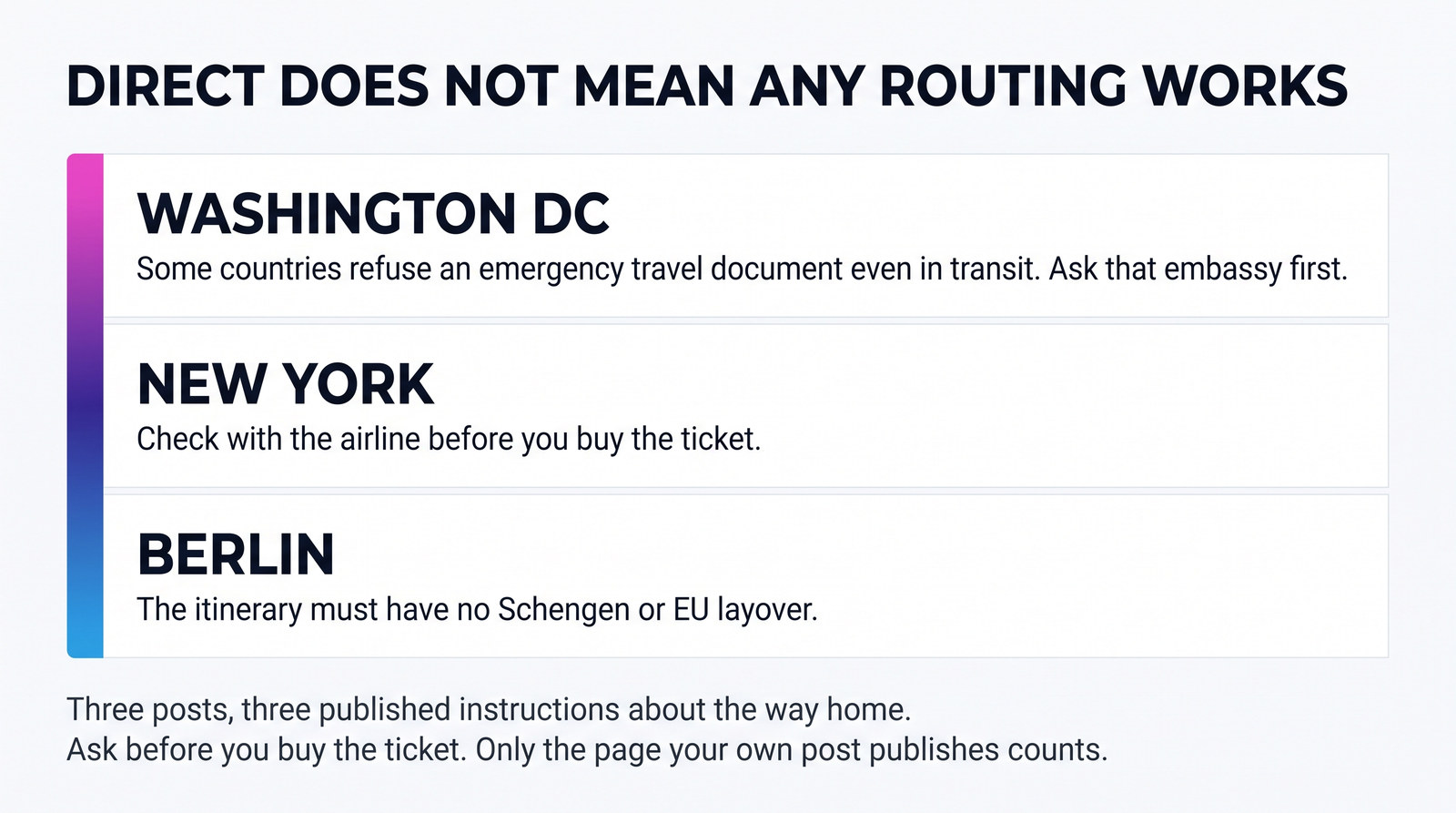
Direct does not mean any routing works: Washington DC warns some countries refuse an emergency travel document even in transit and says to ask that embassy first; New York says check with the airline before buying the ticket; Berlin says the itinerary must have no Schengen or EU layover.
Validity is short where published: 30 days from issuance at Washington DC, New York and Berlin, one month at Cairo, a travel date within a month of application at San Francisco; Tokyo, Madrid and Brasilia publish none. No page says what the country you are leaving needs on the way out — ask your post and the local immigration authority.
What the posts ask you to bring
A post with no passport in front of it still has to establish that you are a Filipino citizen: every list below is a set of ways to prove Philippine citizenship and identity.
Foreign Service Posts do not fully agree — this is the shape, not a national list.
- The form. All eight posts read for this guide want a duly accomplished travel document application form; Washington DC and San Francisco want the form notarised.
- Photos. Four at 2 inches by 2 inches at the US posts, four at European passport size in Berlin, and three elsewhere — 3.5 by 4.5 centimetres at Madrid, Cairo and Brasilia, unspecified at Tokyo. Backgrounds are plain white where specified.
- Proof of Philippine citizenship. An old or expired Philippine passport, its data page, a civil registry document such as a PSA birth certificate, or a government ID. New York accepts a BI ID card, work permit or US visa for natural-born Filipinos, and an ID Certificate for dual citizens; Tokyo wants the PSA marriage certificate if the married name was used in the lost passport; Brasilia calls the birth certificate "a prescribed requirement", with substitutes if the civil registry record of the birth cannot be found.
- A notarised affidavit of loss if it was lost — and sometimes a police report, on conditions that differ: San Francisco wants it "if the lost passport is still valid", Brasilia wants a police report only if it was stolen, Washington DC asks flatly. Brasilia adds what the affidavit must contain: "the circumstances surrounding the loss", plus the lost passport’s number, date and place of issue if known.
- Proof of urgency and your ticket. A death or medical certificate and a confirmed itinerary; Tokyo, Madrid and Brasilia require personal appearance, and a consular officer in Brasilia interviews every lost-passport applicant.
Only your own post's page counts: New York reserves the consular officer's right to require additional documents, requires an appointment and no longer allows walk-ins; Tokyo says there is "no need for an appointment".
How to apply, and what it costs
Download the application form from your post's page, gather what it lists, and check how your post takes the application: San Francisco asks for it by mail with a stamped return envelope, and Washington DC allows it in person or by mail. Washington DC, New York and San Francisco each publish a US$30 processing fee; Tokyo ¥8,250 plus a ¥1,500 expedite fee; others point to a schedule of fees. There is no single national fee, and no page carries a date — check yours. Tokyo issues within 2-3 hours and advises applying at least 24 hours before the flight, and before a weekend; Brasilia says one to two days; most publish nothing, so do not plan on same-day.
If someone else is holding your passport
The Philippine Overseas Employment Administration's standard contract for household workers states, at clause 14, that "the WORKER'S passport, copy of contract and personal property shall not be withheld from the WORKER." That is a contract clause — not a law, not a statement about what any host country enforces, and worth checking against the contract you actually signed.
Tokyo's embassy houses a Migrant Workers Office, the Department of Migrant Workers' office at the post, whose published services include conciliation and mediation with employers and recruitment agencies, and referral assistance for a worker pursuing a case; ask whether yours does. Separately, San Francisco and New York each run an Assistance-to-Nationals section, which San Francisco calls "assistance provided by the Philippine Government to distressed Overseas Filipinos", and each publishes its own ATN hotline. We also have a guide to filing a complaint against a recruitment agency in the Philippines.
Before you go to the post
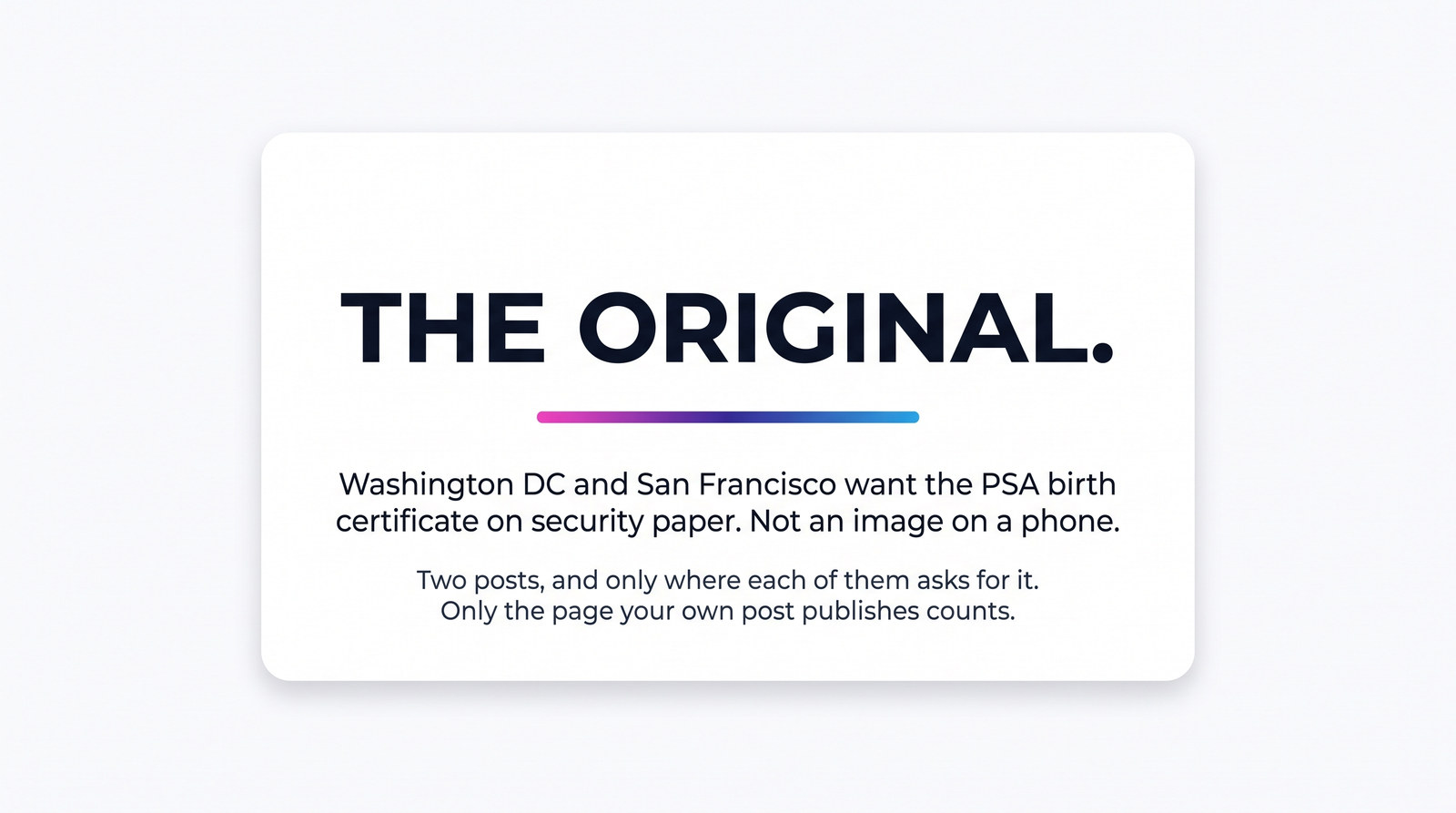
Readiness is not luck: know which post serves your city, keep a photograph of your passport data page, and keep the PSA birth certificate itself — Washington DC and San Francisco want the original on PSA security paper, not an image on a phone. Knowing this exists is what turns an emergency into a queue — the habit that carries a career. Keep it with the other documents that follow you abroad.
- Your post's page printed, an appointment booked if it needs one, and the application form duly accomplished and notarised if asked
- The right photos, your PSA birth certificate or data-page copy, and the affidavit of loss with a police report if asked
- Proof of urgency, your ticket, and the fee
The Questions Filipinos Ask Us Most
Can I use a travel document to fly somewhere other than the Philippines? No. Seven Philippine posts say independently that it is valid for one-way, direct travel to the Philippines only. It is not a temporary passport and it is not a visa.
Is eTravel the same as a travel document? No — eTravel is a free online registration for passengers arriving in the Philippines and Filipinos departing it, within 72 hours of the trip. A travel document is a consular document a post issues. You may need both.
Sources
The definition — Philippine Consulate General, San Francisco: https://pcgsanfrancisco.org/travel-document/ Who it is for, expiry, fee — Philippine Embassy, Washington DC: https://philippineembassy-dc.org/travel-document/ Citizenship proof — Philippine Consulate General, New York: https://newyorkpcg.org/pcgny/consular-services/travel-document/ Fees and timing — Philippine Embassy, Tokyo: https://tokyo.philembassy.net/en/consular-section/services/passport/travel-document/ Affidavit and interview — Philippine Embassy, Brasilia: http://www.philembassybrasilia.org/index.php/travel-documents Photos and validity — Philippine Embassy, Berlin: https://philippine-embassy.de/applying-for-a-travel-document/ Walk-ins and photos — Philippine Embassy, Madrid: https://www.philembassymadrid.com/travel-documents Validity and fee — Philippine Embassy, Cairo: https://www.philippines-egypt.com/travel-document Assistance-to-Nationals — Philippine Consulate General, San Francisco: https://pcgsanfrancisco.org/atn/ Migrant Workers Office — Philippine Embassy, Tokyo: https://tokyo.philembassy.net/attached-agencies/migrant-workers-office/ eTravel — Philippine Travel Information System FAQ: https://etravel.gov.ph/frequently-asked-questions Household worker contract, clause 14 — POEA: https://philippineembassy-dc.org/wp-content/uploads/2019/09/POEA-Standard-Contract-Household-Workers.pdf