

An election comes around back home, someone asks whether Filipinos overseas can still vote, and nobody in the group chat knows.
You do not lose the vote by leaving. But it does not follow you: it is a separate registration, made in person at a Philippine post.
Who can register as an overseas voter
Any Filipino citizen abroad may register as an overseas voter. The Overseas Voting Act — Republic Act No. 9189, as amended by Republic Act No. 10590 — covers every citizen of the Philippines abroad on election day, not otherwise disqualified by law, and at least eighteen that day, not on the day you register.
An overseas voter may vote for President, Vice-President, Senators and Party-List Representatives, and in national referenda and plebiscites. No local office is on that ballot, and what appears depends on the election: a midterm has no presidential contest.
Section 5 names the exceptions: anyone who has lost their Filipino citizenship, anyone who renounced it and pledged allegiance to a foreign country, anyone convicted by final judgment of an offence carrying a year or more in prison, until five years after service of sentence; and any citizen a competent authority has declared insane or incompetent, unless that is later lifted.
Dual citizenship is not a bar. That disqualification excepts anyone who reacquired or retained Philippine citizenship under Republic Act No. 9225, the Citizenship Retention and Reacquisition Act of 2003 — what the law asks of that citizen is proof of citizenship — the order of approval or the identification certificate — not a fresh renunciation. Vancouver's consulate lists dual citizens among those eligible.
Where you register, and what counts as a post
Applications may be filed at any post abroad, or at centres outside it approved by COMELEC, including in the Philippines. The Act defines posts as the Philippine embassies, consulates, foreign service establishments and other Philippine government agencies maintaining offices abroad. Ask which consulate or post serves your city. Wherever Filipinos have gone, the office serving them is not always an embassy.
Registering is one of the consular services a post lists, alongside passports and civil registry work. The Act also requires field and mobile registration — a post's consular outreach to the Filipino community in its jurisdiction. Washington DC registers at the post or at a consular outreach mission; Vancouver's consular outreach reaches Whitehorse.
On appointments there is no single answer. Washington DC requires an appointment, but not at its outreach missions; the consulate general in New York registers by appointment only; Frankfurt and Vancouver say no appointment is needed. Appointments are a post-level matter — check yours.
What overseas voting registration actually involves
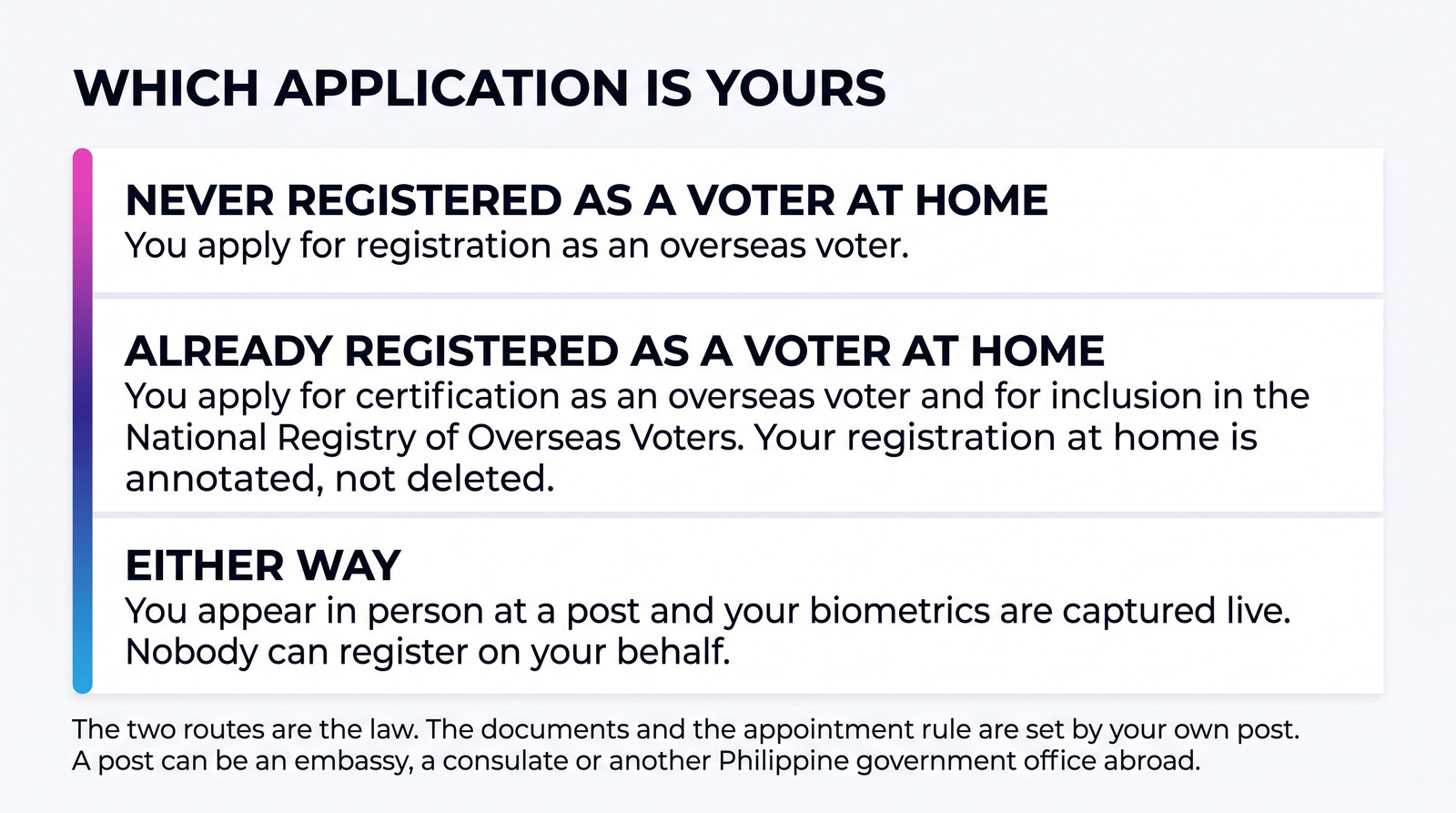
Registration is done in person, and your biometrics are captured live. Section 6 says registration or certification as an overseas voter shall be done in person, with all applicants submitting to live capture of their biometric data. Berlin's post says personal appearance is required precisely for that.
Which means nobody can register on your behalf: a consular service that needs your own biometrics cannot be delegated. The Act's definition of field registration ends with the words the government shall not collect fees for the same — no fee for that, and narrow words — so a fee demanded to "process" your application is a warning sign, not a service.
Three things go in, the Act says: a valid Philippine passport; the form COMELEC prescribes, which the posts call COMELEC Overseas Voting Form 1; and, for anyone who used RA 9225, the order of approval from the post or a Bureau of Immigration identification certificate. Without a valid passport, a Department of Foreign Affairs certification stands in its place — though renewing your Philippine passport abroad is cleaner. Posts often ask for local proof of status too — Frankfurt's consulate names a visa, work permit, permanent resident card or dual citizenship certificate — the post's list, not the law's. A seafarer brings a Seafarer's Identification Record Book alongside the passport — Berlin and Vancouver name it.
Already registered at home? The route is different: a Filipino who registered under the Voter's Registration Act of 1996 applies for certification as an overseas voter and inclusion in the National Registry of Overseas Voters, and the election officer annotates it against your name on the certified voters' list — annotated, not deleted.
Can you register online? What iRehistro does and does not do
No — iRehistro is not an online registration system. Seoul's post says so plainly in its advisory for the 2028 national elections: the system lets a voter fill out, generate and print the form with a QR code, and every applicant must still appear in person at the post for biometric capture.
No personal data is retained on any server either, Washington DC's advisory adds.
After you file: the RERB hearing at your post
Filing is not approval: a Resident Election Registration Board hears your application. The RERB is a three-member board chaired by a career Department of Foreign Affairs official. It posts applicants' names and its RERB hearing dates on the post's bulletin board and website.
Tokyo's post held one such RERB hearing for the 2028 elections, approving new applications, reactivations and transfers. Approved names go up on that board; a disapproved applicant is told why, and the Act gives five days from receipt of that notice to seek reconsideration.
How a record goes inactive — and how to bring it back
A record goes inactive when its owner misses two consecutive national elections. Section 14 lists four grounds on which the RERB deactivates a record into an inactive file: a final judgment carrying a year or more in prison; a declaration of insanity or incompetence; failing to vote in two consecutive national elections — national, not local; and a court-ordered exclusion.
Deactivated is not deleted. It sits in the inactive file, marked and dated, and annotated in the registry. Cancellation is a different section, reaching only those who have died or are proven to have lost their Filipino citizenship.
The Act requires notice to applicants who were disapproved; for deactivation it requires only annotation in the registry. Posts publish a list: Washington DC posts one, naming voters inactive for missing the last two national elections. Nothing in that chain reaches your inbox. You have to go and look.
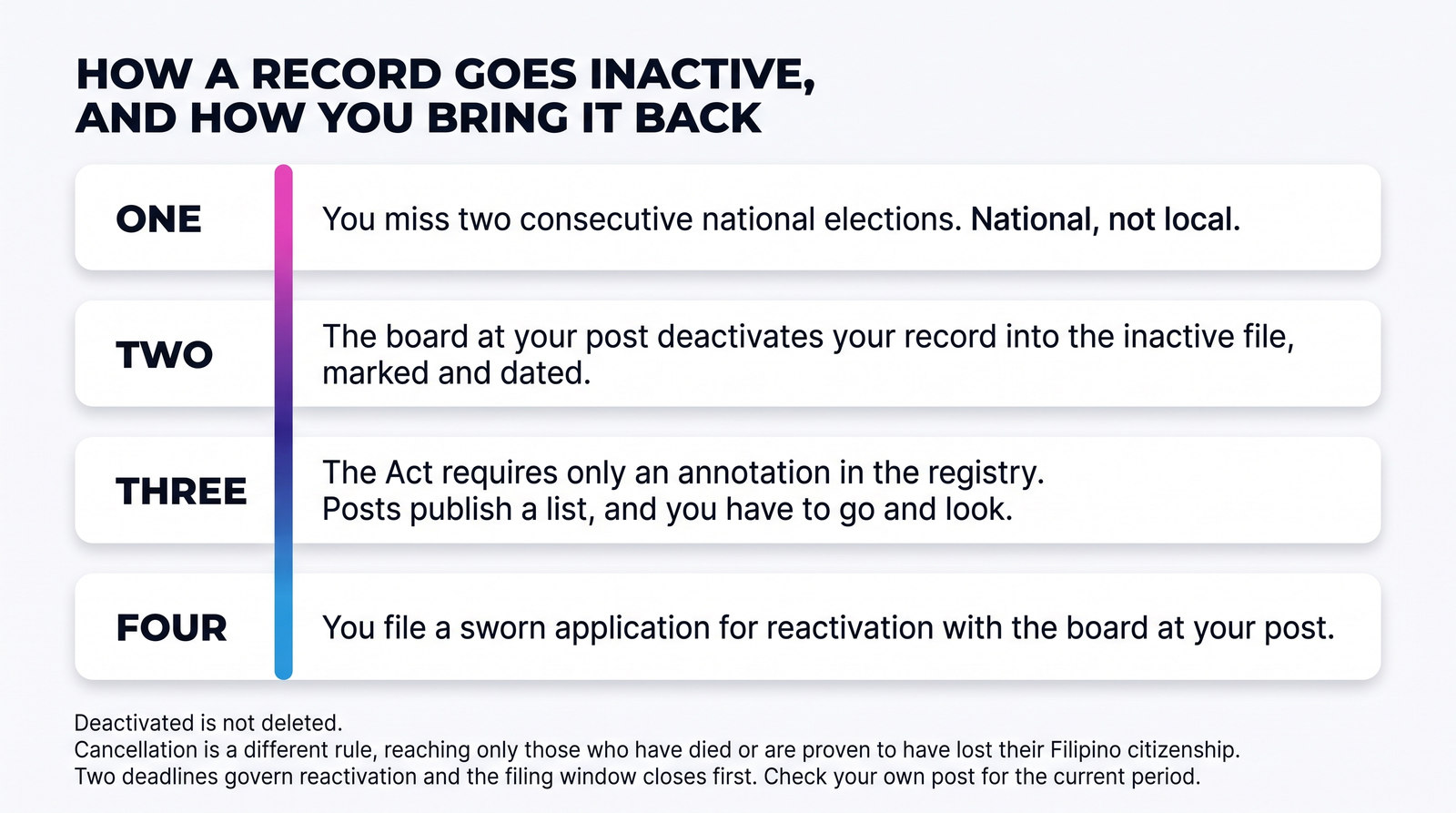
Reactivation itself is simple; its deadline is not. A deactivated overseas voter may file a sworn application with the RERB at any time, but not later than 120 days before the voting period starts — and that period is the thirty days before election day, so the cut-off sits earlier than most guess. The window closes first: Berlin's post takes reactivations in the same filing period as new applications, which ends 30 September 2027 unless COMELEC moves it. It also publishes COMELEC's virtual frontline service: a voter whose biometrics are already on file can email in a reactivation, a transfer, a change of address or a correction. A right you were granted once and a right you keep are not the same thing. A passport, a professional licence, a place on a voters' list are records you maintain, not prizes you were handed.
Before you go to the post
- Your post's consular service page: appointment or walk-in?
- Is voter registration open where you are?
- Your Philippine passport — or ask about a certification if it expired
- Dual citizenship under RA 9225? The order of approval or certificate
- Using the iRehistro system? Fill the form ahead and print it
- Registered before? Search the post's deactivated list
The Questions Filipinos Ask Us Most
Can I register to vote online from abroad? No. The online form only fills, generates and prints your form; every overseas voter must still appear in person at the post for biometric capture, as Seoul's advisory states.
When is voter registration for the 2028 national election? Voter registration runs from 01 December 2025 to 30 September 2027, with 08 May 2028 as election day, as five posts publish it: Washington DC, Berlin, Frankfurt, New York and Islamabad. The Act runs a system of continuing registration, reopening after each national election — but it is not always open: COMELEC sets each period and can move it, so confirm on your post's advisory.
I have not voted in years. Am I still registered? Possibly not. A record is deactivated after two consecutive national elections missed, but it is reversible: a sworn reactivation application to the RERB, inside the filing window above and at least 120 days before the voting period starts.
Sources
Overseas Voting Act, RA 10590: https://lawphil.net/statutes/repacts/ra2013/ra_10590_2013.html Deactivation list — Philippine Embassy, Washington DC: https://philippineembassy-dc.org/overseas-absentee-voting/ Filing and appearance — Philippine Embassy, Berlin: https://philippine-embassy.de/overseas-voting/ Documents — Philippine Consulate General, Frankfurt: https://frankfurtpcg.de/overseas-voting/ Appointments — Philippine Consulate General, New York: https://newyorkpcg.org/pcgny/consular-services/overseas-voting/ Dual citizens — Philippine Consulate General, Vancouver: https://www.vancouverpcg.org/services/overseas-voting/ Registration period — Philippine Embassy, Islamabad: https://islamabadpe.org/overseas-voting-gen-info/ RERB hearing — Philippine Embassy, Tokyo: https://tokyo.philembassy.net/en/ph-embassy-convenes-first-rerb-hearing-for-2028-elections-overseas-voting-registration/ iRehistro advisory — Philippine Embassy, Seoul: https://www.philembassy-seoul.com/announcements-advisories/availability-of-irehistro-for-overseas-voters-2028-national-elections