
Somebody shares a notice in the group chat, and the week looks different. The consulate is coming — a hall two towns over, a weekend — and you start the arithmetic. The drive. The day off. The folder you have not opened since you moved.
This guide is for that moment, and for one Filipino a long way from their post: what a consular outreach mission is, what posts provide there, and how to find your own. It names no dates or venues on purpose — every schedule belongs to a post.
What a Consular Outreach Mission Actually Is
A consular outreach mission is a team from a Philippine embassy or consulate travelling into its own territory to work on site, for a Filipino who lives too far away to reach the counter. The Philippine Embassy in Washington, D.C. describes organising missions "to bring consular services closer to Filipinos living in other areas under its jurisdiction." San Francisco says the same of "Filipinos residing in other states/territories under its jurisdiction."
Jurisdiction decides which mission is yours, and every post publishes its consular jurisdiction: San Francisco's covers Northern California, Northern Nevada, Colorado, Utah and Wyoming; Chicago's, twelve states from Illinois to Wisconsin. Those two lists belong to those posts; yours is on your post's site. New York describes its missions as "organized in partnership with Filipino community organizations" — its own model, not a general one.
What a Mission Can Do — and Why the List Belongs to Your Post
No two posts we read publish the same services at a consular outreach mission, and anyone who hands you a national list is guessing. What each post publishes for its missions:
- Washington, D.C. — passport renewals, applications, replacements and emergency travel documents; dual citizenship; overseas voting registration, civil registry and social security services — bounded on that page: "other services may be provided depending on budget and availability and will be announced."
- Los Angeles — passport applications; consular notarization; civil registry reports of birth, marriage and death; and dual citizenship petitions under RA 9225.
- Vancouver — NBI clearance consularization, with migrant worker and SSS services.
- New York — passport processing, legalization of documents, civil registry documents — birth, marriage and death — and reacquisition of Philippine citizenship, plus information sessions on trade, tourism, investment, assistance to nationals and SSS concerns: sessions, not transactions.
- Tokyo — no service list at all, and the line it does carry stopped applying in 2009. The page, posted that year, said overseas absentee voter registration "may be also administered" only "for missions to be undertaken until 31 August 2009."
So read your post's notice for what this mission carries — passports, dual citizenship, civil registry reporting (report of birth, marriage or death), notarial work, overseas voting registration. Reacquiring Philippine citizenship under Republic Act No. 9225 means an oath of allegiance before a consular officer, as San Francisco sets out. We cover dual citizenship and passport renewal abroad in separate guides, and reporting a child's birth in another. PRC licence renewal is a different agency's process, not a consular service.
How to Find Your Post's Announcements
Announcements appear on a post's website advisory page, its official social page, or both — and those are the only two worth trusting. Los Angeles says announcements go up "a month prior" on its website and Facebook page. Tokyo files its announcements under Consular Advisories.
We have printed no date here, and that is deliberate: Washington's programme carries the line "All locations and dates are tentative and subject to change." We watch Filipino families book a day off and a four-hour drive around a schedule copied from somewhere else.
What to Expect on the Day: the Rules Change from Post to Post
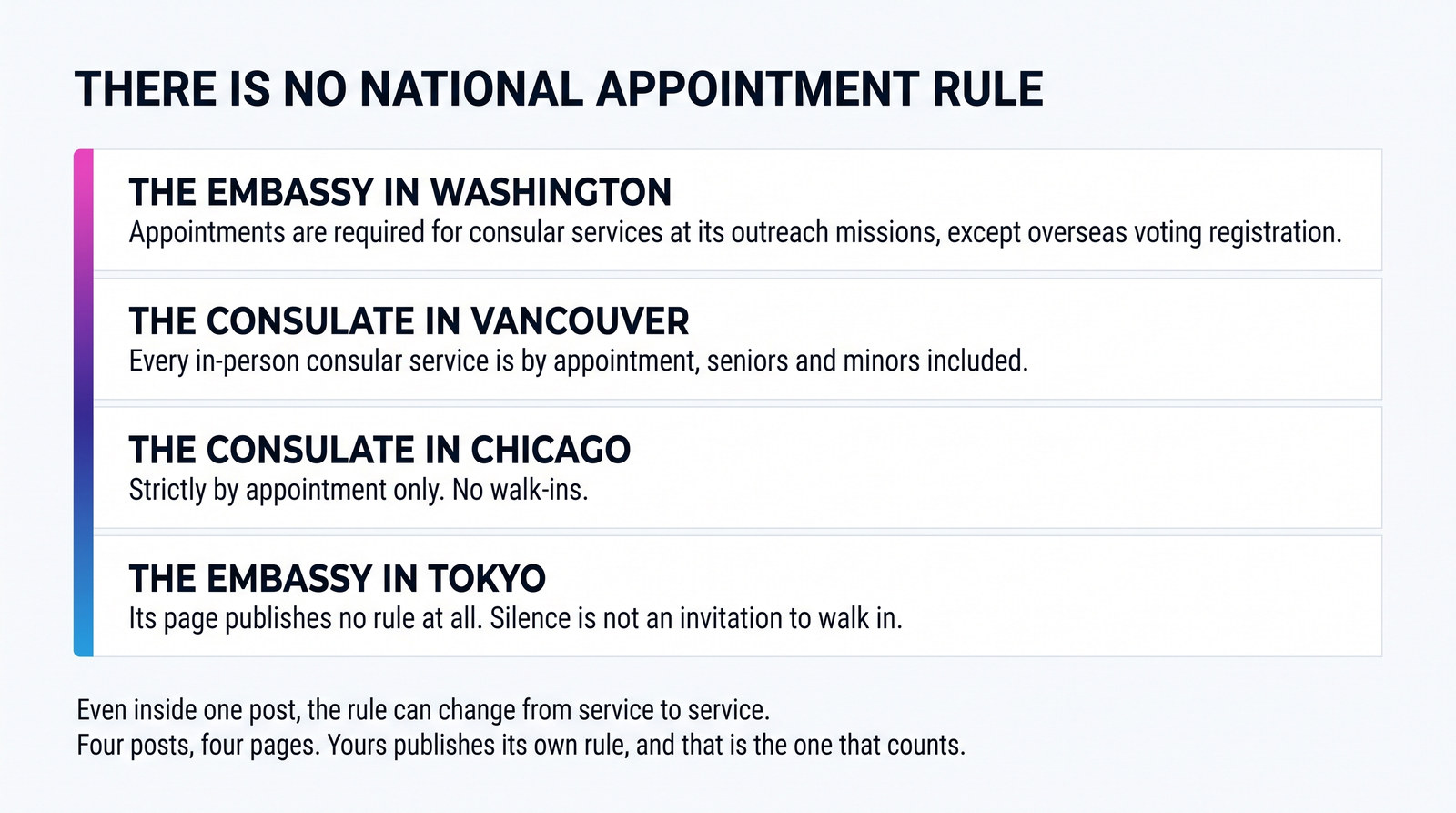
There is no national appointment rule here, in either direction, and a wrong assumption costs a day. Washington publishes that "Appointments are required for consular services during outreach missions." Vancouver makes every in-person consular service appointment-only, seniors and minors included. Chicago is shortest: "strictly by appointment only (No 'Walk-ins')." The exception is that post's, and that service's: on overseas voting registration, Washington publishes that "Appointment is not required for overseas voter registration at consular outreach missions."
The booking channel moves too. Washington, Chicago and San Francisco all point passport applicants at passport.gov.ph, the address those three posts publish, where the passport appointment is booked online; San Francisco books dual citizenship through a separate link. Chicago takes dual citizenship requests by email, wanting the form and requirements as "ONE PDF FILE." Los Angeles takes a mission-specific address and asks for document copies ahead of time, warning that "Only complete submissions will be given an appointment, INCOMPLETE FORMS/SUBMISSIONS WILL NOT BE PROCESSED." Vancouver confirms your appointment by email.
Then the limits, each belonging to the post that set it. Chicago publishes that "Only sixty (60) applicants will be accommodated" for dual citizenship, "first-come, first-served." Los Angeles warns that "Application slots are easily filled up just after a couple of days." Tokyo, on that same 2009 page, requires a minimum of 100 applications before a mission proceeds; Washington publishes that frequency depends "on available budget allocations." A minimum to run a mission is not a cap on attendance, and none of it promises you will be served. Vancouver admits only applicants, one companion each, except for seniors, PWDs and minors needing assistance.
What to Bring With You
Across five posts' published reminders, four things recur. Your booking confirmation, printed: San Francisco asks for the print-out of its confirmation email, Chicago for that plus the application print-out. Your original documents, with a photocopy of each. Your payment, in the exact form that post names. And, where documents come back by mail, a self-addressed return envelope.
Now the carve-outs, because this is where a general sentence does real damage. Los Angeles requires self-addressed stamped envelopes for passports and notarization but not for dual citizenship or a civil registry report of birth, marriage or death. Chicago will not accept FedEx envelopes. Vancouver names Xpresspost, a Canada Post product rather than a global requirement. Payment splits the same way: Vancouver takes debit card, credit card, cash, and money order or bank draft payable to the Consulate General; San Francisco, cash or money order only.
We have published no fee figure here, and not because nobody sets them. Tokyo publishes its fees under a Department order, "SCHEDULE OF SERVICE FEES UNDER D.O. 07-00", then names the rate at which it collects in yen. That schedule is national; the currency, the rate and the counter are the post's. Trust no figure except what your post prints. When posts cannot agree on whether a card works, a number lifted from somebody's guide is worth nothing at the table.
The Mission Is a Deadline, Not a Queue
A mission is a deadline, not a queue you join once it is announced. The posts' pages say so: Los Angeles' slots go in days, and Chicago's sixty-first dual citizenship applicant does not get in. The announcement is not the start of the process. It is the deadline for a folder you should already have.
That habit — documents kept current on your own schedule rather than somebody else's — is what carries a Filipino career overseas. A passport in date, a civil registry record already reported, originals and copies together. Readiness is what makes an opportunity usable, and it is yours to build.

Before the Next Advisory Goes Up
- Confirm which post's consular jurisdiction covers where you live, on that post's site.
- Bookmark its announcements page and follow its official page.
- Check which booking channel it uses for the service you need.
- Put your original documents and a photocopy of each into one folder now.
- Ask what it charges, and in what form it takes payment.
- Ask whether your service needs a self-addressed return envelope.
- Book no travel until the post confirms the date — schedules are published as tentative.
The Questions Filipinos Ask Us Most
What are the fees for consular services at a Philippine consulate? The Department sets them; each post publishes the fees it collects, in local currency — which is why you will not find a figure here. The posts do not even publish the same payment methods: Vancouver lists debit card, credit card, cash, and money order or bank draft; San Francisco, cash or money order.
What documents need to be consularized? That depends on what you need the document for and which post serves you, so treat any general list with suspicion. Several posts do carry the work at outreach missions: Los Angeles lists consular notarization, New York legalization of documents, Vancouver NBI clearance consularization.
Do I need an appointment? There is no national rule, so your post decides. Washington, Vancouver, Chicago and San Francisco all publish an appointment requirement; Tokyo's page publishes none — and a page that is silent is not a page that invites walk-ins. Washington exempts overseas voting registration at its missions.
Sources
Philippine Embassy in Washington, D.C.: https://philippineembassy-dc.org/consular-outreach-program/
Philippine Consulate General in Los Angeles: https://losangelespcg.org/about-the-consulate/outreach/
Philippine Consulate General in New York: https://newyorkpcg.org/pcgny/news-and-events/consular-outreach/
Philippine Consulate General in Vancouver: https://www.vancouverpcg.org/general-reminders-for-consular-outreach-missions/
Philippine Consulate General in Chicago: https://www.chicagopcg.com/outreach.html
Philippine Consulate General in San Francisco: https://pcgsanfrancisco.org/consular-outreach-missions/
Philippine Embassy in Tokyo: https://tokyo.philembassy.net/en/consular-outreach-missions/
Schedule of fees — Philippine Embassy in Tokyo: https://tokyo.philembassy.net/docs/Schedule-of-Fees.pdf
Republic Act No. 9225 and the oath of allegiance — Philippine Consulate General in San Francisco: https://pcgsanfrancisco.org/dual-citizenship/