
It is late, and three tabs are open on a Philippine embassy website: 13(a), balikbayan, temporary visitor. Underneath them is a simpler question about the person asleep in the next room — can my husband just come home with me, or does he need something first?
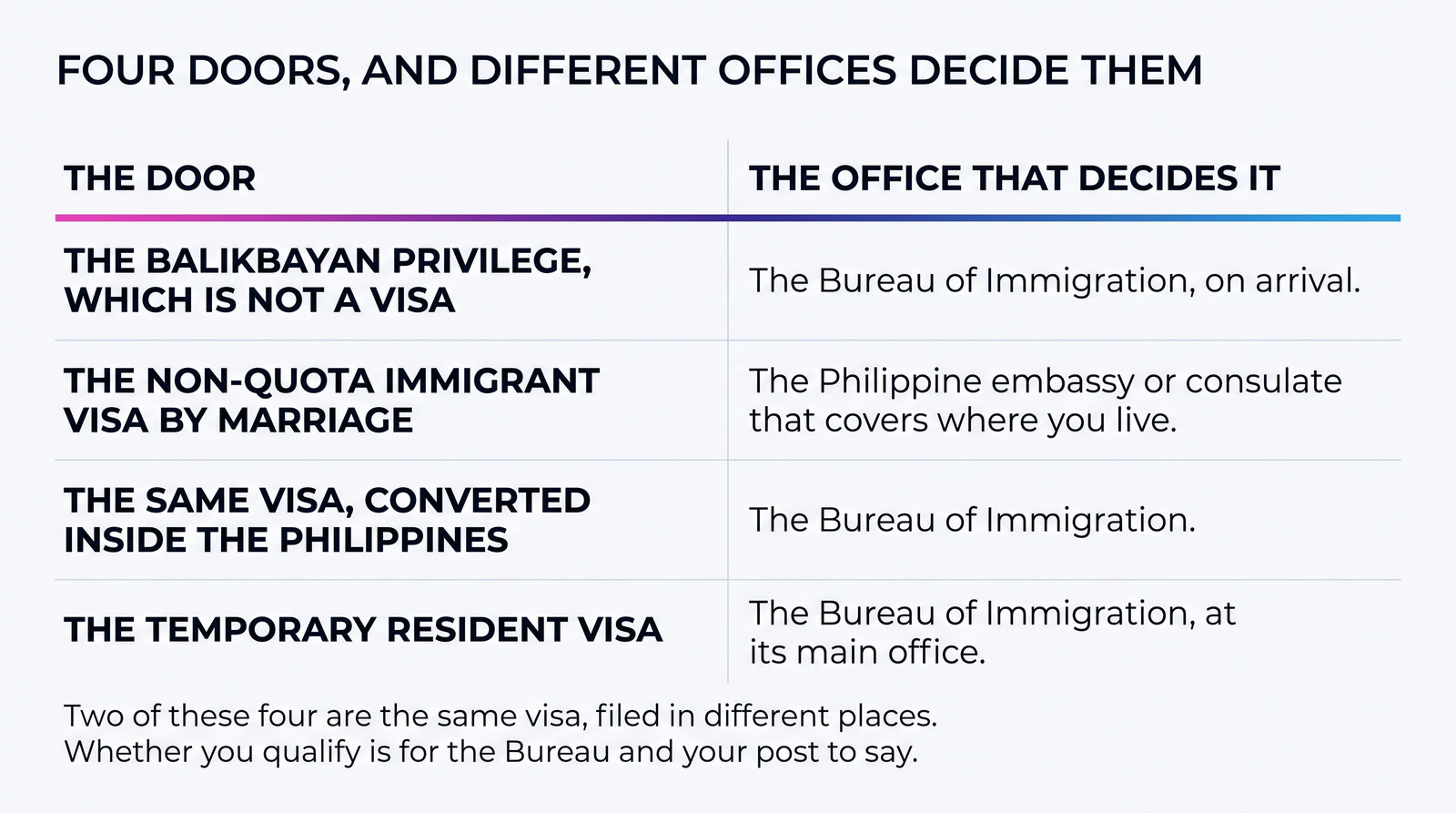
Four things sit on those tabs, and different offices decide them. An admission — the balikbayan privilege, which is not a visa at all. The non-quota immigrant visa by marriage, applied for at a Philippine embassy or consulate abroad; the same one converted inside the Philippines at the Bureau of Immigration; and a Temporary Resident Visa, which the Bureau publishes where the foreign spouse's country has no reciprocity agreement.
Whether you qualify is for the Bureau and your post to say.
The Balikbayan Privilege Is an Admission, Not a Visa
Those admitted as balikbayans are given an initial stay of one (1) year, the Bureau of Immigration publishes — an admission on arrival, with no visa secured in advance.
It runs off the Filipino's status, not off the marriage. The Bureau lists three ways to be a balikbayan:
- a Filipino citizen continuously out of the Philippines for a period of at least one (1) year;
- a Filipino overseas worker;
- a former Filipino citizen naturalised abroad who comes or returns to the Philippines.
Someone living in the Philippines is not one, and a spouse cannot ride a privilege that is not there.
Two conditions then apply. Asked whether one travelling alone may use it, the Bureau answers that a foreign national spouse or child "may only be given the said privilege if he/she is traveling with his/her Balikbayan spouse or parent." The second is nationality: family members must be nationals of countries falling under Executive Order 408, and those outside it "must secure entry visas prior to their travel."
The year may be extended by one (1), two (2) or six (6) months at the Bureau's Visa Extension Section. No authority we checked calls the privilege a visa, residence, or permission to work. If you are planning to live in the Philippines, this is the wrong door.
The 13(a): What the Bureau Publishes About Who May Apply
The Bureau of Immigration issues a non-quota immigrant visa by marriage to "a foreign national on the basis of his valid marriage to a Philippine citizen," under Section 13(a) of Commonwealth Act No. 613, the Philippine Immigration Act of 1940. Its page is headed Immigrant Visa by Marriage (13A) — search those words, not ours.
The Bureau's FAQ states that a foreign national "whose country also grants permanent residence and immigration privileges to Filipinos" may apply, under Foreign Service Circular No. 21-10, and that the visa is "only available" to such citizens.
The list of countries it treats as granting that privilege sits on the same page, and carries conditions of its own — one footnote limits certain entries to Filipinas married to those nationals, another imposes a marriage-date or five-year-marriage condition. We will not reproduce it or tell you that you are covered. Read it, then confirm with your post.
If the answer is no, another route is published. The Temporary Resident Visa page answers who can apply with "a foreign national whose country does not have an existing reciprocity agreement with the Philippines." It is filed at the BI Main Office, and the Bureau lists a separate track for an Indian national married to a Filipino citizen under Memorandum Order No. ADD-01-038.
Applying at the Philippine Embassy or Consulate Where You Live
Every post publishes its own visa application requirements, fee and forms, usually under consular services. There is no national list: you file with the post that has jurisdiction over where you live. What one post publishes, as an example and not as your list:
The Philippine Consulate General in Los Angeles asks a 13(a) applicant for:
- the application form (F.A. Form No. 3);
- a passport whose validity "must extend at least one (1) year beyond the length of proposed stay in the Philippines";
- a Medical Certificate (F.A. Form No. 11) from a local physician;
- an "Apostilled Local State Police clearance obtained within the last (6) months";
- proof of financial capacity;
- personal appearance for an interview by the consular officer.
It also wants an original notarised letter from the Filipino spouse petitioning for the immigrant visa — never a bystander in this — and, for anything mailed, a self-addressed, postage-prepaid return envelope, adding that it "shall not assume any responsibility for documents which have been mailed."
Los Angeles publishes an Immigrant Visa Fee of US$150, by cashier's check in person or by cashier's check or US Postal Money Order by mail; Washington DC publishes US$150, non-refundable, by money order. Those are two posts' published fees — check the schedule your own post publishes. Los Angeles adds that the officer can request additional documents.
Converting Inside the Philippines at the Bureau of Immigration
Someone already lawfully in the Philippines converts their status at the Bureau rather than at a post, under the heading Conversion to Non-Quota Immigrant Visa by Marriage (Probationary).
Its checklist, BI Form V-I-002-Rev 1.1, asks for:
- a joint letter request to the Commissioner from the applicant and the petitioning Filipino spouse;
- the accomplished CGAF;
- the marriage certificate;
- the Filipino spouse's birth certificate or a certified true copy of a BI-issued Identification Certificate;
- the passport bio-page and latest admission with valid authorised stay;
- a valid NBI Clearance "if application is filed six (6) months or more from the date of first arrival in the Philippines";
- a BI Clearance Certificate;
- a Bureau of Quarantine medical clearance for nationals of the countries in its Annex "A".
The amendment page answers who can apply for the permanent visa with "a foreign national who has an existing Probationary Non-Quota Immigrant Visa status that is valid for one (1) year." The probationary comes first and the permanent is a separate application — this is not permanent residence granted on the day you marry. The Bureau's ACR I-Card categories list the two stages separately, and that card goes to registered aliens whose stay "has exceeded fifty nine (59) days." The form also requires Philippine civil-registry documents to be PSA-issued originals, and foreign ones authenticated by the Philippine Foreign Service Post.
Php 8,620.00 is published for the principal, for both stages, plus US$50 for a one-year ACR I-Card — under the Bureau's own warning that "Fees are updated as of 06 March 2014 and may change without prior notice."
Then the sequence:
- Documents go for pre-screening at the Central Receiving Unit.
- Fees are paid against an Order of Payment Slip and the Official Receipt submitted.
- You are told to "refer to the Official Receipt for the schedule and venue of the hearing."
- Then: "Check website if visa application is already approved. If approved, submit passport for visa implementation."
Nobody calls you.
The Marriage Record: What Each Office Asks For
The Report of Marriage is what puts a foreign marriage on the Philippine record; a post may want it, the Bureau's checklist does not. Los Angeles makes that report its first 13(a) item, and says that if it was filed over a year before the application it wants the PSA-issued marriage certificate instead — a condition that is its own. The Bureau asks only for a "Marriage Certificate or Marriage Contract," and its 2026 Citizen's Charter accepts one issued abroad if authenticated by the Philippine Foreign Service Post or the DFA, or apostilled. The marriage had to be valid, which is where the legal capacity to contract marriage came in.
Proof of Philippine citizenship is needed on the Filipino side. Los Angeles accepts a passport or birth certificate; the Bureau accepts the birth certificate or a BI-issued Identification Certificate — the document held by a former citizen who has been through dual citizenship.
What separates the couples who get through in one pass from those who go around twice is not luck. They built the file before they needed it: the marriage reported while the papers were fresh, the PSA copy ordered early, the passport renewed long before a post asked for a year beyond the stay.

How Long It Takes — and Who May File for You
Washington DC publishes "two (2) weeks after complete submission of requirements" for 13A and G visas; the Bureau's 2026 Citizen's Charter gives 37 working days in total for each of the two stages. The Bureau's 13(a) page and Los Angeles publish none.
The Bureau's checklist form carries the line "This document may be reproduced and is NOT FOR SALE," and a representative filing for you must attach a BI Accreditation Identification Certificate or an original Special Power of Attorney with the attorney-in-fact's government-issued ID. Los Angeles lists the applicant's own personal appearance for interview. So anyone charging you for the form is selling something the Bureau gives away, and nobody can stand in for an appearance a post requires in person.
Before You Begin: The Short Checklist
- Is the Filipino spouse a balikbayan under the Bureau's three categories, and will you travel together?
- Check the other nationality against EO 408 and the Bureau's reciprocity list.
- Get the marriage certificate your own office asks for — a post and the Bureau differ.
- Gather proof of Philippine citizenship: passport, birth certificate, or Identification Certificate.
- Read what your own post publishes; keep a dated copy.
- Ask the post or the Bureau the one question this guide cannot: whether your case qualifies.
The Questions Filipinos Ask Us Most
How long does it take to get a spousal visa in the Philippines? It depends on the office. The Philippine Embassy in Washington DC publishes two (2) weeks after complete submission of requirements; the Bureau's 2026 Citizen's Charter gives 37 working days in total for the probationary conversion inside the Philippines. The Bureau's 13(a) page and Los Angeles publish none.
How long can a foreign spouse of a Filipino stay in the Philippines? The Bureau gives those admitted as balikbayans an initial stay of one (1) year, shared on two conditions — travelling with the balikbayan, and holding the nationality of a country under EO 408. An ordinary non-visa-required visitor gets thirty (30) days initially.
Who qualifies for a spousal visa? The Bureau issues the non-quota immigrant visa by marriage on the basis of a valid marriage to a Philippine citizen — but only, it states, to citizens of a country granting permanent residence and immigration privileges to Philippine citizens. Otherwise it publishes the Temporary Resident Visa.
How much does a spousal visa cost in the Philippines? The Bureau publishes Php 8,620.00 for the principal, under its note that fees "are updated as of 06 March 2014 and may change without prior notice," plus US$50 for a one-year ACR I-Card. Abroad, Los Angeles publishes US$150 — one post's fee, not a national one.
Sources
Immigrant Visa by Marriage (13A) — Bureau of Immigration: https://immigration.gov.ph/visas/immigrant-visa-by-marriage-13a/
Reciprocity, the Balikbayan Program and visa-free admission — Bureau of Immigration FAQs: https://immigration.gov.ph/faqs/
Amendment to Permanent Non-Quota Immigrant Visa by Marriage — Bureau of Immigration: https://immigration.gov.ph/visas/permanent-resident-visa-prv/
Temporary Resident Visa — Bureau of Immigration: https://immigration.gov.ph/visas/temporary-resident-visa-trv/
BI Form V-I-002-Rev 1.1 checklist — Bureau of Immigration: https://immigration.gov.ph/wp-content/uploads/pdf/visas/BI%20FORM%20V-I-002-Rev%201.1.pdf
13(a) visa for a spouse — Philippine Consulate General, Los Angeles: https://losangelespcg.org/consular-services-2/visa/spouse-or-unmarried-child-of-filipino-national/
13(a) visa for a spouse — Philippine Embassy, Washington DC: https://philippineembassy-dc.org/visa/
Citizen's Charter 2026, 1st Edition — Bureau of Immigration: https://immigration.gov.ph/wp-content/uploads/2026/09/Main-Office-2026-1st-Edition.pdf