

It is usually in a drawer, behind the residence card you actually use: a laminated card with your name, your profession, a registration number, and a date in a corner nobody looks at — which went past between a night shift and a rest day.
Most professionals we meet here are nurses, given how many countries are hiring Filipino nurses, but also teachers, engineers and midwives, and almost none is in trouble. This guide covers the Philippine side; what a foreign board does with your licence is our guide to credential recognition abroad.
What Actually Expires, and How Often
What expires is your Professional Identification Card — the plastic face of a Philippine professional licence, and what your licensure examination and registration became. It is "renewable every three (3) years" under Professional Regulation Commission Resolution No. 2019-1146, and carries the dates of issuance and expiry. Your Certificate of Registration is a different paper, and no page we read describes it as expiring.
The clock runs off your birth month; the Commission's fee schedule adds a surcharge twenty days after it. You can start early, though: the 2026 Citizen's Charter opens the service to a professional whose card "is already expired or will expire in less than one (1) year".
Can You Renew Your PRC License If You Are Abroad?
Yes — the application is filed online, from wherever you are.
The Commission's 2026 charter is not explicit. Its first step offers two paths, collecting the printed card or selecting shipping, yet the later steps, printed under both, still describe presenting the application form at a "designated window" at a Regional Office or Offsite Service Center. It never says whether delivery removes that step, so ask before building a flight around it. A representative and a foreign mobile service are the other routes.
The Online Route: What LERIS Asks You For
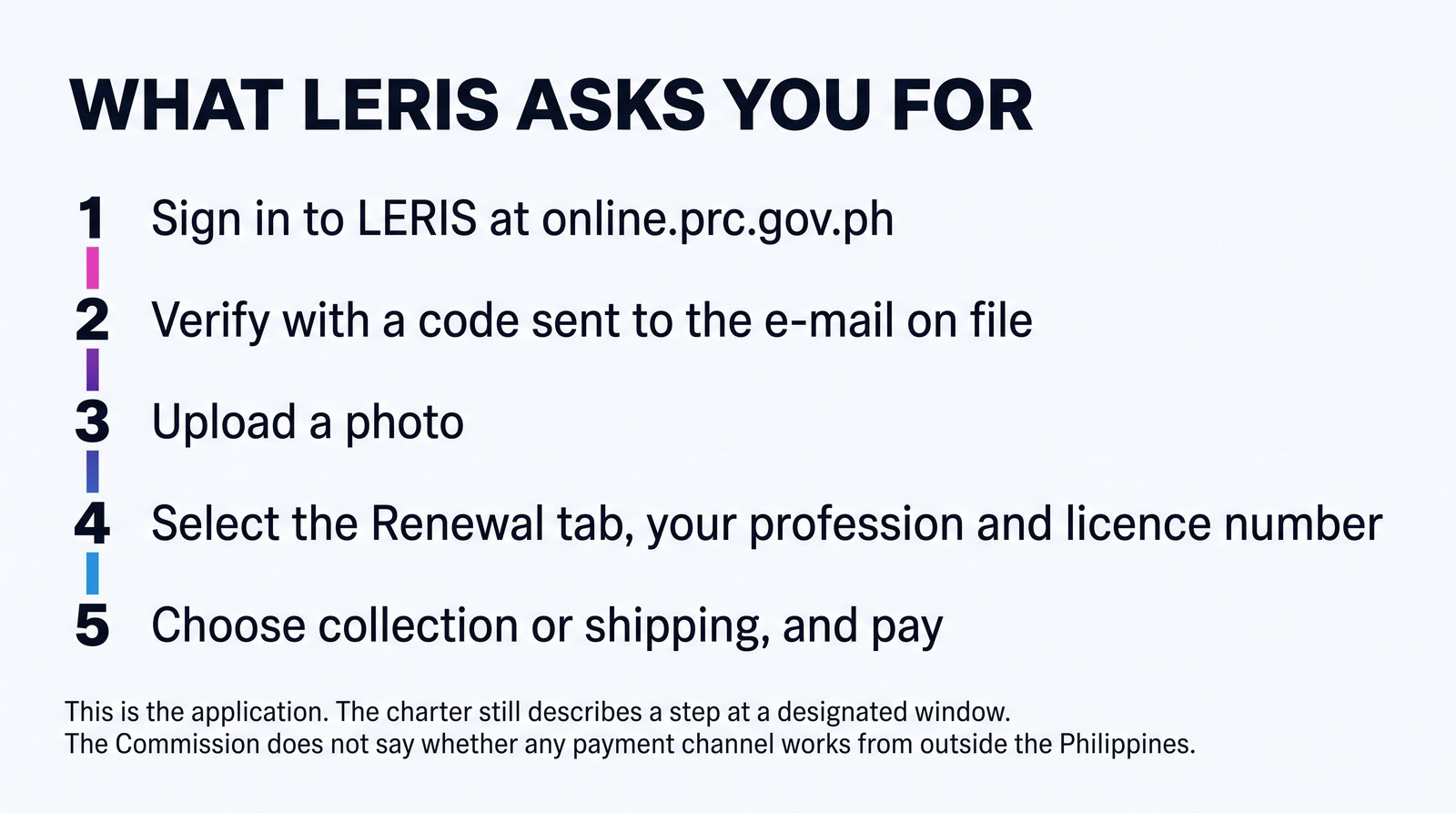
You renew through the same system a professional in Manila uses — LERIS, the Licensure Examination and Registration Information System, at online.prc.gov.ph. The 2026 charter makes logging in the first client step and requires "proof of system-generated application form", generated there. No paper application is posted from abroad.
Its own step-by-step manual sets the sequence: sign in, verify with a code sent to the e-mail on file, upload a photo, select the Renewal tab, your profession and licence number, choose collection or shipping, and pay — LANDBANK iAccess, the cashier at your appointment place, Maya or card. It does not say whether any works from outside the Philippines, so check yours.
What the charter asks you to bring:
- the system-generated application form;
- proof of CPD compliance, or the overseas documents below, accepted "in lieu of CPD Certificates";
- any other paper your Professional Regulatory Board requires — a Certificate of Good Standing for criminologists, interior designers and pharmacists, a surety bond for real estate;
- your existing card, and other valid identification.
For the rest of the paperwork a job abroad asks for, we keep a separate guide.
Which PRC Regional Office — and Can It Be a Different One?
You choose it yourself. The manual says to "Select Preferred PRC Regional Office" when you book, and no page we read ties you to the office where you first registered — though that is no guarantee, so settle an unusual case with the helpdesk.
The e-PIC, and Why It Matters More Overseas
Your renewed licence exists electronically before the plastic does. Since 27 February 2023 the Commission has asked entities "local and international, subject to authentication" to honour the electronic Professional Identification Card as valid government-issued identification; it carries your registration number, registration date and validity period, and a barcode that scans against its verification page.
Under Resolution No. 1610, series of 2023, a renewing professional may view and print that copy at no fee beyond the renewal fee, so a licence is usable "in just a matter of minutes, while the printing of the physical copy is being processed". The regulator sets the limit itself: the e-PIC "is not a substitute for the physical PIC", and cannot oblige a foreign employer to accept it.

The CPD Question: What the Rules Say, and Where They Disagree
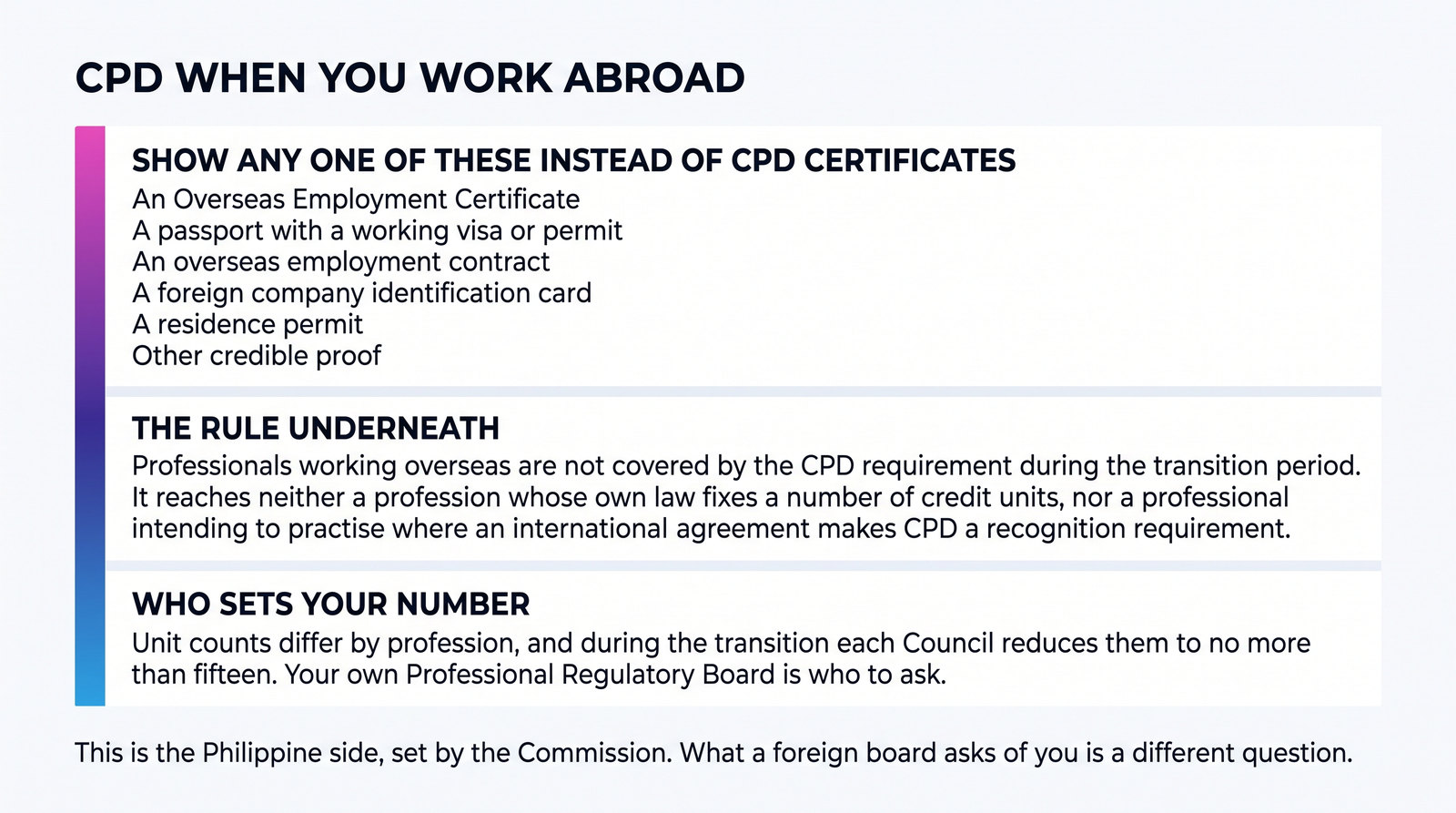
An overseas Filipino professional can satisfy the CPD line with proof of working abroad. The 2026 Citizen's Charter carries a requirement headed "For Overseas Filipino Professionals (OFPs), in lieu of CPD Certificates", accepting any of these in original, photocopy or electronic form: an Overseas Employment Certificate from the Department of Migrant Workers, a passport with a working visa or permit, an overseas employment contract, a foreign company identification card, a residence permit, or other credible proof.
The rule underneath is the Continuing Professional Development Act of 2016, which made CPD mandatory for renewal. Its implementing rules, as amended in 2019, provide that during the transition period "professionals working overseas shall not be covered by the CPD requirement". Two carve-outs sit in the same provision: it reaches neither a profession whose regulatory law fixes a number of credit units, nor a professional intending to practise where an international agreement makes CPD a recognition and eligibility requirement, such as the ASEAN Mutual Recognition Agreements. The relief ends with the transition period.
Unit counts are per profession: the Commission's published matrix lists, from 2020 onward, 45 credit units for nursing and for professional teachers, and 120 for accountancy — but the same 2019 amendment has each profession's Council reduce them to no more than fifteen during the transition. Your own Professional Regulatory Board is who to ask.
The renewal page carries a fallback for professionals unable to comply: they "shall be allowed to renew their PIC upon execution of an undertaking to complete the required CPD credit units for the next compliance period". The Commission extended acceptance of that undertaking until 31 December 2026, under Resolution No. 2200, series of 2026.
What a Lapse Actually Costs
Renewal runs ₱150 a year — ₱450 for the three-year cycle — for professions requiring a baccalaureate degree, and ₱140 a year, or ₱420, for the rest. The schedule calls this the Annual Registration Fee and adds a surcharge of ₱30, or ₱28 for the second class, "if PIC is renewed twenty (20) days after the birth month". Those are the 2026 figures, and the Commission's own FAQ warns that schedules and procedures change. Its arrears table, for baccalaureate professions, shows how a lapse compounds:
- last paid in 2026 — the next three years, ₱450, no surcharge;
- last paid in 2023 — six years, ₱990;
- last paid in 2020 — nine years, ₱1,530.
The money is the small part. Sooner or later a professional abroad is asked for certificates, and most run through a valid card: a Certificate of Good Standing is issued only to "registered professionals with valid Professional Identification Card/ Electronic-PIC", on a ₱75 certification fee plus documentary stamp tax, and an authenticated Certificate of Registration needs that same card. Those are three certificates from two agencies: the Commission issues the first two, and the Overseas Employment Certificate comes from the Department of Migrant Workers. That is what the Commission asks before issuing its own papers, not what a foreign board asks for.
Most people file this under errands owed to Manila. It sits better elsewhere: the card is the one document here with a clock on it, where a transcript describes something you did once. Opportunity is built out of what people keep current, and the ladder above a first contract belongs to those who keep skills, paperwork and a sense of where the work is going alive at once.
When the Commission Comes to You: Foreign Mobile Services
Sometimes the counter travels. Foreign Mobile Services take the Commission's window abroad, and renewal or duplication of the Professional Identification Card is on the service list, with initial registration, application for a licensure examination or a Special Temporary Permit, certifications and authentication, and a Certificate of Good Standing. The announcements name where it has been — Cambodia, the United Arab Emirates, Australia, Thailand, Japan, Qatar, Saudi Arabia, Singapore, Hong Kong and Malaysia — and it announced Taipei, Taiwan for 12–14 September 2026.
Each mission is a dated event, not a standing service: that list is where the Commission has been, not where it goes next. Watch its news pages; when one is announced for your country, create the transaction in LERIS and select that venue.
Nobody Has to Charge You to Do This
Every step here has a published fee, and none needs a middleman. Someone may file and claim on your behalf: a representative who is not a registered professional needs valid government-issued identification and a Special Power of Attorney executed by you; one who is themselves registered needs their own valid card and an authorisation letter. The Philippine Embassy in Washington DC, for one, notarises a special power of attorney on personal appearance — though posts differ, and no page we read says what form the Commission requires for one executed abroad.
The Commission publishes a standing notice warning against people "claiming to be connected with the Professional Regulation Commission … for personal or financial gain, to facilitate and/or process the application and/or release of various PRC documents", and tells anyone approached that way to report it at arta@prc.gov.ph. Its own line: "the PRC follows its procedures and processes as enshrined in its Citizens Charter" — the published list of requirements, timelines and fees. Anything charged above them you are choosing to buy.
Before Your Birth Month: The Renewal Checklist
- Read the expiry date — you can file once it has expired, or the year before.
- Note your birth month; the surcharge starts twenty days after it.
- Recover your LERIS account early; the code goes to the e-mail on file.
- Look up your profession's credit units, and save your e-PIC when the renewal clears.
The Questions Filipinos Ask Us Most
Can I renew my PRC license if I am abroad? Yes — the application is filed online. The 2026 charter still describes a step at a designated window and never says whether delivery removes it; if you cannot appear, use a representative or a foreign mobile service.
Can I still renew without CPD units in 2026? The 2026 charter accepts proof of overseas status "in lieu of CPD Certificates" — an Overseas Employment Certificate, a working visa or permit, an employment contract, a foreign company ID, or a residence permit. The renewal page separately offers an undertaking to complete the units next cycle, and the Commission has extended acceptance of that undertaking until 31 December 2026.
Can I renew my PRC license in a different region? You select a preferred regional office in the application form itself, and no published page we read ties you to where you first registered.
Sources
Card definition, cycle, CPD transition rule: https://www.prc.gov.ph/sites/default/files/2019-1146%20CPD%20IRR.PDF
Renewal requirements, undertaking notice, representative rules: https://www.prc.gov.ph/renewal-professional-id-card
Who may renew, requirements, client steps, Certificate of Good Standing — Citizen's Charter 2026: https://www.prc.gov.ph/sites/default/files/Professional_Regulation_Commission_2026_1st_Edition_Citizens_Charter.pdf
Fees, birth-month surcharge, certification fee: https://www.prc.gov.ph/prc-frequently-asked-questions
2026 fee and arrears schedule: https://www.prc.gov.ph/sites/default/files/ASSESSMENT%20OF%20ANNUAL%20REGISTRATION%20FEESARF%20FOR%20CY%202026-2-3.pdf
Credit units by profession: https://www.prc.gov.ph/uploaded/documents/MATRIX%20OF%20REQUIRED%20CPD%202018-onwards-11718.pdf
Undertaking extended to 31 December 2026: https://www.prc.gov.ph/prc-resolution-no-2200-s-2026
Online steps and payment: https://www.prc.gov.ph/sites/default/files/LERIS-Online-Step-by-Step-Procedure-v8.pdf
e-PIC policy, Resolution No. 1610 s. 2023: https://www.prc.gov.ph/node/6109
e-PIC acceptance, 27 February 2023: https://www.prc.gov.ph/node/6509
Foreign Mobile Service list and venue: https://www.prc.gov.ph/article/reaching-wider-prc-conduct-foreign-mobile-service-taipei-taiwan-september-2026
Notice to the public on facilitators: https://www.prc.gov.ph/advisories/notice-public
Notarisation of a special power of attorney — Philippine Embassy, Washington DC: https://philippineembassy-dc.org/consular-notarization/