

Your mother's flights are booked for her first trip to see where you work. Then someone in the group chat says it: get her the affidavit, or they will offload her.
We read the departure rules and the posts' own pages on 23 and 24 September 2026. A post — a Foreign Service Post, in the government's own term — is a Philippine consulate or embassy.
What the affidavit is, and what it cannot promise
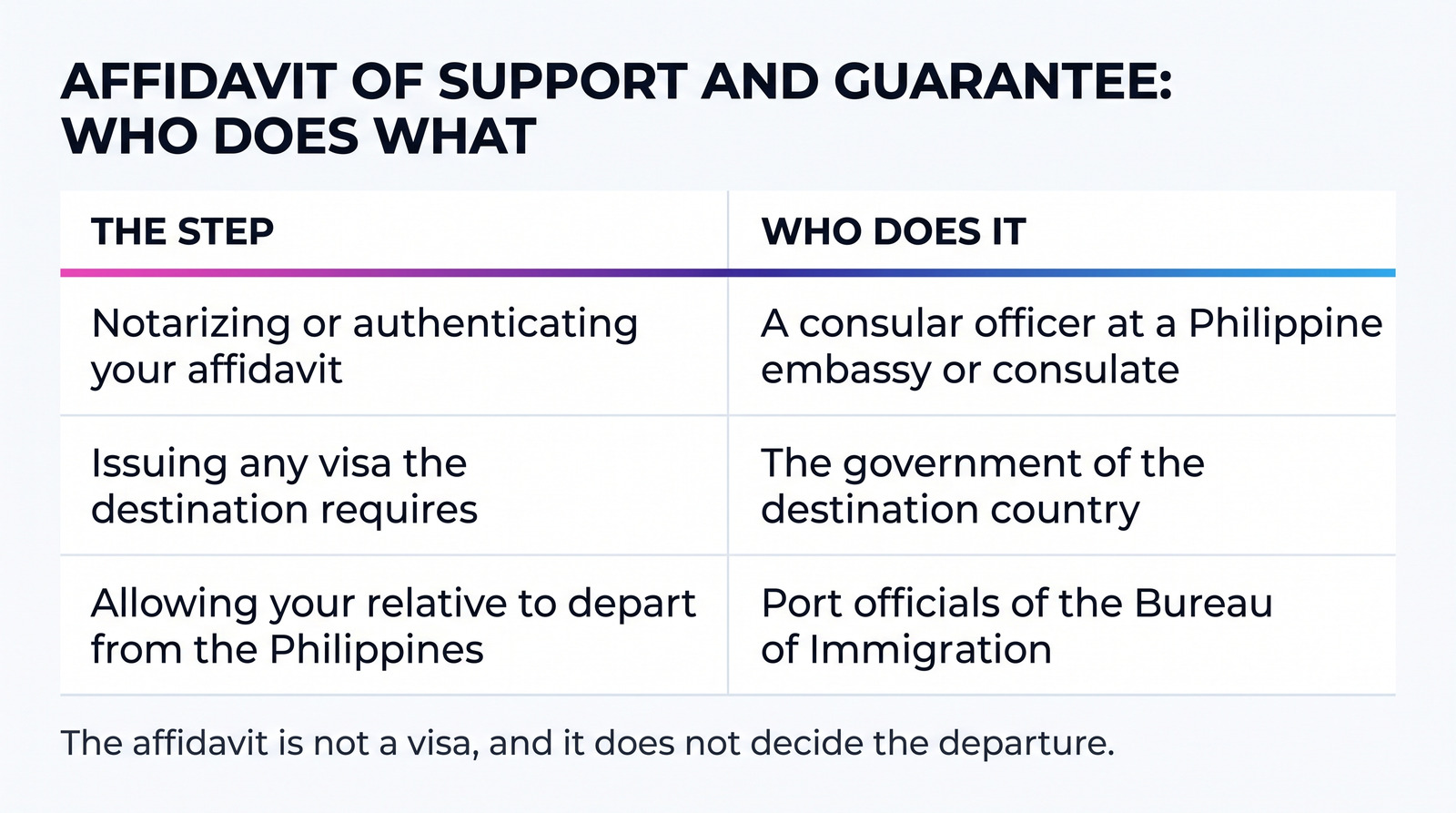
An Affidavit of Support and Guarantee (AOSG) is a sworn statement that you, living abroad, have notarized or authenticated by a consular officer at your post, promising to support someone who comes to visit. Singapore's 2026 form has you swear to cover their accommodation and living costs, that they "will not … work or seek employment in Singapore", and that they will return "on or before the expiration of the period of their authorized stay." It also has you make sure they have travel insurance, or cover their medical costs yourself.
It is not a visa. Your relative still needs any visa the foreign country requires, from its own government; the departure checklist of the Bureau of Immigration (BI) lists the visa separately, from the "concerned visa issuing authority".
And it does not decide the departure. Berlin's post says: "Allowing a Filipino tourist to depart from the Philippines is under the authority of port officials of the Bureau of Immigration" — not of the post. The post's job is the paper; the decision is the officer's.
Who needs one: what the departure rules actually say
No departure rule asks every traveller for an AOSG. BI's Citizen's Charter 2026 lists what the counters at NAIA Terminals 1 and 3 check: a valid passport, proof of eTravel registration and a boarding pass, plus "Additional Requirements (if applicable)" such as a visa. The AOSG is not on that list.
It belongs to secondary inspection, the closer look an officer can order, under a rule the Charter still names: Department of Justice Memorandum Circular No. 036 of 15 June 2015, the IACAT Revised Guidelines on Departure Formalities. That circular says: "If the passenger is travelling through a sponsor, the following additional documents shall be required." First on its list is a sworn statement authenticated by a Philippine post, showing your relationship within the fourth civil degree, your financial capacity with your legal status abroad, and your contact details.
The circular calls it an Affidavit of Support and Undertaking; Singapore calls it an invitation letter. A relative whose trip you are paying for may be asked for it; under the circular, that happens when they are referred for that closer look. The officer is testing whether the trip is what it says it is, and no paper replaces a truthful answer.
The Charter's Iloilo airport entry, though, puts the AOSG at the counter when you are a relative within the fourth civil degree, with PSA records; when you are your visitor's parent or child, it lists a PSA birth certificate or report of birth and copies of your passport, permit and, if you are a worker, your Overseas Employment Certificate instead. Pack both sets. Departing overseas Filipino workers have their own checklist, in our guide to departure requirements for workers.
Who can sponsor a visit
A relative within the fourth civil degree, by blood or by marriage, can sponsor a visit under the circular. Its own examples: a first cousin (pinsang buo), and in-laws such as a bayaw, hipag or biyenan. It also names a second route, a sworn statement by "a person or legal/juridical entity" showing contact details, financial capacity with legal status and, for an entity, registration papers. Singapore's page says foreign nationals may apply to invite Filipino friends, and warns that the visitor may still be asked for more.
Singapore lists proof of your legal status or DMW registration, and of your finances, among the papers the airport officer may ask your relative for, and asks a household service worker to attach their employer's letter consenting to the visit and promising accommodation. That is Singapore's rule; check whether your post has its own.
If the person paying is in the Philippines and flying with your relative, the circular asks instead for a duly notarized statement of their financial capacity, their reason, an undertaking that the trip is solely for tourism and the passenger will return, and contact details.
What to bring to the post
What the post needs and what the airport may ask your relative for are two lists; at Singapore, Berlin and Melbourne, the post's list begins with:
- The form, filled in. Singapore and Melbourne want it unsigned, because you sign in front of the consular officer. Use your post's own form from its downloadable forms page.
- Your passport or ID, with photocopies; Singapore asks for both your passport and your IC.
Berlin adds your relative's passport copy, proof of relationship and proof of finances, such as a payslip and a bank statement or certificate. Singapore lists relationship, status and money papers among those the airport may ask for, to attach if you wish; Melbourne's page names none. Have them ready anyway.
For the relationship, Singapore names PSA birth certificates tracing the line between you, and a PSA marriage certificate for an in-law. Our guide to PSA documents explains these civil registry records. The further the relationship, the longer the trail: a first cousin is linked through the birth certificates of two parents who are siblings, as well as your own and theirs. A marriage that happened abroad is recorded in the civil registry through a Report of Marriage, filed at a post.
The AOSG is borrowed credibility, worth exactly what your own papers are worth: the circular asks it to show your financial capacity with your legal status abroad, and a promise signed over expired permits cannot. So the real preparation starts months before the appointment, and it is the readiness that keeps your own career abroad secure: current status, clean records, a job that is on paper what it is in life.
How posts differ: signing, fees and waiting times
Fees and waiting times differ by post, and your own post's page, read the week you book, is the only price that counts.
- Singapore (page updated 23 July 2026): the post authenticates it; you sign before a consular officer, by appointment. SGD 37.50 per document copy; 2 business days.
- Berlin (undated page, read 23 September 2026): the post authenticates it, in person by appointment or by mail after German pre-authentication. €25 per document, plus €11 for express; 5 working days, or 2 for express, in person only.
- Melbourne (updated 6 May 2025): the consulate general notarizes it, "executed and signed in the presence of a Consular Official", by appointment. A$45 per document; mailed at least 3 business days after complete papers.
Melbourne adds that it "assumes no liability of the contents." Note Berlin's warning: do not pay until its authentication officer tells you to.
You may have seen a minimum income for sponsors quoted online. We could not read the Gulf and Hong Kong posts' pages on 23 September 2026, so we print no figure; if your post publishes one, its page is the rule, not a number from a forum.
How to get one, step by step
You get an AOSG from the post that covers where you live; at the three posts we read, the usual route is an appointment in person.
- Confirm the trip is a visit, and that your relative can get any visa the destination needs.
- Open your post's official AOSG or notarial page, download its form and note the photocopies it asks for.
- Book the appointment; Singapore asks you to select "Affidavit".
- Sign in front of the consular officer and pay the fee.
- Send the original home. Your relative carries it with the passport, visa, return ticket and eTravel proof: ready to show if asked, never offered as a pass.
When the "visit" is really a job
An AOSG that says tourism when the plan is work is a false sworn statement, and it is the pattern illegal recruitment and trafficking rely on. That is why the rule exists: the circular was issued under the anti-trafficking and migrant workers' laws.
In July 2026, warning Filipino travellers who hide the real purpose of a trip, BI Commissioner Joel Anthony Viado said that "truthful declarations at our ports are not mere formalities. When travelers conceal the real purpose of their trip, they bypass safeguards that are meant to protect them from illegal recruitment, human trafficking, and exploitation."
If your relative's real hope is to work abroad, that hope deserves the real route: a job offer verified with the Department of Migrant Workers, as BI urges, through an agency you have checked is licensed. Start with how to verify a licensed recruitment agency. A lawful first job abroad is the first rung of a career you can build on. A job smuggled in on a tourist's paper has no ladder above it.
Before you book the appointment
- The visit is a visit, with dates and a return ticket.
- Your relative's passport is valid and any destination visa is sorted.
- You have read your post's AOSG page this week and noted its form and fee.
- The PSA birth and marriage records that show the relationship are in hand.
- In-laws through a marriage abroad: if PSA records will prove it, its Report of Marriage is filed.
- Your residence status, payslips and bank statement are current.
- Your relative keeps a copy with their travel papers.
If your visitors include children, read our guide to the DSWD travel clearance for a minor before you book: it is a different document from a different agency.
The Questions Filipinos Ask Us Most
Where do I get an Affidavit of Support? Can my relative get it in the Philippines? You, the relative abroad, get it from the post that covers where you live. The circular's in-country version is different: a notarized statement from a local sponsor who travels with the passenger.
What are the requirements for the affidavit of support form? Under the circular, it shows your relationship within the fourth civil degree, your financial capacity with your legal status abroad, and your contact details. Each post adds its own list; Berlin's includes proof of relationship and a payslip or bank statement.
Does an AOSG mean my relative will be allowed to leave? No. Singapore's post answers that officers weigh several factors, and that the letter is "only one of several possible requirements and may not always be requested." The decision to allow departure is BI's, not the post's.
How much does it cost? As published when we checked on 23 September 2026: SGD 37.50 per document copy in Singapore, €25 per document in Berlin, and A$45 per document in Melbourne. Check your post's page the week you book.
Sources
DOJ Memorandum Circular No. 036, 15 June 2015 (IACAT departure guidelines), hosted by BI: https://www.immigration.gov.ph/wp-content/uploads/2023/11/18_2015Jun15_IACAT_RevisedGuidelines.pdf
BI Citizen's Charter 2026, 1st Edition (departure entries, NAIA and Iloilo): https://immigration.gov.ph/wp-content/uploads/2026/08/BI-CC2026-1stEdition.pdf
The term "Foreign Service Post", BI frequently asked questions: https://immigration.gov.ph/faqs/
BI warning on truthful declarations, 19 July 2026: https://immigration.gov.ph/bi-warns-against-online-recruitment-as-pinay-who-claimed-will-only-visit-mother-ends-up-in-victimized-in-scam-hub/
Invitation letter (AOSG) requirements and FAQs — Philippine Embassy in Singapore: https://www.philippine-embassy.org.sg/invitation-letter/
Notarial services and fee — same post: https://www.philippine-embassy.org.sg/consular/notarial-services/
AOSG form, 2026 revision — same post: https://www.philippine-embassy.org.sg/wp-content/uploads/2026-AOSG-Revised.pdf
AOSG requirements, fees and procedure — Philippine Embassy in Berlin: https://philippine-embassy.de/affidavit-of-support-and-guarantee/
Consular notarization and fees — Philippine Consulate General in Melbourne: https://melbournepcg.org/?page_id=1058