
Somebody has told you that you need a National ID. A cousin back home, a post on your feed. And you are in Riyadh, or on a ship, or mid-shift in Singapore.
Here is what exists today, read off the official pages on 16 September 2026.
The Short Answer for an OFW: Where Registration Happens
If you are an OFW, you apply for the National ID when the Philippine Statistics Authority brings registration to where you are — an Embassy, a Consular Office, a Migrant Workers Office — or at a registration center in the Philippines, on a trip home. It is not a counter standing open at every post.
The agency runs a page called the National ID Overseas Pre-Registration Survey. It exists so you can be notified when the authority "is at your local Embassy or Consular Office for National ID overseas registration services." It asks for a full name, a country, a consular office. Signing up is a notification, not a registration.
When we opened it on 16 September 2026 the page read "Submissions are currently disabled. Please try again later," under the line "Date last updated: 21 January 2025." One day's reading, not a permanent state.
Who Runs It, and What You Get
The National ID system is the government's central identification system for Filipino citizens and resident aliens in the Philippines, created by Republic Act No. 11055, the Philippine Identification System Act, signed on 6 August 2018. Its implementing body is the same civil-registry agency behind the PSA documents Filipinos order for work abroad.
The ID comes in three formats — the physical card, the ePhilID or paper format, and the digital version — and all three carry the same functionality and validity. Registration is open to every Filipino of any age — a public advisory dated 20 February 2025 opened it to children below one year old, registering with an already-registered parent or guardian — full biometrics from age 5, once only: double registration is strictly prohibited.
Can You Register Online?
No. Registration captures biometrics in person: fingerprints, an iris scan and a front-facing photograph.
The digital version is for people already registered: all registered persons can reach it through the eGovPH app. The published rule says who is eligible and how; it says nothing about where in the world you are standing.
What a Registration Day Has Looked Like
In a release dated 29 February 2024 the agency said it was registering Filipinos in Malaysia with the Philippine Embassy and the Migrant Workers Office in Kuala Lumpur — 23 February to 21 March 2024, Mondays to Thursdays, 9:00AM to 4:00PM. The authority's 27 March 2024 release adds Sandakan, Sabah. That activity is finished, not an offer today.
Demographic data encoded against your supporting document, biometrics captured, then a transaction slip with a reference number. Four weeks, four days a week, two cities, staffed by people who flew in. The registration process at a post is a dated event, not a standing service.
On its frequently asked questions page, updated 13 February 2026, the authority says it is still "developing strategies" with the Department of Foreign Affairs and the Department of Migrant Workers for registering OFWs. For returning or departing workers, a registration center now sits in select Migrant Workers offices. That answer is written for a worker in transit, not for one already settled where they live.
What to Have Ready Before Registration Reaches Your Post
The documents are the part you can settle today:
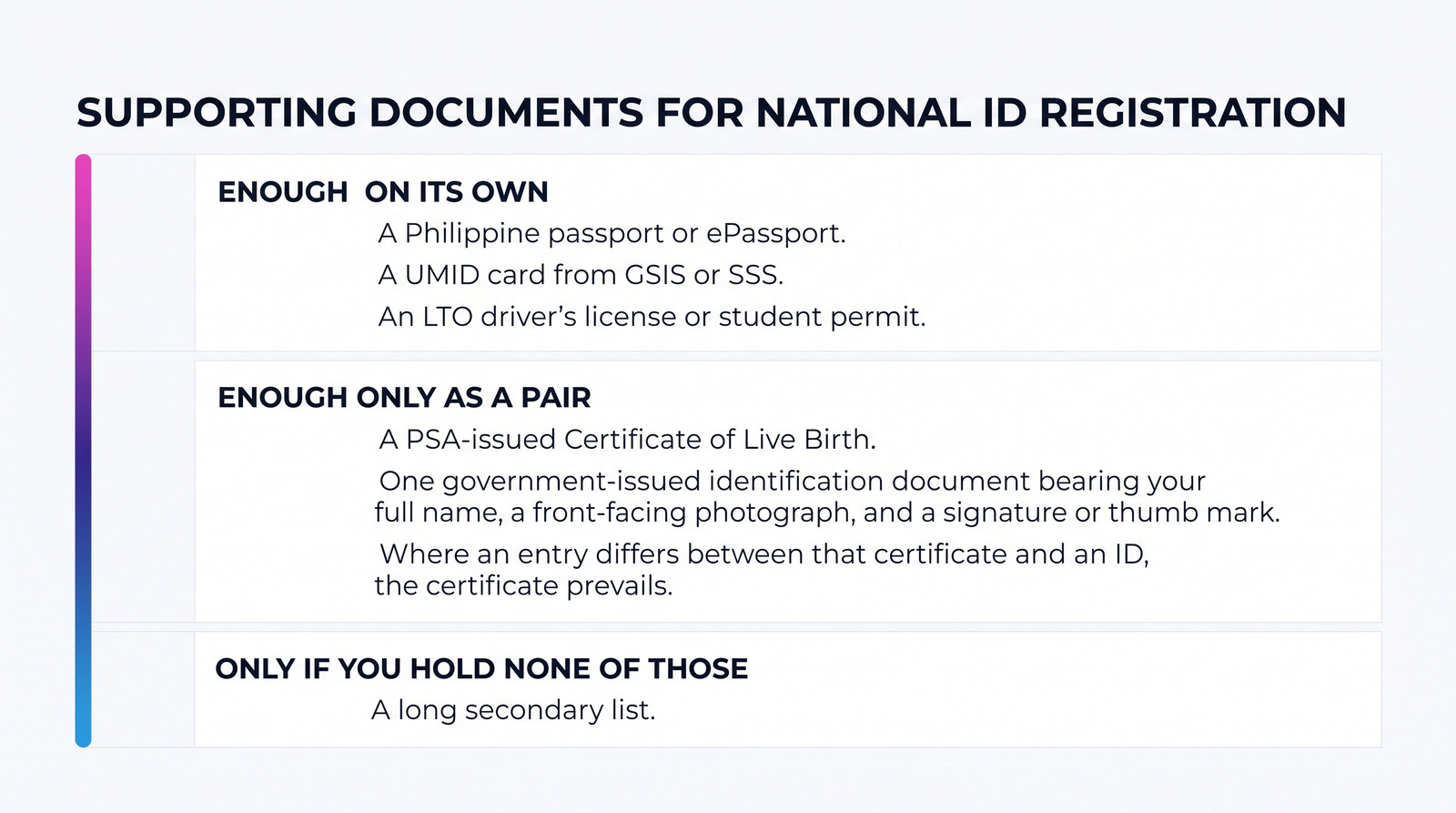
- A Philippine passport or ePassport — a primary supporting document on its own, and the one you likely hold.
- A PSA-issued Certificate of Live Birth, plus one government-issued identification document bearing your full name, a front-facing photograph, and a signature or thumb mark.
- A UMID card from GSIS or SSS, or an LTO driver's license or student permit.
- Only if you hold none of those: a long secondary list, which includes the Seaman's Book, the OWWA ID, PRC, SSS, PhilHealth and postal IDs, a PSA Report of Birth, and a national or residence ID from another country.
- Where an entry differs between that certificate and an ID, the certificate prevails.
The papers that make you registrable are the ones that make you movable — a passport that has not quietly lapsed, a birth record whose spelling matches it. If yours is near expiry, that is this month's job: renewing a Philippine passport.
What the ID Does Not Do
Holding the ID does not entitle you to cash, rice subsidies or free electricity. In a public advisory dated 7 May 2026 the agency warned about videos on social media claiming it does. The claims are untrue, it said, came from no legitimate government agency, and may be AI-generated. Benefits stay subject to the policies and qualifications of whichever body runs the programme.
Only the authority may print and issue this ID, and printing the digital version onto a plastic card is strictly prohibited and will not be accepted as proof of identity. The official channels are short: the PhilSys site, its survey page, its Facebook page, hotline 1388. And the pages we read on 16 September 2026 name no registration fee — so treat anyone quoting you a price as somebody to check first.
The Record Follows You
A release dated 10 December 2025 records the ID's authentication service integrated into the systems of the Commission on Filipinos Overseas, letting Filipino immigrant-visa holders take pre-departure services online, including the Pre-Departure Orientation Seminar. That authenticates an identity you already hold. It does not issue one.
An identity record is infrastructure you build before you need it, not paperwork you chase on the afternoon somebody asks for it.
A Short Checklist
- Sign up on the survey page, and check back when submissions reopen.
- Check your passport's validity now, not in the week you need it.
- Order your birth certificate while you can afford to wait for it.
- Use the official channels, never a page that merely looks like them.
The Questions Filipinos Ask Us Most
Is it okay to get a National ID anywhere in the Philippines? Yes. The published registration centers sit at regional and provincial offices, in malls and at local government units, with mobile registration for far-flung areas — all inside the Philippines, which is why many register on a visit home.
I registered years ago and never received my ID. What now? Keep the transaction slip. A reference number is issued for tracking, and a registered person still receives the physical card after obtaining the paper format. For Filipino citizens the ID has no expiration. What is not published is delivery to an address outside the Philippines, and we will not invent one.
Can somebody register on my behalf? No. Registration captures your fingerprints, your iris scan and your face.
Sources
Overseas pre-registration survey - PSA: https://overseas.philsys.gov.ph/
National ID frequently asked questions - PSA: https://philsys.gov.ph/faq-frequently-asked-questions/
Children below one year old - PSA: https://philsys.gov.ph/public-advisory-26/
Registration in Malaysia, 2024 - PSA: https://philsys.gov.ph/psa-brings-national-id-registration-to-malaysia-invites-filipinos-to-register/
Sandakan, 2024 - PSA: https://philsys.gov.ph/philsys-registration-reaches-85-million/
Benefit claims, 7 May 2026 - PSA: https://philsys.gov.ph/public-advisory-40/
Integration with the CFO - PSA: https://philsys.gov.ph/national-id-integration-with-cfo-streamlines-online-services-for-filipinos-overseas/