

A friend posts a photo from a campus abroad: a master's degree, fully funded. You have a degree, a few years in your job, and one quiet question: is this for someone like me?
The short answer: the Philippines is on the Manaaki New Zealand Scholarship's eligible list, for postgraduate study only, and the award asks for at least two years back home when you finish. We read the programme's own pages and conditions on 23 September 2026.
Is there a Manaaki New Zealand Scholarship for Filipino students?
Yes: the Philippines is one of nine "Eligible Asian Countries", and the programme's subject page says: "You may only study at postgraduate level in New Zealand." That means a postgraduate certificate (6 months), a postgraduate diploma (1 year), a master's (1 to 2 years) or a PhD (3.5 years). It is a full tertiary award, for full-time study. In Asia, undergraduate awards go to Timor-Leste only. The programme aims for scholars to start from Semester 1 of the year after they apply.
Education New Zealand operates the programme, MFAT (New Zealand's foreign ministry) sets its direction, including intake profiles agreed with partner governments, diplomatic posts help shortlist, and institutions decide admission, as MFAT explained on 14 October 2025.
When we checked on 23 September 2026, the programme's pages said tertiary applications "have now closed", and warned that the system "may close early to countries with a large volume of applications". Facebook posts repeat dates; trust the programme's how-to-apply page and ask through its enquiry form.
Short Term Training: open to the Philippines, but by nomination
Filipino professionals reach Thematic Short Term Training through a closed process run by the New Zealand Embassy, not an open call. The award lists the Philippines: courses of two to four weeks, in New Zealand or online, for mid- and senior-level professionals with their employer's endorsement. The embassy may ask government and local organisations for nominations. The vocational version is for a list of mostly Pacific countries, such as Samoa, Tonga, Tuvalu, Kiribati and Vanuatu. The Philippines is not on it.
The eligibility criteria a Filipino applicant must meet
You must meet every eligibility criterion to apply, and the application opens with the key questions: which country you are a citizen of, how long you have lived there, your work experience, whether you are serving in the military, and whether you have had a Manaaki award before.
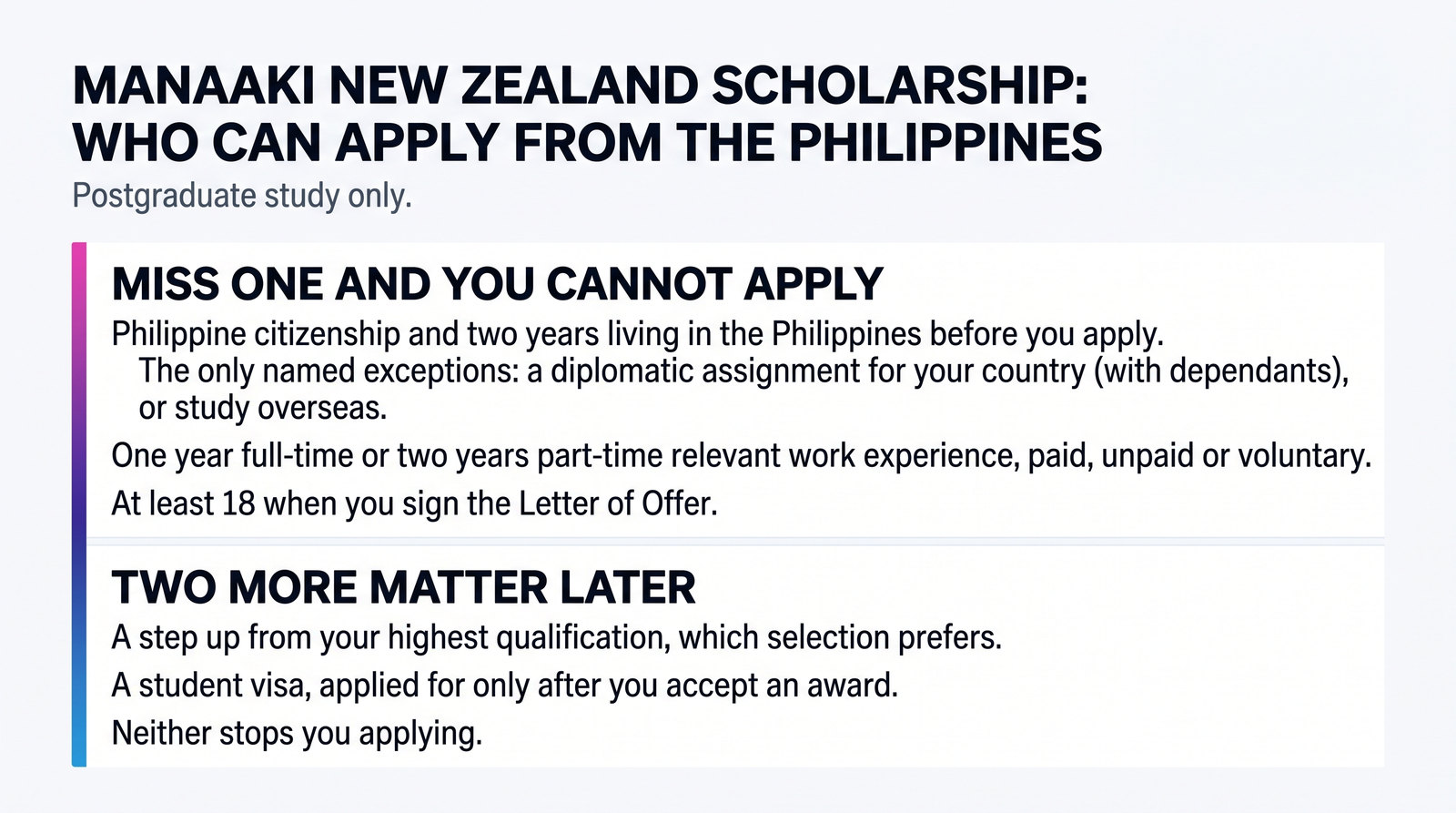
- Citizenship and residence. You must be a Philippine citizen who has "resided in their home country for two years prior to applying". The only exceptions named are a diplomatic assignment for your country (with dependants) and enrollment in a course of study overseas. If you are working abroad now, note that overseas employment is not on that list.
- Work experience. One year full-time (30 hours or more a week) or two years part-time, paid, unpaid or voluntary, and relevant to your course. The programme prefers applicants who will "continue working in their current job sector" afterwards.
- Age. You must be 18 when you sign the Letter of Offer. There is "no upper age limit", though the programme prefers applicants under 40.
Miss one and you cannot apply; the criteria page points to the Study with New Zealand website for "other full scholarships available to international students".
Two more matter later, and neither stops you applying:
- An academic step up. Selection prefers a qualification that progresses on from your highest one; applying for a second master's is listed among the common reasons for decline. Upload your transcript with its grading scale. PhD applicants should contact supervisors early. The approved institutions are eight universities, among them the University of Auckland and Victoria University of Wellington, plus Southern Institute of Technology and Unitec Institute of Technology.
- A student visa. You apply only after accepting an award, but "Only those who qualify for a student visa can take up" one.
Read as a whole, these rules describe a career already under way at home, one the award is meant to take further. The strongest application is built long before the form opens: in the job you do now, and the problem you can name in your own field.
The study subjects recommended for the Philippines
The programme recommends five sectors for Filipinos this cycle: Climate Resilience, Science, and the Environment; Economic Resilience and Private Sector; Food Safety and Agriculture; Governance; and Infrastructure. Education, ICT and law appear on other Asian countries' lists, but not on the Philippines'.
Applications that do not strongly align with these subjects "are highly unlikely to be considered." You choose up to three qualifications and explain how each relates to a sector and why your country needs those skills. Write it as a career plan, not a wish.
The English language requirement, and who pays for the test
You need no English test score to apply; only shortlisted candidates must provide a score. Each university sets its level. The programme accepts four tests: IELTS, TOEFL, PTE Academic and Cambridge Academic English (advanced). Its general postgraduate guide is IELTS 6.5 overall with no band below 6.0, or the equivalent in the others, and it calls that "a guide only". Our IELTS guide explains the test.
The programme pays for the IELTS test only for shortlisted applicants from a listed group of countries, most of them in the Pacific, and the Philippines is not among them. You pay, and the institution reimburses you on arrival only if you are selected. A preferred candidate slightly under the level may get up to one semester of English language training in New Zealand, though not for a PhD. If you still do not meet the English language requirement after it, "your scholarship will cease."
How competitive is the Manaaki New Zealand Scholarship?
The programme receives over 15,000 applications a year across all countries, and calls the process very competitive. MFAT's allocation table of 14 October 2025 sets aside 44 places for Philippine citizens in each of the latest selection rounds, for study starting in 2026 and in 2027. No acceptance rate is published for Filipinos.
Selection runs in stages: screening against the rules and the recommended subjects, an online reasoning and personality test within 10 days, and an online interview, typically between May and July. The interview runs about 40 minutes: six questions, two of them hypothetical scenarios you cannot prepare for, and one on resilience (the programme suggests the C-A-R method: context, action, result). You then hear whether you are a preferred candidate, a candidate on the reserve list, or unsuccessful. It "can take six to ten months" from the close. If unsuccessful, you may apply again next year.

Nothing in the process the programme and MFAT describe asks you to pay anyone to "secure" an application. Treat any such fee as what it is: not part of the programme.
From preferred candidate to scholar
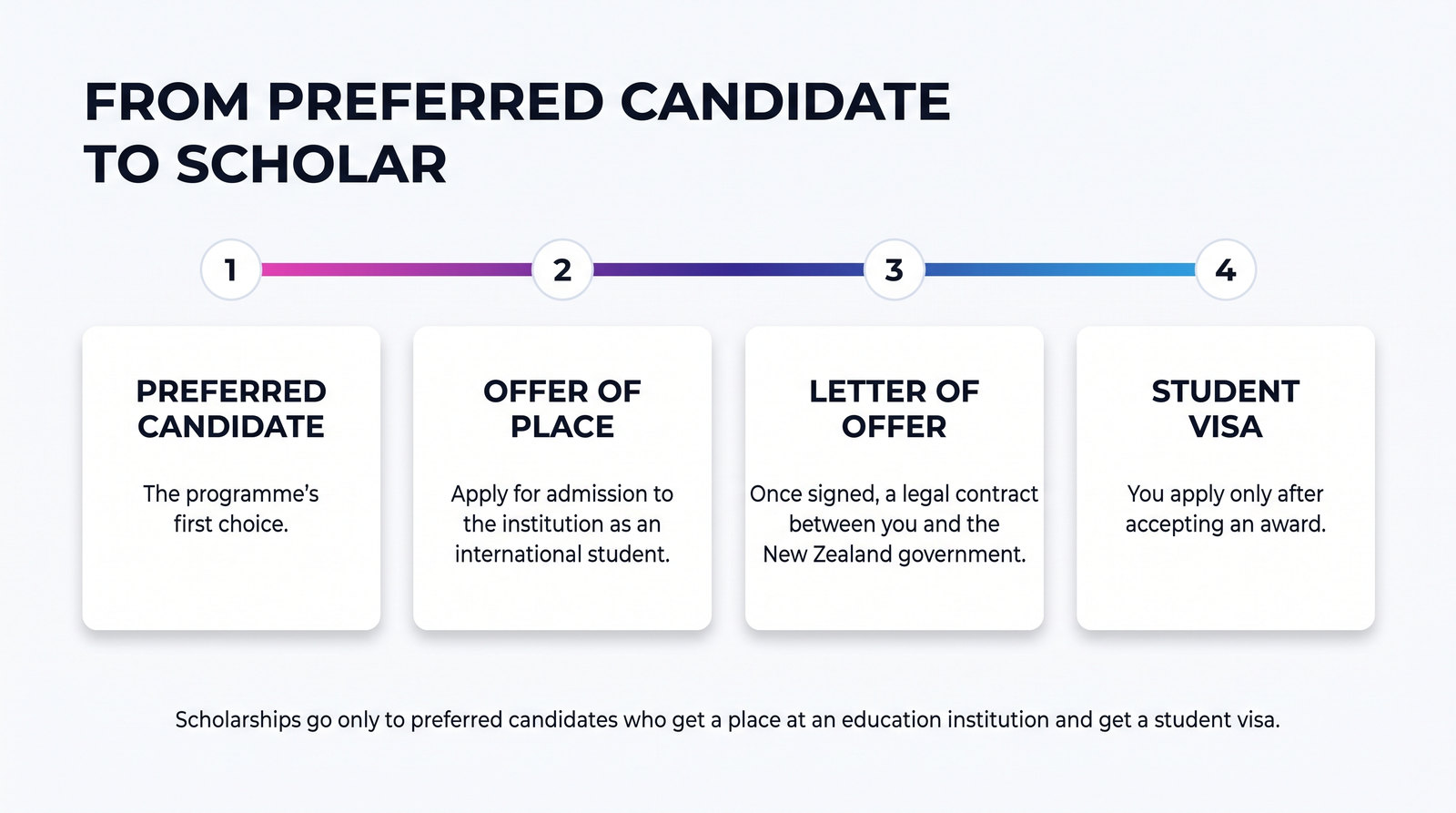
A preferred candidate is the programme's first choice, but "we only give scholarships to preferred candidates who get a place at an education institution and get a student visa." You apply for admission to the institution as an international student, which can take three months for postgraduate study, receive an Offer of Place, then a Letter of Offer to accept within 14 days, which once signed is "a legal contract between you and the New Zealand government." Victoria University of Wellington's own page puts its step as: the award first, then the university once shortlisted. Start authenticating your transcripts and diploma early.
Can you study in New Zealand for free as a Filipino?
The award pays most of a scholar's own costs, but nothing for a scholar's family. It covers full tuition with compulsory enrolment, orientation and student union fees, travel there and home, airport reception and accommodation on arrival, an establishment allowance, a weekly living allowance, medical and travel insurance, tutoring if you need it, a reintegration allowance when you return, and a research and thesis allowance for research degrees.
The scholar handbook says Education New Zealand "will not provide any funding assistance to bring your dependants". You organise your own accommodation where you study, and some visa costs are not reimbursed.
What Manaaki asks in return
Under the Scholarship Conditions for Study in New Zealand, you must depart for home within 14 days of completing your study programme and "remain there for a minimum period of two years", to contribute to your country's "social and/or economic development". In that period you may not apply for a visa to re-enter or remain there, except a short-term visitor visa, or for a work permit or residency in any country. The return and the New Zealand visa bar also apply to your spouse or partner and dependent children, unless they have "entry rights entirely separate to your scholarship".
If you or your family break those terms, "the total cost of my scholarship" becomes "a debt payable to the New Zealand Government", "enforceable under New Zealand law". You can discharge it by returning home for two years or repaying in full. You also follow the Manaaki Scholar Code of Conduct.
The criteria page calls the years at home "a condition of the scholarship", and says the award exists so scholars can "positively impact their communities and country's development".
Before the next round opens: your checklist
- Check the eligible-countries page: Philippines listed, postgraduate only.
- Count your work experience: one year full-time or two years part-time.
- Confirm two years living in the Philippines before applying.
- Match up to three courses to a Philippine sector, each a step up.
- Get your transcript with its grading scale.
- Check each course's English requirement; budget for the test.
- Planning a PhD? Write to supervisors now.
- Read the award's conditions before you apply.
The Questions Filipinos Ask Us Most
Can I apply for an undergraduate degree?
The programme offers Filipinos postgraduate awards only, from a postgraduate certificate to a PhD; in Asia, undergraduate awards are for Timor-Leste only.
Do I need an IELTS score to apply?
You do not need an IELTS score to apply. Shortlisted candidates provide one; Filipinos pay for their own test, reimbursed on arrival only if selected.
I work abroad now. Can I still apply?
The rule is two years living in the Philippines before you apply; the only exceptions named are a diplomatic assignment for the Philippines and enrollment in a course of study overseas, not overseas employment.
Can I bring my family?
You can bring your family only with your own money: the award does not fund dependants. The two-year return and New Zealand visa rules apply to them too, unless they have entry rights of their own.
Sources
Eligibility criteria, Manaaki New Zealand Scholarships (Education New Zealand): https://www.nzscholarships.govt.nz/check-eligibility-criteria/
Eligible countries, same site: https://www.nzscholarships.govt.nz/check-eligible-countries/
Philippine subjects, same site: https://www.nzscholarships.govt.nz/research-study-subjects-for-asian-students/
Subject alignment, same site: https://www.nzscholarships.govt.nz/study-subjects/
How to apply, same site: https://www.nzscholarships.govt.nz/how-to-apply-for-a-scholarship/
Selection, same site: https://www.nzscholarships.govt.nz/6-how-we-select-scholars/
Preferred candidates, same site: https://www.nzscholarships.govt.nz/7-preferred-candidates-what-next/
Get ready to start your scholarship, same site: https://www.nzscholarships.govt.nz/scholars-get-ready-to-start-your-scholarship/
Approved universities and institutes, same site: https://www.nzscholarships.govt.nz/research-available-courses/
Thematic Short Term Training, same site: https://www.nzscholarships.govt.nz/thematic-short-term-training-scholarships/
Vocational Short Term Training, same site: https://www.nzscholarships.govt.nz/vocational-short-term-scholarships/
Scholarship Conditions for Study in New Zealand: https://assets.ctfassets.net/9d9xnserxur1/9znn507FkYTTOpXK08lTe/03eca817f8dae8638e1cfcb1b3c850f3/Scholarship_Conditions_for_Study_in_New_Zealand.pdf
Policy Guidance for Scholars, November 2025 (dependants): https://assets.ctfassets.net/9d9xnserxur1/45NsnHZHYCMG9PvZWMdSNr/a3f73f4bc93860ef8dd8b6e7b62b2eb6/Manaaki_New_Zealand_Scholarships_Policy_Guidance_for_Scholars.pdf
Roles and allocation by country, Ministry of Foreign Affairs and Trade (OIA 30409, 14 October 2025): https://www.mfat.govt.nz/assets/OIA/OIA-2025/OIA-30409-Manaaki-New-Zealand-Scholarships-14-October-2025.pdf
Its own application step, Victoria University of Wellington: https://www.wgtn.ac.nz/international/scholarships-fees/manaaki-new-zealand-scholarships-programme/apply