

Maybe the passport counter caught it. Maybe you read your child's Report of Birth closely and found the month of birth wrong, or your own name missing a letter. It took someone a second to type, and it will take you far longer to undo. It is a slip, and it says nothing about you.
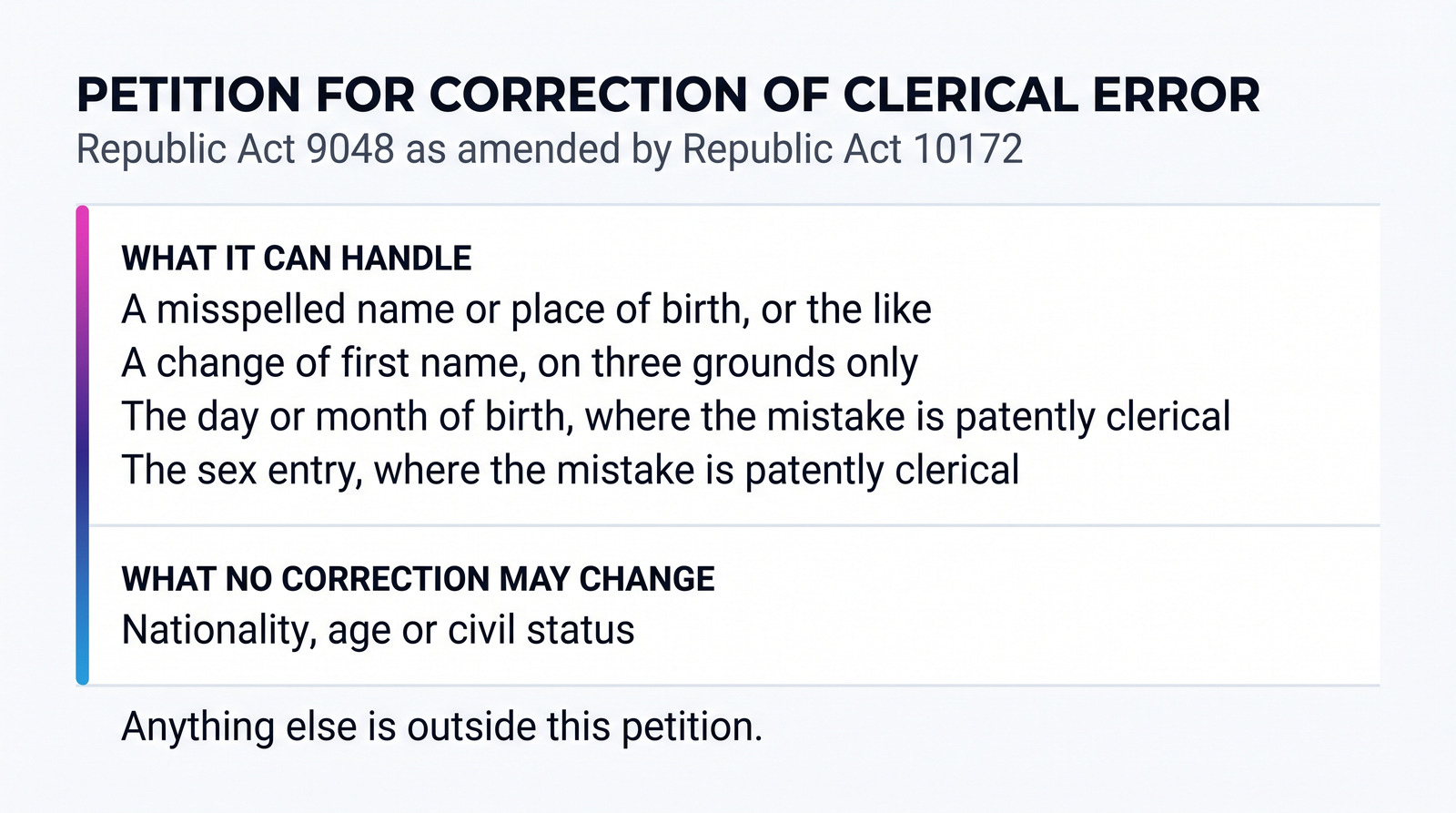
The short answer: Filipinos abroad can file a petition at a Philippine embassy or consulate to correct a clerical or typographical error in a civil record without a court, under Republic Act 9048 as amended by Republic Act 10172. The same law also covers a change of first name on its grounds, and the day or month of birth or the sex entry where the mistake is patently clerical. Anything else is outside this petition. We read both laws, RA 9048's 2001 implementing rules and five posts' own pages (Canberra, Washington DC, New York, Toronto, Tokyo) on 23 September 2026. Whether it is an embassy or a consulate, we call it "the post".
What counts as a clerical or typographical error
RA 10172 defines it as "a mistake committed in the performance of clerical work in writing, copying, transcribing or typing an entry in the civil register that is harmless and innocuous, such as misspelled name or misspelled place of birth … which is visible to the eyes or obvious to the understanding." The test comes last: the error "can be corrected or changed only by reference to other existing record or records." Your other documents have to show what the entry should have said.
The petition at a post can handle four kinds of change:
- A misspelling: a misspelled name or place of birth, "or the like".
- A change of first name: on three grounds only. The name is ridiculous, tainted with dishonor or extremely difficult to write or pronounce; a new one has been used habitually and continuously, and you are publicly known by it in your community; or the change avoids confusion.
- The day or month of birth: where the mistake in the entry is patently clerical.
- The sex entry: where the mistake is patently clerical and, in the words of the Canberra, Washington DC and New York pages, the correction "is not a result of a sex-reassignment".
RA 9048 says these petitions "may be availed of only once", and Toronto's page adds that a second correction of the same entry "should be resolved through judicial means."
Where the law stops, and a judicial order begins
Under RA 9048, anything not on the administrative list needs a judicial order. RA 9048's first section, as amended, says so: "No entry in a civil register shall be changed or corrected without a judicial order, except for" the corrections listed above.
The definition draws the outer line: "Provided, however, That no correction must involve the change of nationality, age, or status of the petitioner." The law names the day and the month of birth; the year is not on the list. Even a granted petition can be stopped. The Civil Registrar General, who under RA 10625 is the head of the Philippine Statistics Authority, may object on three grounds: the error is not clerical or typographical; the correction is "substantial or controversial as it affects the civil status of a person"; or a first-name change does not meet the law's grounds.
The court route for correcting an entry is Rule 108 of the Rules of Court: a verified petition in court, the civil registrar and everyone with an interest made parties, and the court's order published once a week for three consecutive weeks. That is a lawyer's ground, and this guide offers no opinion on anyone's case.
Which Philippine embassy or consulate takes your petition
RA 9048 lets a Filipino living abroad file at the nearest Philippine consulate, and each post then says which records it accepts. In the law's words, citizens "presently residing or domiciled in foreign countries may file their petition, in person, with the nearest Philippine Consulates," and the 2001 implementing rules extend that to a record "registered in the Philippines, or in any Philippine Consulate." When the record sits somewhere other than where you live, it is a migrant petition.
The posts are narrower. As their pages read on 23 September 2026:
- Washington DC: only records "registered or reported at the Philippine Embassy in Washington D.C."; other US records go to the post that recorded them.
- New York: the same rule, for its own records.
- Tokyo: its own records, filed there in person on its own application form; migrants are pointed to the nearest Local Civil Registry Office.
- Canberra: accepts migrant petitions; New South Wales and Victoria go to the consulates in Sydney and Melbourne.
- Toronto: accepts migrant petitions, but not for sex, and advises filing directly with the local civil registry office in the Philippines, yourself if you are going home or through a representative holding a Special Power of Attorney, given "the considerable time required for the transmittal".
If the record is a civil registry document the post itself registered, such as your child's Report of Birth or a Report of Marriage, that post is your door. If it was registered at home, read your post's page.
Who may file the petition
"The petition may be filed by a person of legal age who must have a direct and personal interest in the correction," in the words of the Canberra, Washington DC and New York pages; legal age is eighteen and above, as Canberra, New York and Tokyo state it. First comes the "Owner of the record that contains the error to be corrected"; the 2001 implementing rules add "the owner's spouse, children, parents, brothers, sisters, grandparents, guardian, or any other person duly authorized by law or by the owner of the document sought to be corrected." Family may file for a minor, and Toronto words its rule more narrowly, so read your post's page.
What you send: the requirements for a petition for correction
Every petition is "in the form of an affidavit, subscribed and sworn to before any person authorized by law to administer oaths," stating "the particular erroneous entry or entries" and the correction sought. With it go a certified true machine copy of the certificate or registry page carrying the error, "at least two (2) public or private documents showing the correct entry or entries," and any other document the consul general considers necessary, in three copies: one for the post, one for the Office of the Civil Registrar General, one for you.
Some petitions need more:
- For a change of first name: clearances showing no pending case or criminal record, from your employer if employed, the National Bureau of Investigation (NBI) and the Philippine National Police, plus publication once a week for two consecutive weeks in a newspaper of general circulation, proven by the publisher's affidavit and a clipping.
- For the day or month of birth, or the sex entry: the earliest school record, medical records and a baptismal certificate, as Canberra and New York list them, plus the same clearances and publication.
- For the sex entry: also "a certification issued by an accredited government physician attesting to the fact that the petitioner has not undergone sex change or sex transplant," in RA 10172's words.
How you hand it in depends on the post. Washington DC takes it by mail only, sent to its Civil Registration Unit, including three original notarized affidavits, an original and three certified copies of the Philippine Statistics Authority (PSA) certificate, and a money order. New York starts by email; Tokyo wants it in person, by appointment; Canberra books an appointment with an interview. Canberra and New York publish the prescribed forms (RA 9048 Form No. 1.2 for birth, 2.2 for marriage, 3.2 for death). The two documents showing the correct entry carry your case, so gather the oldest, most official ones you have.
How much the petition costs at each post
There is no single fee. The law allows "reasonable fees" and exempts an indigent petitioner. The 2001 implementing rules, which predate the day, month and sex corrections, set US$50 for a clerical correction and US$150 for a change of first name filed with a consul general, "or its equivalent value in local currency", but the posts do not all quote those figures. As read on 23 September 2026, for a clerical correction unless another type is named:
- Washington DC: US$50, including sex and the day or month of birth, and US$150 for a first name.
- New York: US$50.
- Canberra: US$150, or AUD 270.
- Tokyo: ¥7,500, the one "applicable fee" its page lists.
Toronto's page shows no fee, so ask the consulate.
A migrant petition adds a service fee under the 2001 rules, P500 for a clerical correction and P1,000 for a change of first name; Canberra's page says the local civil registrar contacts you to pay it. Where publication is required, you arrange it and include the publisher's affidavit, as Washington DC's list shows. Pay the post the way its page says, Canberra at its cashier and Washington DC by money order to "Embassy of the Philippines". No post we read sells a faster lane.
How long it takes, and what happens after the decision
No law and no post we read gives a total time. The law fixes only its own steps: the petition is posted for ten consecutive days, and published for two consecutive weeks where required; the consul general decides within five working days after that and sends the decision to the Office of the Civil Registrar General within five working days more; the reviewer in Manila then has ten working days to object, and if it does not, the decision "shall become final and executory."
Nobody sets the travel time between the post, the Department of Foreign Affairs in Manila and the PSA. Canberra sends approved petitions by diplomatic pouch "scheduled the following month"; Washington DC says the PSA's processing time "is beyond the Embassy's control."
Once final, the correction is written onto the record as an annotation, and you request the annotated civil registry document, your corrected PSA copy, from the PSA. If the post denies the petition, you may appeal to the Civil Registrar General within ten working days or go to court; if the reviewer objects, you may ask it to reconsider within fifteen working days or go to court.
Why a correct civil record comes before everything else
At the Washington DC and Tokyo embassies, a passport follows the PSA civil record. Washington DC's passport page says: "The name on your passport will follow the name on your PSA birth certificate." Tokyo asks a new-passport applicant whose PSA record has "a misspelled first or last name", or a wrong day or month of birth, for a PSA-annotated certificate under RA 9048 as amended. Those are two posts' rules for new applications; if a renewal is coming, our guide to renewing a Philippine passport abroad covers the rest.
The petition is slow for reasons you cannot control and quick for reasons you can. The pouch is nobody's to hurry; the documents are yours. The pattern we keep seeing: the error is found at a counter, in the week the paper is needed. Read your civil record the way you would read your CV before an interview, while nothing depends on it yet, and an emergency becomes an errand done early. Every document a working life abroad rests on is built on this one. Getting it right is groundwork, and groundwork is where a career abroad is quietly won.
Before you file: a checklist
- Read the record line by line against your oldest documents.
- Check the error against the law's list; if it is not there, this petition cannot fix it.
- Find which post registered the record, and read that post's own page.
- Gather at least two public or private documents showing the correct entry.
- For a first name, the day or month of birth, or sex, add the employer, NBI and police clearances and the publication.
- Confirm the fee and how to pay on the post's page, on the day you file.
- Keep your copy of the petition, and ask for the annotated PSA copy once it is final.
The Questions Filipinos Ask Us Most
Can I correct my PSA birth certificate at the embassy if it was registered in the Philippines?
The law lets a Filipino living abroad file with the nearest consulate, but only some posts take migrant petitions: of the five we read, Canberra and Toronto do (Toronto, not for sex); Washington DC and New York take only the records they registered, and Tokyo takes its own records and points migrants to the Local Civil Registry Office.
Can the embassy change the year of my birth?
The law names the day and the month of birth, and no correction may change your age. Anything outside the administrative list needs a judicial order, which is a question for a lawyer, not the post.
Can a relative in the Philippines file for me?
Yes, if they are of legal age and among the people the 2001 rules name: your spouse, children, parents, brothers, sisters, grandparents or guardian, or anyone duly authorized by law or by you. Toronto suggests a representative with a Special Power of Attorney filing at the local civil registry office.
Can this petition fix a clerical mistake in a court judgment?
No: RA 9048's petition reaches entries in the civil register only, and a mistake inside a court decision belongs with the court and a lawyer.
Sources
- Republic Act No. 9048 (2001) — Lawphil: https://lawphil.net/statutes/repacts/ra2001/ra_9048_2001.html
- Republic Act No. 10172 (2012) — Lawphil: https://lawphil.net/statutes/repacts/ra2012/ra_10172_2012.html
- RA 9048 implementing rules (Administrative Order No. 1, s. 2001) — Office of the Civil Registrar General: https://lawphil.net/statutes/repacts/ra2001/irr_9048_2001.html
- Republic Act No. 10625 (the Philippine Statistics Authority) — Lawphil: https://lawphil.net/statutes/repacts/ra2013/ra_10625_2013.html
- Rules of Court, Rule 108 — Lawphil: https://lawphil.net/courts/rules/rc_72-109_proceedings.html
- Petition page — Embassy of the Philippines, Canberra: https://philembassy.org.au/consular/civil-registry/petition-for-correction-of-clerical-error-in-a-report-of-birth-marriage-and-death
- Petition page — Embassy of the Philippines, Washington DC: https://philippineembassy-dc.org/correction-of-clerical-error/
- Petition page — Philippine Consulate General, New York: https://newyorkpcg.org/pcgny/civil-registration/correction-clerical-error-in-civil-registry-documents/
- Petition page — Philippine Consulate General, Toronto: https://www.philcongen-toronto.com/consular/consular_correct.php
- Petition page — Embassy of the Philippines, Tokyo: https://tokyo.philembassy.net/consular-section/services/civil-registration/petition-for-correction-of-clerical-error-in-civil-registry-documents/
- New adult e-passport requirements — Embassy of the Philippines, Washington DC: https://philippineembassy-dc.org/new-e-passport-applicant-adult/
- New adult passport application — Embassy of the Philippines, Tokyo: https://tokyo.philembassy.net/consular-section/services/passport/new-application-adult/