
The hospital's birth certificate is still in its envelope, and the baby is asleep. Somebody — a cousin, a workmate, a group chat — has already told you the next thing: get the passport sorted.
This guide is about doing that at a Philippine Embassy or Consulate overseas, the counter most Filipino parents will stand at. Applying through a DFA Consular Office back home in the Philippines is a different queue.
Your Baby Is Already a Filipino Citizen. The Document Only Proves It
Your child is Filipino from the moment they were born, provided a parent held Philippine citizenship at that moment. The 1987 Constitution says so in Article IV, in the present tense: the citizens of the Philippines include "those whose fathers or mothers are citizens of the Philippines." A parent who lost Philippine citizenship before the birth and reacquired it later is on a different route.
So the Department of Foreign Affairs asks every applicant for documentary proof of Philippine citizenship — proof of something that already exists.
What Has to Happen First: the Report of Birth, and the One-Year Door It Opens
A post will not issue a Filipino baby's first passport until the birth has been reported and recorded. That record is the Report of Birth, a separate consular service — see reporting the birth of a child abroad.
Normally the application wants the copy issued by the Philippine Statistics Authority. But the DFA's 2024 implementing rules for Republic Act No. 11983, the New Philippine Passport Act, let a post waive that, and only on three conditions together: the report "has been registered in an FSP," the passport application "is being made in the same FSP," and it "is made within one year of registering the Report of Birth."
That is a shortcut past the wait for the PSA copy, not a rule about where you may apply — and Canberra shortens it, replacing a Report of Birth "issued more than six months ago" with the PSA copy. The post is rarely yours to choose either: Canberra says a birth abroad "must be immediately reported to the Philippine Embassy or Consulate General which exercises jurisdiction over the place of birth."
The same rules carry a newborn shortcut — a certified true copy of a Local Civil Registrar birth certificate authenticated by the PSA — but it is written for "a minor applying in the Philippines," and a Filipino baby overseas has no such record. The Philippine Embassy in Canberra names the alternative: the "original copy of Report of Birth (ROB) issued by the Philippine Embassy in Canberra."
Which Post: the National Floor, and the Packet Only Your Post Can Tell You
A Philippine Embassy or Consulate abroad is one of the places the rules name: they list "the consular sections of Philippine Foreign Service Posts (FSPs)" among the places Filipinos may apply, alongside the DFA's own offices and an online portal "once available."
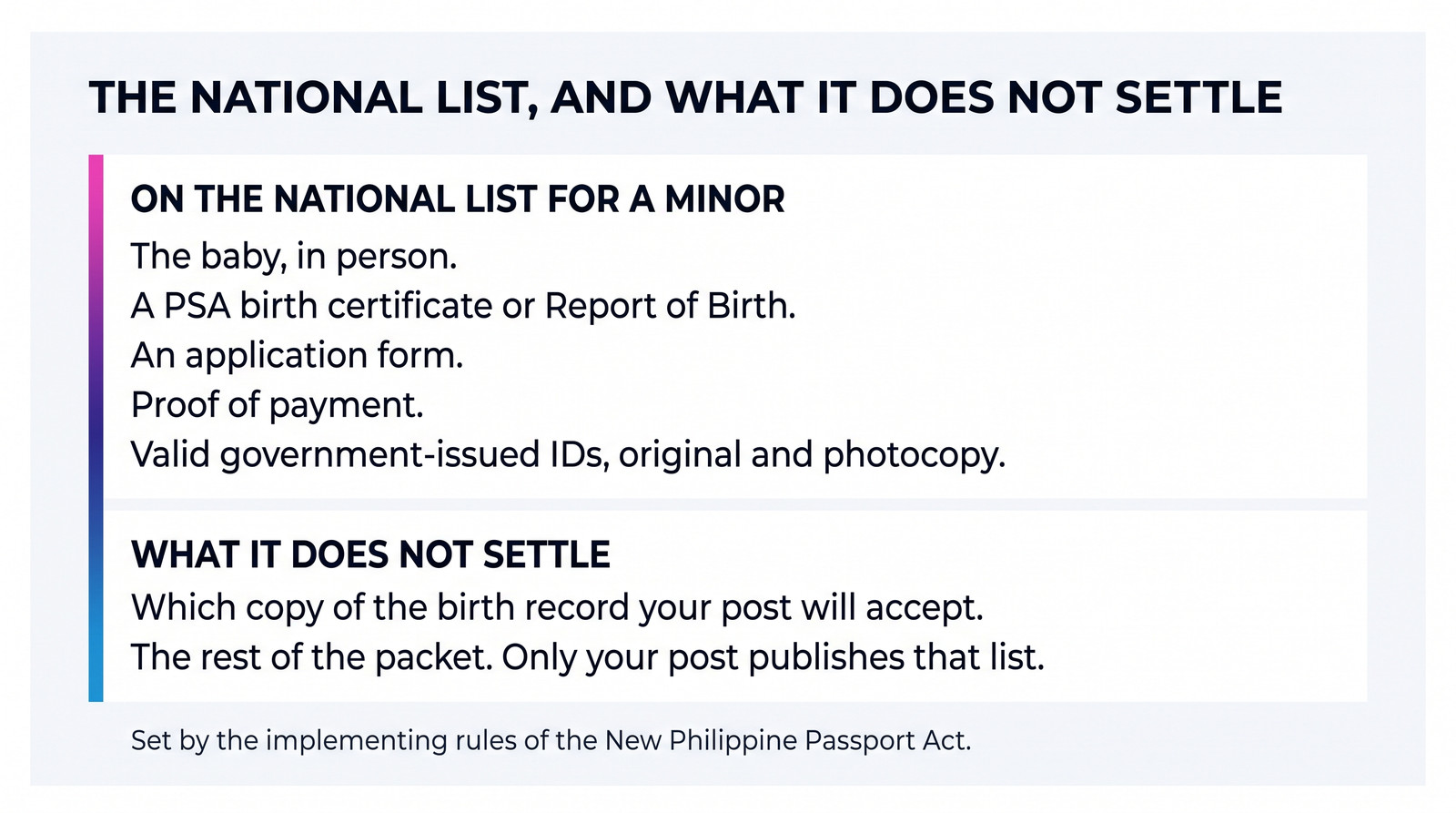
The national floor for a minor is short: a PSA birth certificate or Report of Birth, an application form, proof of payment, and valid government-issued IDs — original and photocopy.
Then the packet becomes your post's. The Philippine Embassy in Canberra wants a "self-addressed prepaid REGISTERED POST or PLATINUM EXPRESS POST return envelope" and a photocopy of a school ID "if available." Washington DC asks for a permanent resident card, visa, work permit or dual-citizenship certificate, the latest Philippine passport, and the data page of any foreign one. Melbourne wants the PSA birth certificate or the record "issued by the Philippine Consulate General in Melbourne." The post that serves you sets the packet, and its own requirements page is the only list that governs your morning.
Who Has to Be at the Counter
Your baby must appear in person at the Philippine Embassy or Consulate. The rules require the "personal appearance of the minor applicant for biometric and biographic data capturing," accompanied by either parent, a legal guardian or an authorized adult companion, and they define a minor as a person below eighteen, with no lower bound. A month-old baby goes to the appointment.
Where the civil registry record shows the parents as married, the parent whose name is on it appears, and the other is documented by a copy of their passport or competent proof of identity. Where the parent who attends is not Filipino, they present their own foreign passport and a copy of the Filipino parent's. Canberra adds a step: where the father brings the child, the original PSA marriage certificate comes too, with a photocopy.
Where the parents are not married, the rules are narrower. "Only the mother shall principally accompany the child and file the passport application," with her consent required where the child is below seven, and that displaced only where custody has moved to the father or a legal guardian "by a competent Philippine court." Custody and consent are legal questions this guide does not settle.
When the parent who should attend cannot, the document is a Special Power of Attorney executed by a parent or legal guardian, naming the companion. Authentication is the post's call, not the DFA's: Canberra requires the Special Power of Attorney "authenticated by the Philippine Embassy/Consulate if executed abroad," Melbourne wants it notarized, and Washington DC asks the mother for a notarized Special Power of Attorney and an Affidavit of Support and Consent. Canberra and Melbourne also list a DSWD travel clearance where the child is not travelling with a parent — a separate document, and not a national requirement.
This folder is not busywork. It is the opening entry in a record that will carry your child for twenty years: civil registry, passport, school enrolment, a job application, somebody's visa. The Filipino families who find that easy built it early, while nothing was urgent. The next stop for that record is the PSA documents you will need later.
The Fee, and How Long It Lasts
A passport issued to a minor is valid for five years, where an adult's runs ten — the rules' own validity table, with the DFA free to "limit the period of validity further." The adult version of the same morning is a passport renewal overseas.
On the fee there is no national figure: the rules say only that "reasonable fees shall be collected" and that any fee "shall not be increased more than once every three years." An ePassport costs AUD 108.00 at the Philippine Embassy in Canberra, on a schedule headed "As of 09 March 2016"; A$108.00 in Melbourne, cash and debit card only, and USD 60.00 in Washington DC, neither of which publishes a date against it. Read your own post's schedule on the day.
"What's the Fastest Way?" — the Honest Answer
No Philippine post we could read — Canberra, Melbourne and Washington DC — publishes a guaranteed turnaround for a baby's first passport, and the national rules publish none. Only Washington DC publishes an estimate at all — the document "will be mailed to you within six to eight weeks after your appointment," a period the same page also calls "processing and release." It is DC's own figure, not postage on top.
What a parent controls sits earlier. Canberra's online appointment terms say slots go "on a first come, first served basis," and that its passport appointment slots "are opened on a monthly basis." Report the birth promptly at the post that covers it, then book the passport appointment while that record still works there.
The Part Nobody Tells You at the Start
Canberra's online appointment terms say its slots "are not for sale and non-transferrable" — so anyone selling you one is selling what the embassy says cannot be sold. The same page warns that "making false statements in passport application form, furnishing falsified or forged documents in support thereof are punishable by law" — so refuse a stranger who offers to arrange a document.
Canberra states that the Philippine passport "is at all times the property of the Republic of the Philippines" and that "using the passport as collateral is against the law." The DFA's rules have an employer or recruitment agency demanding it as collateral reported to the Department of Migrant Workers. If an employer or an agency ever asks to hold it, the answer is no.
Before You Book: the Checklist for the Counter
Six things to have in hand:
- The birth reported at the post that covers it, its record still current
- Your post's own requirements page read on the day you book
- Both parents' passports or valid government-issued IDs, originals and photocopies
- A Special Power of Attorney or Affidavit of Support and Consent, if the adult at the counter is not the parent named
- The return envelope your post specifies, in the product it names
- The fee confirmed on your post's own schedule, in your post's currency
The Questions Filipinos Ask Us Most
Can a one-month-old baby get a Philippine passport? Yes. The Department of Foreign Affairs' rules set no minimum age and define a minor as a person below eighteen, and require personal appearance for data capturing, accompanied by a parent, a legal guardian or an authorized adult companion.
Do both parents have to come? No. The parent whose name is on the record appears; the other is documented by a copy of their ID. Where the parents are not married the rules put the mother first, unless a Philippine court has moved custody. Where neither can attend, a Special Power of Attorney names the companion.
What is the fastest way? No post we could verify guarantees a date. Washington DC publishes a six-to-eight-week processing-and-release estimate, as its own figure. What you control is earlier: report the birth promptly at the post that covers it, and apply while that record still works there.
Can I do this at a DFA consular office in the Philippines instead? The national rules list the DFA's consular offices in the Philippines and the consular sections of Philippine Foreign Service Posts, where Filipinos overseas apply. A Manila appointment is a different process, and the newborn shortcut written for "a minor applying in the Philippines" is not yours.
Sources
Minors, the one-year window, validity and fees — 2024 Implementing Rules of Republic Act No. 11983: https://elibrary.judiciary.gov.ph/thebookshelf/showdocs/2/99268
Minor new ePassport requirements — Philippine Embassy, Canberra: https://www.philembassy.org.au/consular/passport/minor-new
Appointment terms — Philippine Embassy, Canberra: https://www.philembassy.org.au/consular/passport
Report of Birth and jurisdiction — Philippine Embassy, Canberra: https://philembassy.org.au/consular/civil-registry/report-of-birth
Consular fees, as of 09 March 2016 — Philippine Embassy, Canberra: https://www.philembassy.org.au/consular/schedule-of-fees
Minor requirements and fee — Philippine Embassy, Washington DC: https://philippineembassy-dc.org/minor-passport/
Minor requirements and fee — Philippine Consulate General, Melbourne: https://melbournepcg.org/?page_id=4745
Citizenship from birth — 1987 Constitution, Article IV: https://www.lawphil.net/consti/cons1987.html