

The contract is signed, the flight is booked, and somebody says it — OFWs don't pay travel tax, right? — and nobody is quite sure.
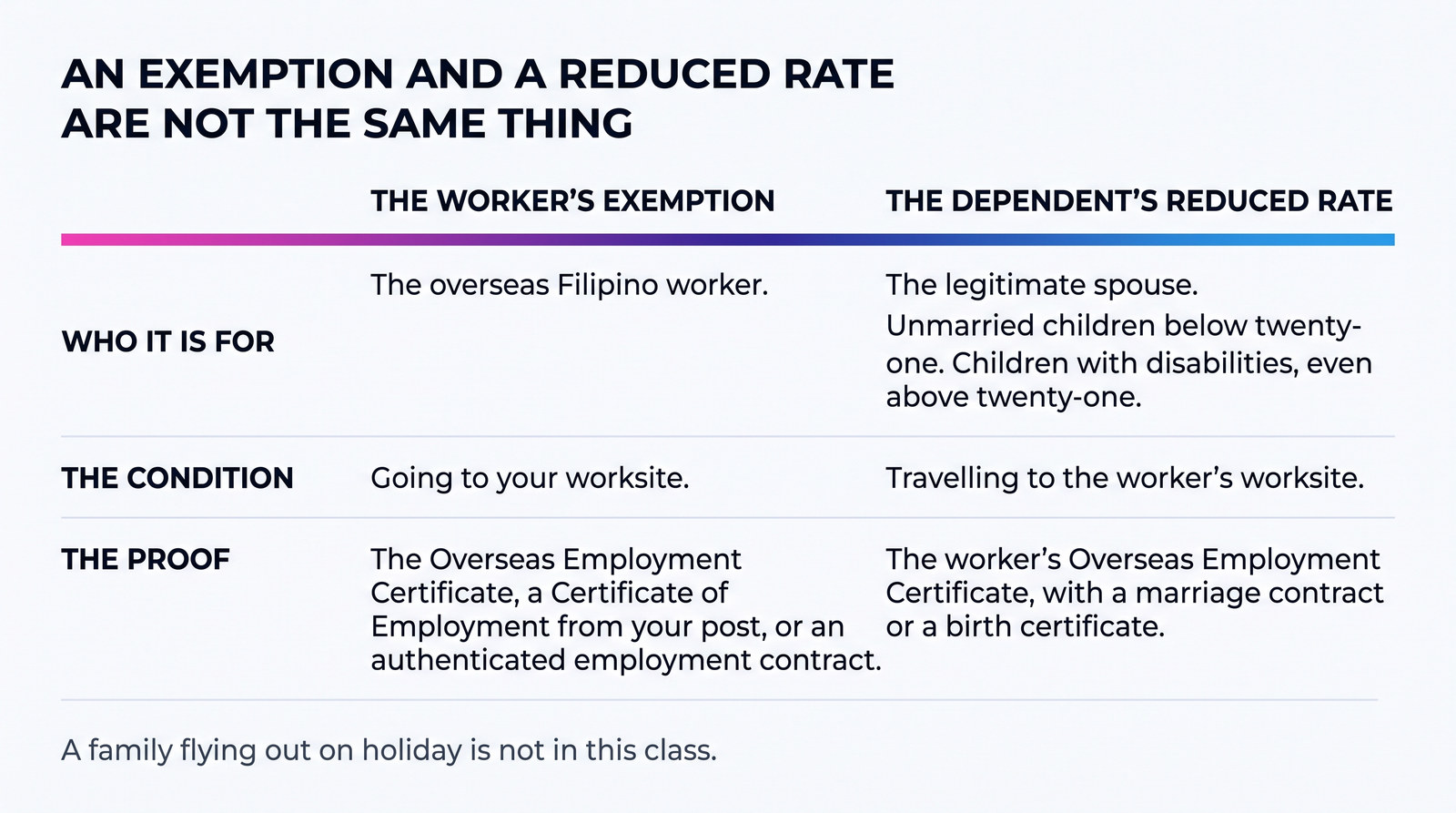
If you are an overseas Filipino worker going to your worksite, this is a tax you are exempt from, and the document that proves it is probably already in your contract folder. The money is in the detail: an exemption, a reduced rate and a refund are three different things, and your dependents sit under the second one, not the first. It belongs with the papers you gather before you leave.
What the Philippine Travel Tax Is, and Who Actually Pays It
The travel tax is a levy on people leaving the Philippines for a foreign destination. The Philippine Consulate General in New York publishes that it applies irrespective of the place where the air ticket is issued and the form or place of payment, under Presidential Decree 1183, as amended.
The body that collects it is the Tourism Infrastructure and Enterprise Zone Authority — TIEZA — a Government Owned and Controlled Corporation attached to the Department of Tourism, created by Republic Act No. 9593, otherwise known as the Tourism Act of 2009.
Who owes it, in TIEZA's own grouping: every Filipino citizen leaving the country, and foreign passport holders in its taxable classes.
The full rate is ₱2,700.00 for first class passage and ₱1,620.00 for economy. TIEZA shows no "as of" date beside them, so these are the rates on its page as we read it on 16 September 2026. Confirm the latest figures before you budget. The portal itself says to check first whether the travel tax is already inside your ticket.
Are OFWs Exempt from the Travel Tax? Yes — Going to Your Worksite
Yes. Overseas Filipino workers are exempt from the Philippine travel tax by law, and the limit comes from the source itself: the Philippine Consulate General in New York publishes that the OEC is valid as an exemption certificate if used in going to the OFW's worksite.
If you were hired through the government's overseas employment process, the post publishes that the Overseas Employment Certificate serves as the exemption certificate, so you may not need to apply for anything separate. The OEC has its own process; here, it is your proof.
If you were directly hired abroad, your proof is a Certificate of Employment issued by the Philippine Embassy or Consulate in the place of work, or an Employment Contract authenticated by that post. The exemption application reads the class broadly — "Overseas Filipino Worker Directly Hired Abroad going to their job site".
Whichever branch you are in, the proof is a document that already exists: the OEC in your folder, a Certificate of Employment from your post, or an authenticated contract in your employer's file.
How to Apply for a Travel Tax Exemption Certificate
If you need a certificate in your own name, go to TIEZA's online system and choose the travel tax service you need. The exemption route is its application form; in person it is a TIEZA Travel Tax Office or an airport counter.
The exempt list runs far beyond the OFW class, each with its own proof:
- an infant two years old and below, travelling no later than the second birthday — where the original passport cannot be presented, a birth certificate and a photocopy of the passport identification page;
- a Filipino permanent resident abroad whose stay in the Philippines is less than one year — the latest arrival stamp and proof of residence;
- a balikbayan under Republic Act 6768 — a Filipino citizen continuously out for at least one year whose stay is less than one year;
- an official or employee of the Philippine government travelling on official business, excluding Government Owned and Controlled Corporations;
- a crew member of airplanes plying international routes — a certification from the Civil Aeronautics Board that the crewmember is joining his aircraft;
- a person authorized by the President of the Republic of the Philippines for reasons of national interest — a written authorization from the Office of the President;
- a Philippine Sports Commission athlete, coach or official at an international competition;
- an exporter joining international trade fairs endorsed by the Export Development Council;
- personnel of a multinational company with regional headquarters in the Philippines, not engaged in business here — a certification from the Board of Investments.
In all cases the passenger presents the original passport.
The online application asks for your passport number, your ticket or booking reference, the flight details, and your exempt applicant type. It requires your passport identification page, and your consent for TIEZA to collect and process the personal data the form asks for, under Republic Act No. 10173, otherwise known as the Data Privacy Act of 2012. That personal data, TIEZA says, is used solely for that transaction.
TIEZA publishes that an online TEC application is processed within one (1) day of a complete submission, and that your flight must fall at least one day after you apply. No fee and no validity period for the certificate are published on any page we could read. Ask on the contact published on TIEZA's own travel tax service page. You complete this form yourself. Nobody has to be paid to file it.
What an OFW's Dependents Actually Pay
The discount for an OFW's dependents is a reduced rate, not an exemption. TIEZA states the condition itself: this privilege is granted if the dependent is traveling to the OFW's worksite. A family flying out on holiday is not in this class.
Three may avail of it: the legitimate spouse of an OFW; unmarried children, legitimate or illegitimate, below 21 years of age; and children of OFWs with disabilities even above 21.
The privileged reduced rate is ₱400.00 first class and ₱300.00 economy; the standard reduced rate runs at ₱1,350.00 and ₱810.00. Neither table carries an "as of" date; both are as we read them on 16 September 2026. Against a full economy rate of ₱1,620.00 that is far less — but it is still a payment.
What the dependent brings is mostly the worker's paperwork: the original passport, the OFW's Overseas Employment Certificate or a certified true copy of the Balik-Manggagawa Form, an original or authenticated marriage contract or birth certificate, and the airline ticket if already issued.
For a child, three steps: exempt outright to the second birthday, the standard reduced class from two years and one day to the 12th birthday on the date of travel, then the full rate. That is the general track — an OFW's own unmarried child under 21, travelling to the worksite, keeps the privileged rate above instead.
If You Already Paid: How to Claim It Back
Claims for refund must be made within two (2) years from the date of payment, TIEZA publishes, under its basic policies on regular refunds. The clock runs from the day you paid — not from your flight, and not from the day the ticket was issued.
Being exempt and charged anyway is one of the listed grounds, with an unused ticket and a double payment. That ground asks for the original passport, the supporting documents required under Presidential Decree No. 1183, as amended, the airline ticket showing the collection, and the original TIEZA official receipt if you settled with TIEZA directly.
An airline or its agent may grant a refund — but only if the tax has not been remitted to TIEZA, and only with a TIEZA-issued refund certificate. Tax settled directly at an airport counter can be claimed back within 24 hours, on the original passport, an accomplished SDR form and the original receipts. That route is for tax you settled at the counter, not for tax that came inside a ticket.
The money comes as a cheque for deposit to the payee's account, though it may be uncrossed on the request of a payee who is properly identified. In an announcement posted in June 2026, TIEZA says an approved refund can also be credited to an eligible passenger's GCash wallet. No page we could read says whether a claim can be filed from outside the Philippines. Use the channel published on TIEZA's own refund page and ask.
The Habit This One Teaches
You do not lose this money by failing a test. You lose it because nobody told you the document in your folder was doing the job — an OEC does more than one job, and used going to the worksite it is the proof of exemption.
The workers who never lose ₱1,620 are rarely better read on tax law. They are in the habit of knowing what each paper they hold does. It is the skill that carries a renewal, a licence, a step up. Opportunity abroad gets built, and part of what builds it is reading your own file.
Before Your Next Departure
- Check whether the travel tax is already inside your ticket.
- Hired through the government's overseas employment process? Carry the OEC — going to your worksite, it is your proof.
- Directly hired abroad? Ask your post about the Certificate of Employment before you book.
- Dependent flying to your worksite? Bring the marriage contract or birth certificate with the OEC — and expect a reduced rate, not zero.
- Already paid when exempt? Two years from the date of payment.
The Questions Filipinos Ask Us Most
Are OFWs exempted from paying travel tax?
Yes, going to the worksite: the Philippine Consulate General in New York publishes that the OEC is valid as an exemption certificate used going to the OFW's worksite. Directly hired, the proof comes from your post.
Is there a travel tax discount for OFW dependents?
A privileged reduced rate, not an exemption, and only travelling to the OFW's worksite: the legitimate spouse, unmarried children below 21, children with disabilities above 21. ₱400.00 first class, ₱300.00 economy, read 16 September 2026.
Who is eligible for tax exemption?
An overseas Filipino worker going to their job site, an infant two years old and below, a Filipino citizen permanently resident abroad, and more — each with its own proof, and the original passport in every case.
How to claim travel tax refund for OFW?
Within two (2) years from the date of payment, on the original passport, the documents required under Presidential Decree No. 1183 as amended, and the airline ticket showing the collection.
Sources
Full travel tax rates — Tourism Infrastructure and Enterprise Zone Authority (TIEZA): https://tieza.gov.ph/full-travel-tax/
Reduced travel tax — TIEZA: https://tieza.gov.ph/reduced-travel-tax/
Travel tax refunds — TIEZA: https://tieza.gov.ph/travel-tax-refund/
Travel Tax Exemption Certificate — TIEZA: https://onlinettax.tieza.gov.ph/tec
Travel tax exemption — TIEZA: https://tieza.gov.ph/travel-tax-exemption/
Online Travel Tax Services System — TIEZA: https://tieza.gov.ph/online-travel-tax-services-system/
Travel tax payment portal — TIEZA: https://onlinettax.tieza.gov.ph/
Travel tax exemption classes — Philippine Consulate General, New York: https://newyorkpcg.org/pcgny/other-services/travel-tax-exemption/
Refunds to GCash — TIEZA: https://tieza.gov.ph/tieza-and-gcash-partner-to-streamline-online-travel-tax-refunds-for-filipino-travelers/