You have sent out the resumes. You have refreshed the inbox more times than you want to admit. And around the third week of silence, at your desk in Quezon City, a quiet question starts: maybe this isn't for someone like me.
Here is what we see every week, and it is almost never your experience. Very often you are sending a Philippine-style resume — the bio-data document, photo and civil status and all — into a market that reads something different, and it is set aside before anyone reaches your work. That is a format problem, and it is fixable in an afternoon.
It is worth fixing properly, because this is not really paperwork. Opportunity abroad is built, not waited for, and the CV you create is the first proof that you are employable on someone else's terms — not just for one job, but as the first rung of a career you keep climbing.
Why Your Philippine Resume Quietly Gets Ignored Abroad

The resume most of us first write in the Philippines shares everything — a photo, date of birth, age, height, weight, religion, marital status — often across three or four pages, and abroad that works against you. Western employers and their hiring managers read for fit fast, and the hiring process steers around those personal details on a Philippine-style resume, because a photo, an age, or a marital status creates discrimination exposure for the company. The difference is rarely your experience; it is the shape of the resume it arrives on.
Resume vs. CV: What the Words Mean by Country
The same two words mean different things in different places. In the US and Canada a "resume" is the short job document you send for a role. In the UK, Ireland, Australia, New Zealand, and Europe, "CV" simply is that one-to-two-page job document. So the international CV format differs by country, and that difference decides whether you are read.
The International Resume Format, Section by Section
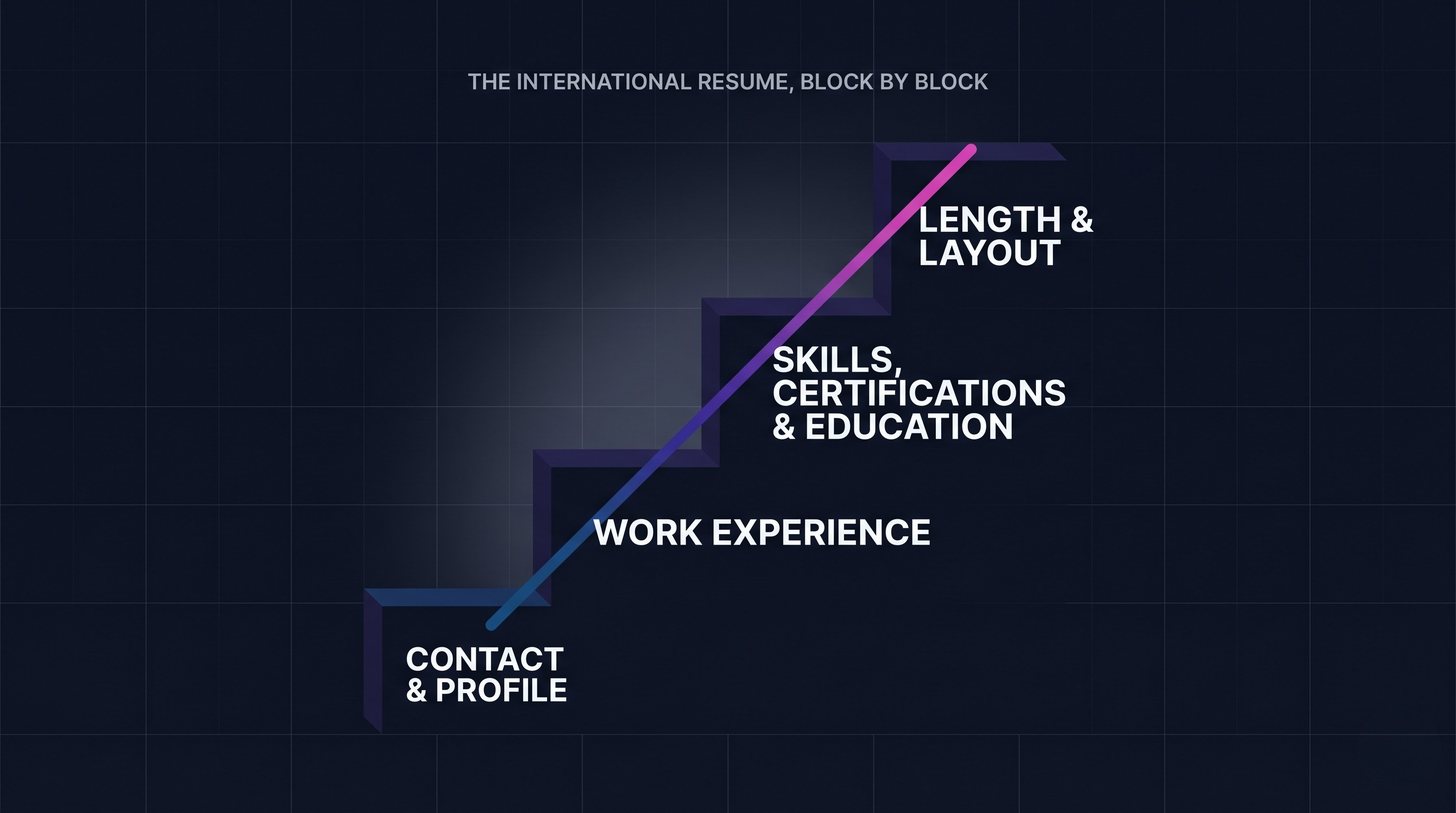
The structure is standard, and any job seeker can build it in an afternoon — reverse chronological order, newest first. This resume format is what employers abroad expect. Prepare these four blocks.
Contact details and your personal profile
Keep only what a recruiter needs to reach you: full name, professional email, phone with country code, city and country, and LinkedIn or portfolio links. Delete the rest — photo, date of birth, age, civil status, religion, height and weight. The UK's National Careers Service says a CV should not include your age, date of birth, whether you are married, or your nationality. Replace the tired "Career Objective" with a short personal profile — a two-or-three-line summary of your professional level and the career goals you are climbing toward. Add an interests line only if an interest is also a relevant skill.
Work experience and employment history
This is the heart of the resume. For each role in your employment history, lead with the company, title, location, and dates, then bullets that open with action verbs and real numbers — "increased sales by 18 percent" or "managed a team of nine" are the highlights a recruiter notices first. Name the projects that prove a skill, and keep the focus on results. Work done in the Philippines counts in full once a foreign reader can place the company and the result.
Skills, certifications, and education
Give the reader a clean skills section — technical skills and softer skills grouped to scan easily, language proficiency stated plainly ("English: fluent"), and the certifications and training that map to the role. List the relevant skills the posting asks for. This block rewards the person who keeps learning: a recent certification shows you invest in yourself, and that continuous learning is what carries a career upward once you are in. Qualifications from the Philippines belong here too — a PRC license, a board exam, the credential a nurse or a medicine graduate holds — each in one line a foreign reader can recognize. Education goes near the foot once you have real work experience.
Length, layout, and CV design that reads cleanly
This part of the resume format should run one to two pages long, with a simple layout and consistent formatting — one font, even spacing, plain headings. That clean formatting makes the strongest first impression. Favour plain CV design over heavy graphics: software often scans the text, and a busy, multi-column layout can scramble the formatting, so a strong candidate never reaches a human. A few quick tips: skip the tables, save as a PDF, and review for typos.
Tailoring Your CV to the Job Description
Stop sending one identical resume to every opening; tailor it. Read the job description, note the words the employer leans on, and mirror that language — the real, relevant keywords — in your summary, skills, and top bullet points for that specific role. The scanning software many recruiters use looks for the keywords from the job post, so the closer your job application sits to theirs, the likelier you clear that first pass ahead of generic applicants. The research also teaches you what the next level in your field demands.
How the CV Format Changes by Country

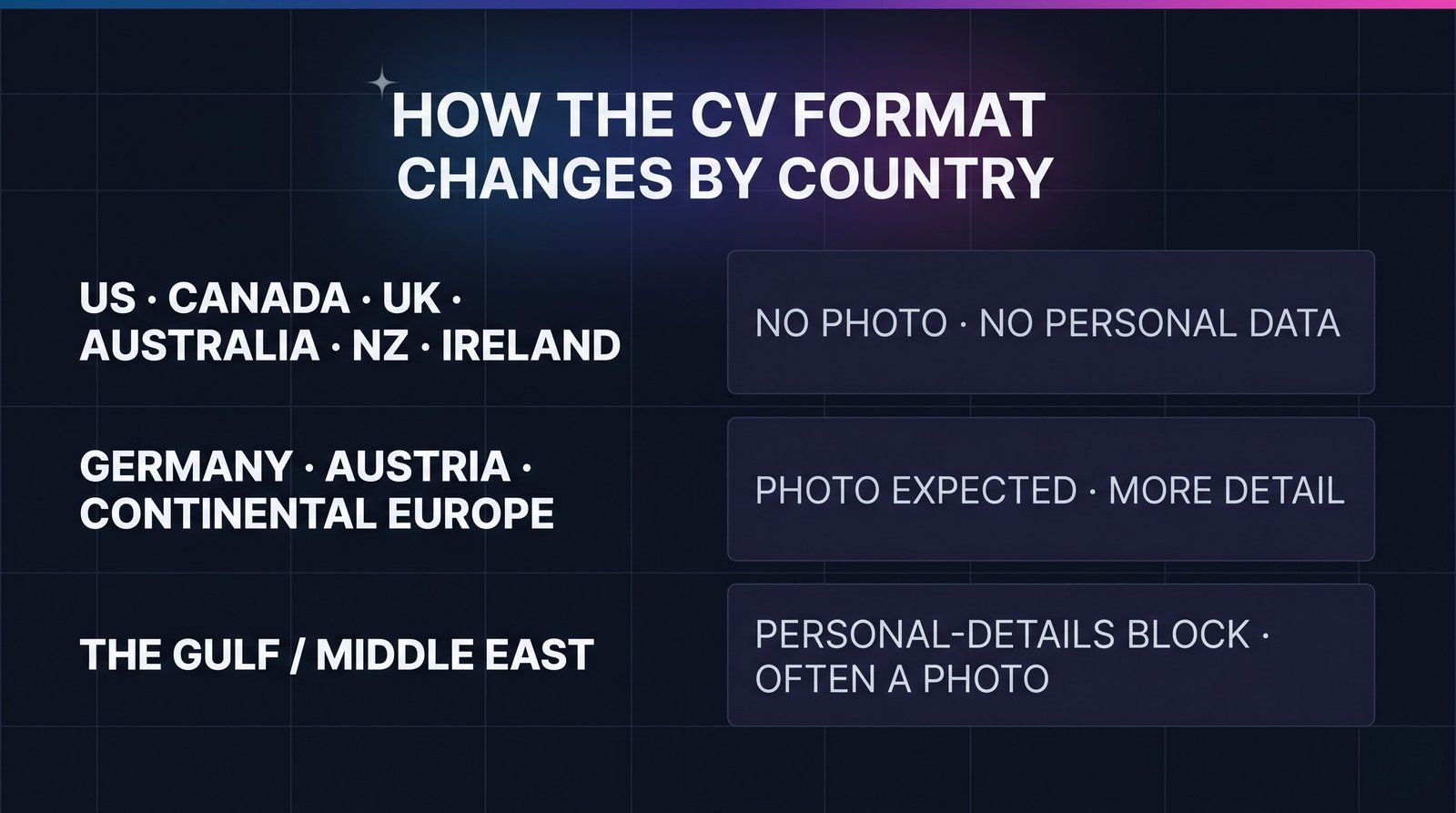
This is where applications quietly fail, because the right cv format changes by country — so do a little research before you send:
- US, Canada, UK, Australia, New Zealand, Ireland — leave the photo and personal data off. The US Equal Employment Opportunity Commission says employers should not ask for a photograph before hiring. Canada's federal Job Bank advises against a photo because "it is not the norm in Canada" and "can actually lower your chances," and caps a resume at two pages. Australia's norm rests on anti-discrimination law from the Australian Human Rights Commission, and the UK's National Careers Service guidance applies too.
- Germany, Austria, much of continental Europe — the older practices still hold. Many German and Austrian employers still look for a photo, date of birth, and nationality, and the CV runs more detailed. This is local practice, not law — though the EU's own Europass template marks those fields optional, so check first.
- The Gulf and the Middle East — expect a personal-details section. Across the UAE and the Gulf, employers commonly expect a "Personal Details" block with nationality and visa status, often a photo — convention, not law, but it matters for sponsorship.
Where to Get Free Templates and Inspiration (Safely)
You need not pay for a usable layout. The EU's official Europass builder is free to create a CV with, made by the European Union, in 31 languages, and one of the best-known CV formats in Europe — and every heading on it, including photo, date of birth, and nationality, is optional, so you switch off whatever your country does not want. For inspiration, study a helpful example or two, then write your own CV in your own words.
One honest warning. Watch for the "free CV maker" that builds your whole resume, then charges to download it once you are invested. No one can guarantee you a job for a fee to fix or submit your CV — that fee is the red flag. For no-placement-fee destinations the rule runs the other way: the Philippine POEA and DMW bar licensed agencies from charging placement or recruitment fees; the employer bears the cost — the US, Guam, and (as of 2024) Qatar among them. Check the agency against the DMW's list of licensed recruitment agencies first.
Fix Your CV Tonight: The Checklist
You can do all of this in one sitting, before you send a single thing tomorrow:
- Delete the personal data — photo, date of birth, age, civil status, religion, height and weight (keep full name, professional email, phone, city and country, LinkedIn).
- Cut to one or two pages — drop anything that does not earn its place for the role you want.
- Rewrite three bullets — each an action verb plus a real number, so your results read as the highlights.
- Swap the objective for a personal profile — two or three lines on who you are and where you are headed.
- Tailor to one posting — mirror the keywords and skills from the job description you send to next.
- Add one thing that shows you are still learning — a recent course or certification — because that habit keeps a career rising.
The Questions Filipinos Ask Us Most
Should I put a photo on my CV for jobs abroad? It depends on the country. Leave it off for the US, UK, Canada, Australia, and most English-speaking markets — the US EEOC tells employers not to request one before hiring. Germany, Austria, parts of Europe, and some Gulf employers still commonly expect one.
How long should my international CV be? One to two pages — Canada's Job Bank tells you to limit a resume to two pages.
What personal details should I remove from my Philippine CV? Photo, date of birth, age, marital status, religion, height and weight. The UK's National Careers Service says to leave off your age, date of birth, whether you are married, and your nationality; keep your full name, professional contact, city and country, and LinkedIn.
Do I need to pay for a CV template or builder? No — the EU's official Europass builder is free and made by the European Union. Be wary of any site that builds the whole resume then charges at download, and of anyone who "guarantees" a job for a fee.
How do I tailor my CV to a specific job? Read the job description, pull out the relevant keywords and skills the employer names, and mirror them in your summary, skills, and bullet points for that specific role.
So take one step tonight: delete the photo and personal data, cut your CV to length, and rewrite three bullet points each with a strong verb and a real number. You are not less qualified than the people already getting interviews — you simply needed the resume the other side can read, and that gives your experience a far better chance of being read. And this page is not a one-time ticket: it is the first version of a document you keep growing, because lasting success abroad comes from staying ready and never stopping the learning. Big dreams start with exactly that — one honest page that lets the world finally see what you can do.
Sources
UK CV sections (leave off age, date of birth, marital status, nationality) — UK National Careers Service: https://nationalcareers.service.gov.uk/careers-advice/cv-sections
Canadian resume rules (no photo, two pages, third person) — Government of Canada Job Bank: https://www.jobbank.gc.ca/findajob/resources/write-good-resume
No photo before hiring; protected categories — US Equal Employment Opportunity Commission: https://www.eeoc.gov/prohibited-employment-policiespractices
Australian anti-discrimination law in recruitment — Australian Human Rights Commission: https://humanrights.gov.au/our-work/employers/quick-guide-australian-discrimination-laws
Australian resume (jobseeker resource) — Workforce Australia: https://www.workforceaustralia.gov.au/individuals/coaching/job-applications/resumes
Europass CV is free, EU-made, 31 languages, fields optional — European Union: https://europass.europa.eu/en
Create your Europass CV — European Union: https://europass.europa.eu/en/create-europass-cv
No placement/recruitment fee; employer bears cost (US and Guam) — POEA Advisory No. 19, s. 2010 (Supreme Court E-Library): https://elibrary.judiciary.gov.ph/thebookshelf/showdocs/10/56908
No placement fee policy (Qatar, as of 2024) — DMW Advisory No. 24, 2024: https://dmw.gov.ph/archives/v1/resources/dsms/DMW/ISN-EXT/2024/DMW-ADVISORY-24-2024.pdf
Verify a recruitment agency's licence — Department of Migrant Workers: https://dmw.gov.ph/inquiry/licensed-recruitment-agencies