

It is late, the house is quiet, and you have searched how to move to Singapore for work one more time, from your desk in the Philippines. The results are a wall of Facebook "agencies" promising fast placement, and somewhere under all of it sits the real question: is this even for someone like me? We've watched many Filipinos make this exact move, and we'll walk you through the real pathway — the work pass that fits your skill, the jobs Singapore actually hires for, an honest salary picture, and how to spot the people who only want your money. Start with the one truth that protects you most: in Singapore you do not buy a visa. A Singapore company hires you first, then your employer applies for your pass and carries the cost — not you.
Can a Filipino Really Work in Singapore? The Honest Answer
Yes. Singapore hires foreign professionals and workers across nearly every field, and the Philippines is an approved source country for the Singapore Work Permit — part of why Singapore keeps hiring Filipinos, alongside workers from other approved source countries. Filipinos build careers across many countries, but few sit as close to home as Singapore: a short flight from Manila, about four hours, to one of the most connected cities in the world.
You won't arrive alone, either. A large Filipino community already lives there, as the Philippine Department of Foreign Affairs records in its distribution of Filipinos overseas. On weekends, Lucky Plaza fills with Filipino faces and the smell of Filipino food, and on a hard day a familiar dish among friends is its own kind of home. English is a working language across the city, so many Filipinos settle in fast. The route runs through Singapore's Ministry of Manpower — the government body locals simply call MOM — and it turns on two things: your skills, and the company that decides to hire you.
Your Work Pass Options: Employment Pass, S Pass, and Work Permit
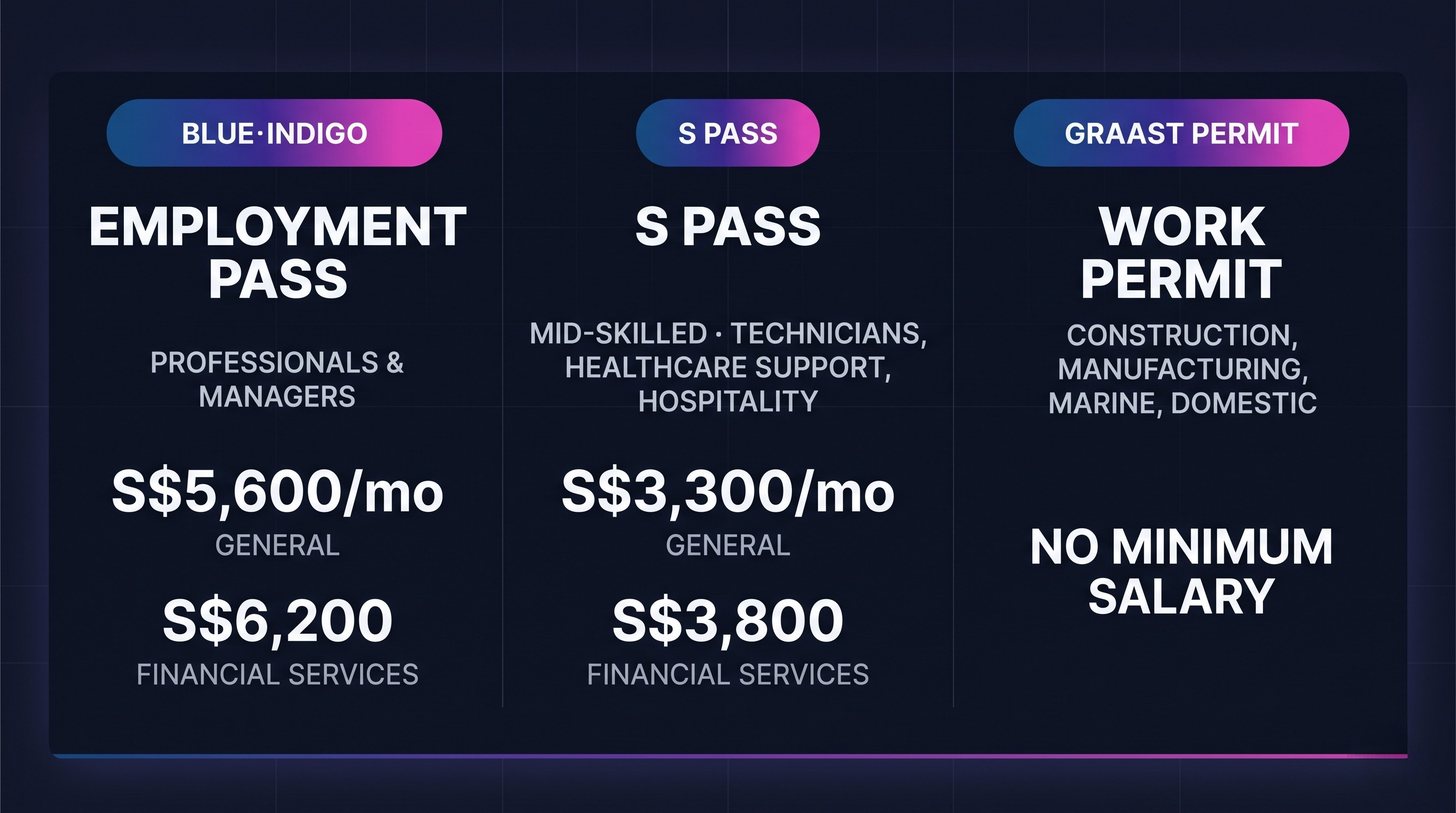
Singapore sorts its workforce by the role you do and the pay you earn, not from a menu you pick off. There are three Singapore work passes you'll hear named again and again, and which one fits depends on the job, your salary, and your qualifications.
The Employment Pass: for professionals and managers
The Employment Pass is the route for professionals, managers, and executives — degree-level, full time roles in corporate and managerial work. Singapore sets a fixed monthly salary floor for each pass, and for the Employment Pass that floor is the highest of the three. According to MOM, the minimum qualifying salary currently starts at S$5,600 a month in general sectors and S$6,200 in financial services, rising with age. MOM has also announced higher floors from 1 January 2027, so always confirm the current figure on mom.gov.sg before you count on a number.
Salary alone is not enough. An Employment Pass candidate must also clear a points test called COMPASS, which MOM scores against a 40-point pass mark. It weighs your salary, your education and qualifications, and how well the hiring firm supports local employment — so your education genuinely counts, especially in finance roles that sit in the higher financial-services band. Treat the pass as the entry rung of a ladder, not the summit: executive into manager, manager into senior leadership. Because COMPASS rewards qualifications and pay, the person who keeps learning and earns more responsibility renews from a stronger position each time. At first issue the Employment Pass runs up to two years, with renewals able to run longer — read that longer renewal as a milestone in a career, not paperwork. The duration is set by MOM, and the employer lodges the application, not you.
The S Pass: for mid-skilled roles
The S Pass is built for mid-skilled staff in full time roles — technicians, associate professionals, and some healthcare-support and hospitality positions across most industries. Its salary floor sits lower than the Employment Pass: MOM lists the minimum qualifying salary starting at S$3,300 a month in general sectors and S$3,800 in financial services, also rising with age, with a further increase announced for 1 January 2027 — so check the live figure on mom.gov.sg. Treat it as a real foothold, not a ceiling: technicians and associate professionals who build certifications and experience can grow into higher-skilled roles over time.
Two more things shape an S Pass. It is quota-controlled, meaning a company can hold only so many S Pass workers as a share of its total headcount, so even a full time position depends on the employer having room. And for each S Pass holder, the Singapore employer pays a monthly levy to the government — a cost that belongs to the company, not to the team leads and managers it brings into Singapore.
The Work Permit: for construction, manufacturing, and marine roles
The Work Permit covers migrant workers in construction, manufacturing, marine shipyard, process, and services roles, per MOM's key facts. Singapore's work-permit system also covers domestic work, but through a separate permit — the domestic-helper route runs through a licensed recruitment agency, not the general permit above. It is worth being precise about that distinction before you sign anything.
This work earns full respect. For many Filipinos it is exactly how they put children through school and care for parents back home — never "cheap labour," but a person carrying a family on a steady contract in Singapore. And the throughline holds even here: skills compound, and the worker who builds a trade, a record, and a reputation is building a career, not just completing a contract. The spine truth holds too: for the Work Permit, the Singapore employer or appointed agent applies, and that employer bears the levy, the medical insurance, and the security bond. The cost of bringing you over is the company's to carry.
In-Demand Jobs in Singapore for Filipinos

Singapore does not publish an official list of "jobs Filipinos do," so treat what follows as honest examples of the fields that hire — not a ranking, and not a guarantee that any one role is open today. Each one is also the first rung of a long profession, not a single job, so we'll name the road past the door as well as the door.
Healthcare is a long-standing shortage area: nurses, caregivers, and clinical-support staff, where demand has held for years — and a nurse who keeps building can grow toward specialist and senior clinical roles. Engineering and tech is another deep one — software, engineering, and IT roles, with major firms running their regional hubs from the city. Google and other large technology companies operate in Singapore as their Asia base, which tells you how much of this industry treats the city as a hiring centre, even though no firm publishes who it sponsors. Finance, accounting, and sales make up a wide band of corporate roles across the financial-services industry: a sales hire who delivers can grow into account management and, in time, the business-development leadership that opens new markets. Hospitality and tourism run from the budget hotels near Bencoolen Street to the resorts on Sentosa, and the kitchen roles underneath matter just as much — a line cook climbs toward sous chef, and banquet crews and restaurant teams staff the floors the tourism trade runs on. Domestic work, as above, comes through a licensed agency.
A fair question is how this compares to home. Against many Philippines jobs in the same field, these Singapore roles often pay more — though the cost of living is higher too, which is the next thing to be honest about. The point is simpler than any list: the Singapore job market hires across many industries, and the candidates who get the offer are the ones who apply well to real companies and keep growing once they are in — not the ones who chase a "most in-demand" myth.
Salary Expectations: What These Jobs Realistically Pay
Here is the kind hard-truth: MOM's published floors are a minimum, not a typical wage. Your real salary tracks your role, your industry, your experience, and the Singapore labour market — what the market rate is for someone like you, not what the floor allows. A strong candidate in a shortage field can sit well above the minimum; the floor only tells you where the door is. Read it for what it is: where you start, not where you stay. The climb above it is yours to earn — pay rises with experience, skill, and the value you bring — so the smartest move is not chasing the highest starting figure but entering a field where you can keep growing and investing in the skills that compound. The question worth asking of any role is less "what does it pay?" and more "what can it become?"
A Singapore salary can be life-changing next to what the same work pays in the Philippines. But the cost of living in Singapore is high, and that matters more than the headline number. Rent alone eats into a fixed monthly salary before you remit a single peso home, so the figure to aim for is one that comfortably covers Singapore first — housing, transport, food — and still leaves something to send back. And because the published floors are minimums that MOM raises over time, treat any salary you read, here or anywhere, as a starting point to confirm on mom.gov.sg.
The Step-by-Step Application Pathway
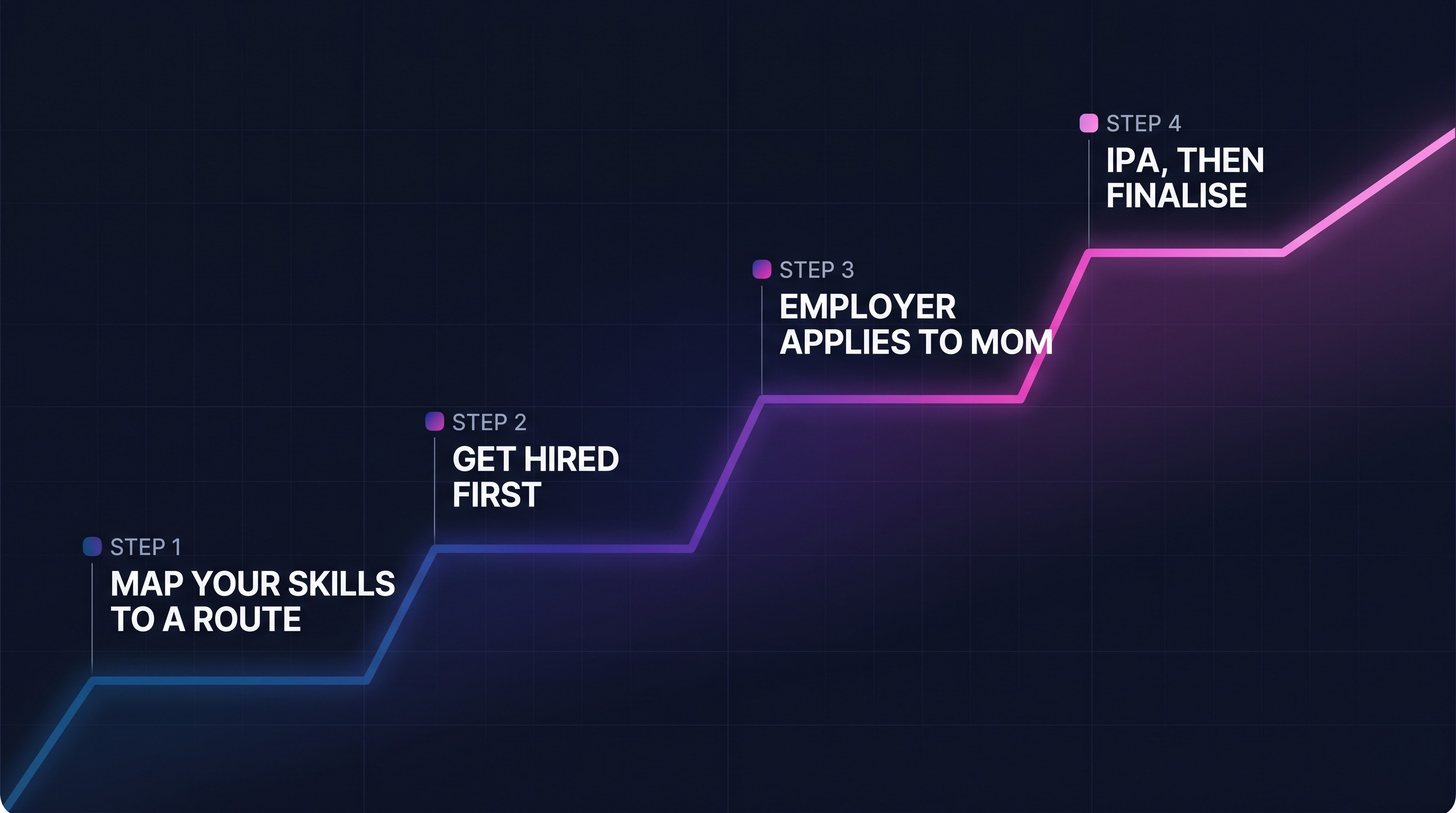
In Singapore the application process is employer-led, and the job genuinely comes first. Here is the order it happens in.
Step 1 — Map your skill to a route. Work out which pass fits you — Employment Pass, S Pass, or Work Permit — so you know where you stand before you spend a month planning applications. This one decision shapes everything after it.
Step 2 — Get hired first, before any approval exists. This is the real work: your job search. Create an account on the main job portals, search company careers pages and job postings filtered to location Singapore, and tailor every application to the role. The early applicant who tailors a real CV beats the one who blasts the same file to a hundred listings. So run a focused search, apply through legitimate channels only, and never pay anyone at this stage. A patient Singapore job search beats a frantic one every time.
Step 3 — Your employer applies for your work pass, not you. Once a Singapore company decides to hire you, that company lodges the Employment Pass, S Pass, or Work Permit application with MOM; you simply provide your documents. The employer is responsible for the filing and bears the cost. If anyone tells you to apply for your own work visa, something is wrong.
Step 4 — Approval, then finalising in Singapore. When MOM approves, it issues an In-Principle Approval, or IPA. For the Employment Pass this IPA is a pre-approved single-entry visa that gives you 6 months to enter Singapore and get the pass issued; you finalise everything once you are on the ground. MOM processes the application on its own timeline, so be patient and let the steps run in order.
Protect Yourself: The Scam Tells Every Filipino Should Know

This is the part no recruiter with an agenda will ever tell you, so we will.
The fee red flag. The Singapore company pays the work-pass costs, and MOM explicitly forbids charging those costs back to the worker, directly or indirectly — doing so is an offence. So if a "recruiter" or agency asks you for a fee to secure a job or a pass, that is your signal to walk away. No legitimate hire starts with you wiring money to a stranger.
Sit with what that rule is really telling you, because it is bigger than a scam shield. The thing of worth here is not a visa someone can sell you — it is a candidate a real company will sponsor and carry the cost for. You cannot buy your way in; you become worth hiring, and the pass follows the person. The candidates we watch get hired are the ones who stopped looking for a shortcut and started becoming worth sponsoring. The opportunity is not purchased — it is built into you, and that part is entirely in your hands.
The "visa with no employer" lie. Nobody can hire you into a Singapore visa that has no job behind it. A "guaranteed" pass with no named employer attached is not an opportunity; it is a script, and the next line is always a payment.
Verify the company and the recruiter. In the Philippines, the Department of Migrant Workers licenses and regulates recruitment agencies and publishes the official list of licensed agencies — use that list, and only that list. (The DMW absorbed the old POEA under Republic Act 11641; it exists to support and protect you.) In Singapore, employment agencies must be licensed by MOM, and you can check any agency yourself in MOM's public EA Directory before you trust it with a single document.
The "pay to skip the queue" lie. No one can sell you faster MOM approval, and no fee buys you a place at the front of Singapore's line. Honest hiring managers hire on merit and let the government do its part; anyone promising to jump the queue for a payment is selling something that does not exist.
Before You Apply: Your Singapore Readiness Checklist
Every item here is something you can do tonight, and every one is in your control — no waiting, no luck required.
- Match your skill to the right pass — Employment Pass, S Pass, or Work Permit — so you know exactly where you stand before you apply.
- Sharpen your CV for one real role at a time, not a hundred — a strong, tailored application beats a mass blast.
- Apply only through legitimate channels — company career pages and recognised job postings, never through a stranger asking for a fee.
- Verify every agency on the official list — the DMW list in the Philippines and MOM's EA Directory in Singapore — before you hand over a single document.
- Keep your money in your pocket — the employer pays for the pass; anyone charging you to "secure" a job or pass is a red flag.
- Confirm the live salary floor on mom.gov.sg — the figures rise, and a change is already announced for 1 January 2027.
- Invest in the skill that climbs — the certification, course, or experience that moves you up, because the floor is only where you start.
- Plan to keep learning after you land — treat the first job as the first rung, not the finish line.
The Questions Filipinos Ask Us Most
Do I need a job offer before I can get a work pass in Singapore?
Yes. The Employment Pass, S Pass, and Work Permit are all employer-sponsored: a Singapore company must hire you first, and then your employer applies to MOM on your behalf. There is no general Singapore work visa you can buy on your own from the Philippines, which is exactly why any offer to "sell" you one is a scam.
What is the difference between the Employment Pass and the S Pass?
The Employment Pass is for professionals and managers, on a higher minimum qualifying salary plus the COMPASS points test; the S Pass is for mid-skilled roles, on a lower floor, and it is quota- and levy-controlled. Both are full-time employment with a real employer, not gig or freelance work — and both are a starting rung, the EP opening onto management and the S Pass onto higher-skilled roles for those who keep building skill. Because MOM updates both floors, verify the current figures on mom.gov.sg.
How much do these jobs pay?
Pay varies by role, industry, and experience, so anchor on MOM's published minimum qualifying salaries rather than any number a recruiter quotes. As of now those floors are the Employment Pass from S$5,600 (general) or S$6,200 (financial services), and the S Pass from S$3,300 or S$3,800, all rising with age — with higher floors announced for 1 January 2027, so confirm the live figure on mom.gov.sg. Remember the floor is a minimum, not a typical wage, and it is where you start, not where you stay; pay climbs with experience and skill, and Singapore's cost of living is high.
Do I have to pay an agency to get a job or a pass in Singapore?
No. In Singapore the employer bears the cost of the work pass, and MOM forbids charging it back to you. If anyone asks you for a fee to "secure" a Singapore pass or a job, walk away. Use only licensed agencies to begin with — the DMW in the Philippines and the MOM register in Singapore both let you check that an agency is real before you deal with it.
How do I find a legitimate job in Singapore from the Philippines?
Start your search on real companies' career pages and recognised job postings, tailor each application to the role, and verify the employer actually exists before you hand over anything. Being a strong early applicant to one genuine Singapore job will take you further than a wide search no honest company will ever hire from.
Singapore is closer than it felt a few minutes ago. The route is real, the employer carries the cost, and your first job is to become the candidate worth hiring — you don't buy the opportunity, you become it. But getting hired is only the first rung. The people who build a real future abroad are the ones who keep learning after they land, because lasting success comes through readiness, continuous learning, and personal development — never a shortcut. Big dreams don't start with a plane ticket; they start with knowing the real path. Now you do, so start your search the right way — you are more ready than you think.
Sources
- EP & S Pass eligibility / minimum qualifying salary / COMPASS 40-point pass / 1-Jan-2027 changes — Singapore Ministry of Manpower: https://www.mom.gov.sg/passes-and-permits/employment-pass/eligibility
- S Pass minimum qualifying salary (current + 1-Jan-2027) — Singapore Ministry of Manpower: https://www.mom.gov.sg/passes-and-permits/s-pass/eligibility
- EP duration (up to 2 years first issue) & who applies — Singapore Ministry of Manpower: https://www.mom.gov.sg/passes-and-permits/employment-pass/key-facts
- EP application — employer/agent applies, IPA letter, fees — Singapore Ministry of Manpower: https://www.mom.gov.sg/passes-and-permits/employment-pass/apply-for-a-pass
- Employers pay work-pass costs; EAs may not recover fees from workers — Singapore Ministry of Manpower: https://www.mom.gov.sg/faq/employment-agencies/are-eas-allowed-to-charge-foreign-workers-fees-for-work-pass-renewals
- Work only with licensed employment agencies; how to verify — Singapore Ministry of Manpower: https://www.mom.gov.sg/faq/employment-agencies/why-should-i-work-with-a-licensed-ea-and-how-can-i-check-if-they-are-licensed
- S Pass quota (10%/15%) and levy (S$650 from 1 Sep 2025) — Singapore Ministry of Manpower: https://www.mom.gov.sg/passes-and-permits/s-pass/quota-and-levy/levy-and-quota-requirements
- Work Permit sectors & employer obligations — Singapore Ministry of Manpower: https://www.mom.gov.sg/passes-and-permits/work-permit-for-foreign-worker/key-facts
- DMW licenses/regulates Philippine recruitment agencies (RA 11641) — Department of Migrant Workers: https://dmw.gov.ph/licensed-recruitment-agencies
- Migrant Workers Act protections (RA 10022) — Official Gazette of the Philippines: https://www.officialgazette.gov.ph/2010/03/10/republic-act-no-10022-s-2010/
- Filipino community abroad (distribution of Filipinos overseas) — Philippine Department of Foreign Affairs: https://dfa.gov.ph/distribution-of-filipinos-overseas